

- BGG-Rang
- BGG #5.035
- BGG-Bewertung
- 6,2
504
- 2–4 Spieler
- 30–120 Min.
- Komplexität 3,5/5
- 2015
2020
Regelhilfe für 18DO: Dortmund
Verständliche Erklärungen zu Spielzügen, Karteneffekten und strittigen Situationen mit Verweisen auf offizielle Quellen und gespeichertem Fragenverlauf.
Für 2 Personen
Was möchtest du wissen?
Antworten stammen aus dem offiziellen Regelheft, mit Seitenangabe zum Nachprüfen.
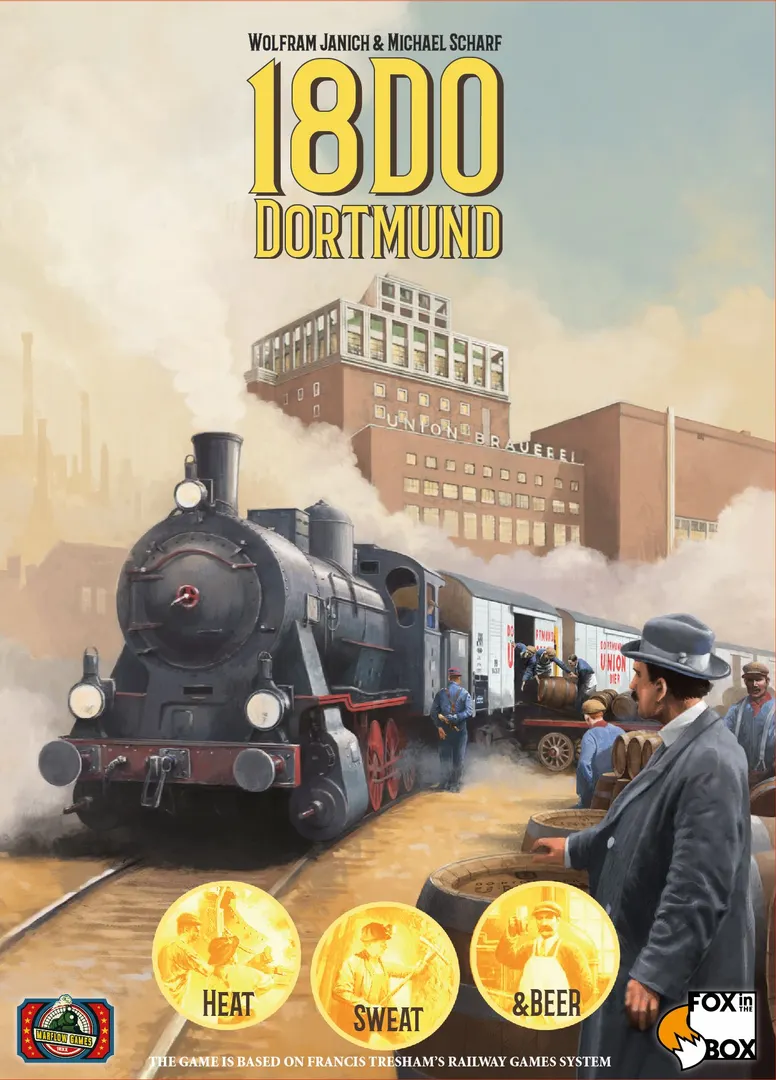
18DO: Dortmund ist ein Brettspiel aus dem Jahr 2020 für 2–5 Personen, mit 180–360 Minuten pro Partie und ab 12 Jahren. Entwickelt wurde es von Wolfram Janich und Michael Scharf; die wichtigsten Mechaniken sind Auction / Bidding, Tile Placement und Commodity Speculation.
Auf Englisch
18DO-Dortmund is a strategic economy game, which reflects the development of the most important industries in Dortmund during the 19th century. Dortmund has been a town of beer brewers since the medieval age. About 1840 the first underground mining started and the first steel mill has been built. The connection with the German railway net pushed the industrial development of Dortmund furthermore. The expansion of coal mines and steel mills led to a population increase. From the latter the Dortmund breweries benefited as the demand for beer boosted. At the end of the 19th century the Dortmund breweries used conditioned cars to transport the Dortmund Export beer by railway to distant regions. In 18DO-Dortmund the players are investors who invest in both, breweries and railway corporations. Each player starts with a private brewery. In addition every player may found a railway corporation. Coal mines and steel mills have a passive role only, but their locations have an impact on the game’s development. All breweries are located in the hex “Dortmund City”. They produce and supply beer and during the course of the game they improve their brewery equipment in order to scope with the increasing requirements of the beer market which a separate element of the game. The railway corporations are more dynamic. From their starting field at the border of the map they lay tracks to the coal mines and steel mills. On this tracks they run their trains virtually and achieve income according to the value of the hexes which are part of their trains’ routes. When connecting the locations of coal mines and steel mills with the railway network the demand for beer will be increased. This reflects that the coal mines/steels mills with a railway link are able to increase their capacities and the consequently needed higher workforce will trigger an increase of beer consumption. Later in the game the breweries start shipping beer by using the transport capacity of the railway corporations. In order to do so the train of a railway corporation must run a route that leads from the “Dortmund City” hex to one of the red off-board destination hexes. While the railway companies start the game as corporations the brewery corporations will be founded later during the game. For this purpose private breweries may be converted into brewery corporations. In order to give an owner/director of a brewery more room for decisions there are special function tokens which will give each brewery specific advantages. When a corporation pays dividends the owner of its shares receive the due payment by the bank. In addition the stock value of these shares will be increased. At the end of games all players accumulated their possessions’ which consists of their private cash plus the value of their share portfolio. This richest player will win! Description by the author
Laut Katalog unterstützt 18DO: Dortmund 2–5 Personen. Diese Spanne entspricht der vom Verlag angegebenen Spielerzahl, das Spiel lässt sich also für jede Gruppengröße innerhalb dieser Spanne aufbauen. Aufbau, einzelne Regeln und Wertungsdetails können je nach Personenzahl trotzdem abweichen; prüfe daher die genaue Konfiguration in der Anleitung deiner Ausgabe.
Die angegebene Spieldauer für 18DO: Dortmund beträgt 180–360 Minuten. Das ist die Schätzung des Verlags für eine vollständige Partie. Die tatsächliche Dauer hängt von der Gruppe, der Personenzahl und der Regelkenntnis ab: Erste Partien dauern meist länger, erfahrene Gruppen sind oft schneller fertig. Aufbau und Regelerklärung sind in dieser Schätzung nicht enthalten.
Im Katalog wird 18DO: Dortmund ab 12 Jahren empfohlen. Das ist die Empfehlung des Verlags und berücksichtigt Leseanforderungen, Regelkomplexität und Kleinteile, nicht nur das Thema. Jüngere Kinder können oft mit Hilfe eines Erwachsenen mitspielen; beachte die Altersangabe deiner Ausgabe und die Brettspielerfahrung deiner Gruppe.
18DO: Dortmund hat bei BoardGameGeek eine Komplexitätswertung von 4,0 von 5 und gilt damit als schweres Spiel. Die Wertung zeigt, wie viel Regelwissen, Planung und Entscheidungen eine typische Partie verlangt. Schwerere Spiele brauchen bei der ersten Erklärung mehr Zeit, daher hilft vor dem Spieleabend eine Vorbereitungsanleitung.
18DO: Dortmund gehört zu diesen Kategorien: Economic und Trains. Die wichtigsten Mechaniken sind Auction / Bidding, Tile Placement und Commodity Speculation. Kategorien beschreiben Thema und Setting eines Spiels, Mechaniken dagegen, was die Spielenden in ihrem Zug tatsächlich tun. Jede Mechanik führt zu einer Katalogseite mit ähnlichen Spielen, falls du etwas Vergleichbares suchst.
Als Autoren von 18DO: Dortmund sind angegeben: Wolfram Janich und Michael Scharf. Diese Angaben stammen aus den veröffentlichten Spieldaten und nennen die für das Spieldesign verantwortlichen Personen, nicht die Illustratoren oder Verlage. Die Autorenseiten auf MeepleRules sammeln weitere Titel derselben Autoren – praktisch, wenn dir ein Spiel gefällt und du ähnliche Spiele suchst.
Im Katalog ist 18DO: Dortmund als Grundspiel aufgeführt. Es lässt sich eigenständig mit dem Material aus der Schachtel spielen und benötigt keinen weiteren Titel. Erweiterungen, sofern es welche gibt, ergänzen neues Material oder neue Regeln und sind im Katalog separat mit einem Verweis auf dieses Grundspiel aufgeführt.