

- BGG-Rang
- BGG #572
- BGG-Bewertung
- 8,1
Fire in the Lake
- 1–4 Spieler
- 180 Min.
- Komplexität 4,2/5
- 2014
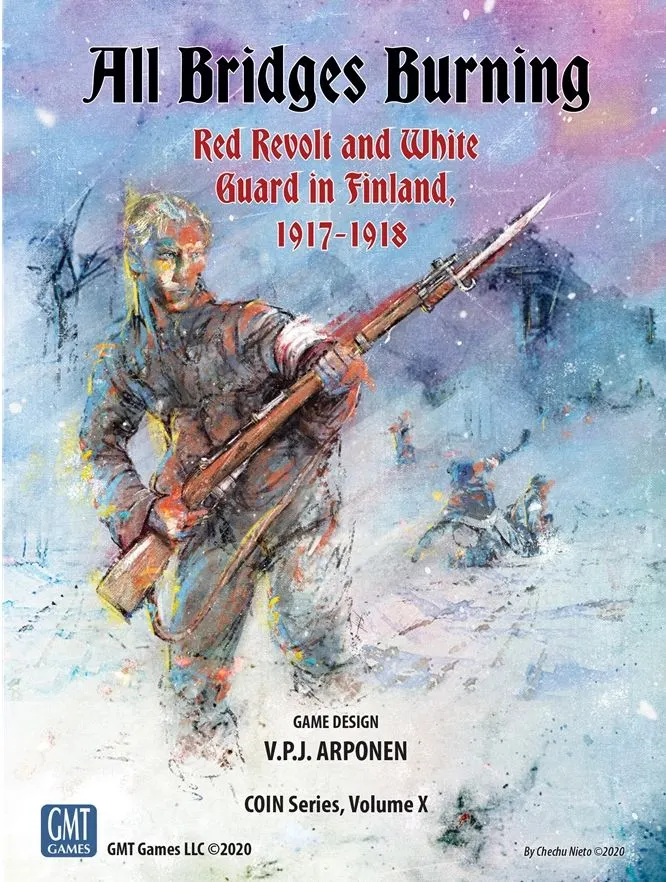
2020
Regelhilfe für All Bridges Burning: Red Revolt and White Guard in Finland, 1917-1918
Verständliche Erklärungen zu Spielzügen, Karteneffekten und strittigen Situationen mit Verweisen auf offizielle Quellen und gespeichertem Fragenverlauf.
Für 1 Person
Was möchtest du wissen?
Antworten stammen aus dem offiziellen Regelheft, mit Seitenangabe zum Nachprüfen.
All Bridges Burning: Red Revolt and White Guard in Finland, 1917-1918 ist ein Brettspiel aus dem Jahr 2020 für 1–3 Personen, mit 180–360 Minuten pro Partie und ab 14 Jahren. Entwickelt wurde es von VPJ Arponen; die wichtigsten Mechaniken sind Variable Player Powers, Area Movement und Dice Rolling.





Auf Englisch
The year is 1917. Russia’s Tsar Nicholas II has abdicated and Russia slides toward an ever deepening internal crisis. On the western edge of the vast Russian Empire, the uncertainty in Russia is giving rise to a power vacuum in the semi-autonomous Grand Duchy of Finland. For many across the Finnish political spectrum, the turmoil in Russia looks like an opportunity to fulfill the dream of Finnish national independence. Yet the competing factions are unable to agree on a common political vision for the country. By January 1918, a bloody civil war will have broken out in Finland. All Bridges Burning recreates the political and military affairs of the Finnish civil war in a new COIN System volume for three players. The Reds seek to stage a working class revolt and then hold onto their gains, while the White Senate forces seek to reassert control. A third, non-violent Social Democratic faction fights for the survival of moderate leftism and political reform. All three factions must keep the national sentiment conciliatory enough for a post-conflict settlement and national independence. In addition, the non-player powers of Germany and Russia offer military assistance to the Senate and the Reds, respectively. Excessive foreign involvement, however, could quash the dream of Finnish independence and prompt a collective loss of all three player factions. Historical events, asymmetrical action menus, as well as extensive historical design notes familiarize the players with the historical period. A unique sequence of play for three factions poses players –whether veteran or new to the COIN Series– fresh challenges in selecting from the asymmetric commands and special activities. The Reds will find themselves needing to split time and resources between competing tasks of solidifying the Red revolt by creating working organs of civilian administration on the one hand, and fighting an increasingly desperate war against a far more powerful enemy on the other. The White Senate faction, in contrast, has a more traditional war to fight. The Senate will want to enhance their military performance by capabilities such as armored trains, cannons, as well as the Finnish, German-trained 27th Jaeger Battalion. Meanwhile the Social Democrats will be focused on building and maintaining underground networks of information, distributing news across the fronts, and advancing a stagnating political process while fending off retributions from the two warring factions. A simple but effective card-driven non-player system enables the game to be played solitaire as well as in a two-player mode. The structure of the sequence of play, the character of the commands and special activities in the game, the smaller number of players, and compact size combine to enable All Bridges Burning to play fast. The solitaire system has been designed to preserve that speed and fluidity of play. —description from the publisher
Laut Katalog unterstützt All Bridges Burning: Red Revolt and White Guard in Finland, 1917-1918 1–3 Personen. Diese Spanne entspricht der vom Verlag angegebenen Spielerzahl, das Spiel lässt sich also für jede Gruppengröße innerhalb dieser Spanne aufbauen. Aufbau, einzelne Regeln und Wertungsdetails können je nach Personenzahl trotzdem abweichen; prüfe daher die genaue Konfiguration in der Anleitung deiner Ausgabe.
Die angegebene Spieldauer für All Bridges Burning: Red Revolt and White Guard in Finland, 1917-1918 beträgt 180–360 Minuten. Das ist die Schätzung des Verlags für eine vollständige Partie. Die tatsächliche Dauer hängt von der Gruppe, der Personenzahl und der Regelkenntnis ab: Erste Partien dauern meist länger, erfahrene Gruppen sind oft schneller fertig. Aufbau und Regelerklärung sind in dieser Schätzung nicht enthalten.
Im Katalog wird All Bridges Burning: Red Revolt and White Guard in Finland, 1917-1918 ab 14 Jahren empfohlen. Das ist die Empfehlung des Verlags und berücksichtigt Leseanforderungen, Regelkomplexität und Kleinteile, nicht nur das Thema. Jüngere Kinder können oft mit Hilfe eines Erwachsenen mitspielen; beachte die Altersangabe deiner Ausgabe und die Brettspielerfahrung deiner Gruppe.
All Bridges Burning: Red Revolt and White Guard in Finland, 1917-1918 hat bei BoardGameGeek eine Komplexitätswertung von 3,6 von 5 und gilt damit als mittelschweres Spiel. Die Wertung zeigt, wie viel Regelwissen, Planung und Entscheidungen eine typische Partie verlangt. Schwerere Spiele brauchen bei der ersten Erklärung mehr Zeit, daher hilft vor dem Spieleabend eine Vorbereitungsanleitung.
All Bridges Burning: Red Revolt and White Guard in Finland, 1917-1918 gehört zu diesen Kategorien: Wargame und Civil War. Die wichtigsten Mechaniken sind Variable Player Powers, Area Movement und Dice Rolling. Kategorien beschreiben Thema und Setting eines Spiels, Mechaniken dagegen, was die Spielenden in ihrem Zug tatsächlich tun. Jede Mechanik führt zu einer Katalogseite mit ähnlichen Spielen, falls du etwas Vergleichbares suchst.
Als Autoren von All Bridges Burning: Red Revolt and White Guard in Finland, 1917-1918 sind angegeben: VPJ Arponen. Diese Angaben stammen aus den veröffentlichten Spieldaten und nennen die für das Spieldesign verantwortlichen Personen, nicht die Illustratoren oder Verlage. Die Autorenseiten auf MeepleRules sammeln weitere Titel derselben Autoren – praktisch, wenn dir ein Spiel gefällt und du ähnliche Spiele suchst.
Im Katalog ist All Bridges Burning: Red Revolt and White Guard in Finland, 1917-1918 als Grundspiel aufgeführt. Es lässt sich eigenständig mit dem Material aus der Schachtel spielen und benötigt keinen weiteren Titel. Erweiterungen, sofern es welche gibt, ergänzen neues Material oder neue Regeln und sind im Katalog separat mit einem Verweis auf dieses Grundspiel aufgeführt.