

- BGG-Rang
- BGG #3.750
- BGG-Bewertung
- 6,8
City of Remnants
- 2–4 Spieler
- 90 Min.
- Komplexität 3,1/5
- 2013
2011
Regelhilfe für Aquileia
Verständliche Erklärungen zu Spielzügen, Karteneffekten und strittigen Situationen mit Verweisen auf offizielle Quellen und gespeichertem Fragenverlauf.
Für 3 Personen
Was möchtest du wissen?
Antworten stammen aus dem offiziellen Regelheft, mit Seitenangabe zum Nachprüfen.
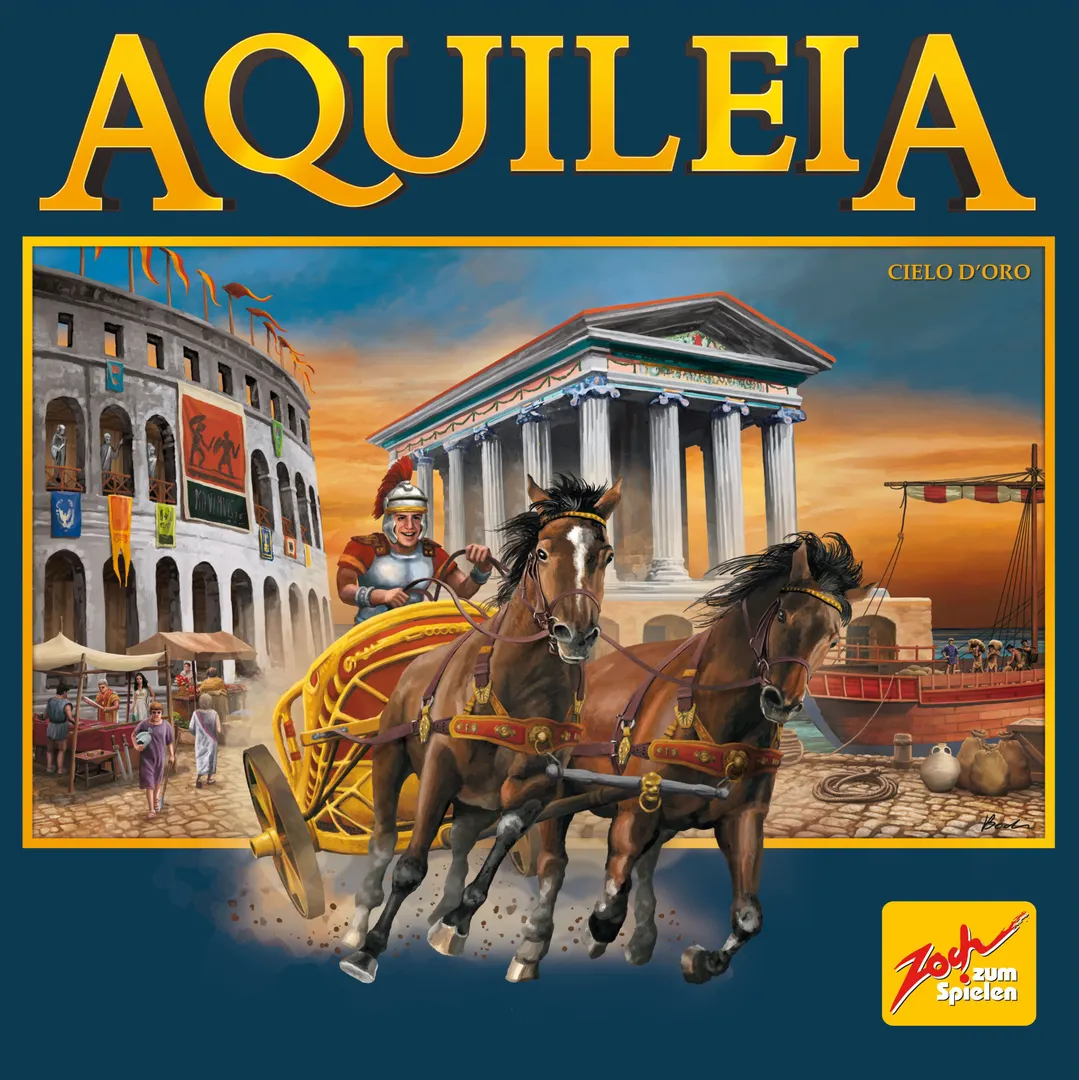
Aquileia ist ein Brettspiel aus dem Jahr 2011 für 3–5 Personen, mit 90 Minuten pro Partie und ab 12 Jahren. Entwickelt wurde es von Cielo d'Oro; die wichtigsten Mechaniken sind Hand Management, Auction / Bidding und Dice Rolling.




Auf Englisch
Aquileia, the second most important city of the Roman Empire, had been originally founded as an outpost against the Barbarian invaders. From its military origin comes the peculiar quadrilateral structure divided by the main streets. Later, the city developed to become an important political and cultural center and a prosperous trading city, especially for precious goods, thanks to its convenient and efficient river port. Important monuments such as the Gladiator Arena, the horse-racing Stadium, and the famous theater were built, as well as craftsmen's workshops, patrician villas which completed the architectural network of the city. In Aquileia, players want to become the most powerful figure in the city by trading and building. Each player, representing a wealthy Aquileian patrician, owns a certain number of henchmen (pawns) which he uses for these main activities: sports playing, culture, trading, and building. Each activity can bring expenses, earnings and sometimes victory points (VPs). Each round begins with a placement phase in which players take turns placing their henchmen on action spaces and their tiebreaker disc on the tiebreaker track. Placing the tiebreaker is mandatory; placing henchmen is not (but you probably want to place them). Once everyone has passed or placed all of their tokens, players resolve the action spaces in numerical order: The Mercatus allows players to buy weapons, arms and slave cards, collect money through a die roll, claim four blue dice for use with the Arena and Stadium, and trade one currency for another. (This is the only way to make change, and some actions require specific currencies; if you must pay bronze and have only silver and gold, then you cannot take that action!) At the Arena, players compare fighting strength, with that number determined by the starting strength on the action space claimed, the roll of three dice and the playing of slave and weapon cards. The winner gets three bronze coins and either double his strength in VPs or a slave card. The second and third best players receive lesser rewards. The Stadium is similar to the Arena, with the horse cards coming into play and the winner receiving gold or silver coins and his choice of two laurel cards; laurel cards deliver 3-10 VPs or are a multiplier for endgame scoring. The Theatrum brings a bid for a dual-colored laurel card, with players needing to ante and raise in particular currencies. In the Forum, players build villas and private banks, sometimes scoring points for doing so when they pay the specific costs with the proper coins. Finally, the Portus gives players a chance to activate their buildings, thereby earning them VPs or money. After six rounds, the game ends and players score VPs for their hidden point cards and the product of their villas' values times laurel cards of a matching color. (For example, a total of 8 points of blue villas and three blue villa cards equals 24 points.) The player with the most victory points wins.
Laut Katalog unterstützt Aquileia 3–5 Personen. Diese Spanne entspricht der vom Verlag angegebenen Spielerzahl, das Spiel lässt sich also für jede Gruppengröße innerhalb dieser Spanne aufbauen. Aufbau, einzelne Regeln und Wertungsdetails können je nach Personenzahl trotzdem abweichen; prüfe daher die genaue Konfiguration in der Anleitung deiner Ausgabe.
Die angegebene Spieldauer für Aquileia beträgt 90 Minuten. Das ist die Schätzung des Verlags für eine vollständige Partie. Die tatsächliche Dauer hängt von der Gruppe, der Personenzahl und der Regelkenntnis ab: Erste Partien dauern meist länger, erfahrene Gruppen sind oft schneller fertig. Aufbau und Regelerklärung sind in dieser Schätzung nicht enthalten.
Im Katalog wird Aquileia ab 12 Jahren empfohlen. Das ist die Empfehlung des Verlags und berücksichtigt Leseanforderungen, Regelkomplexität und Kleinteile, nicht nur das Thema. Jüngere Kinder können oft mit Hilfe eines Erwachsenen mitspielen; beachte die Altersangabe deiner Ausgabe und die Brettspielerfahrung deiner Gruppe.
Aquileia hat bei BoardGameGeek eine Komplexitätswertung von 2,9 von 5 und gilt damit als eher leichtes Spiel. Die Wertung zeigt, wie viel Regelwissen, Planung und Entscheidungen eine typische Partie verlangt. Schwerere Spiele brauchen bei der ersten Erklärung mehr Zeit, daher hilft vor dem Spieleabend eine Vorbereitungsanleitung.
Aquileia gehört zu diesen Kategorien: Economic, Dice und Ancient. Die wichtigsten Mechaniken sind Hand Management, Auction / Bidding und Dice Rolling. Kategorien beschreiben Thema und Setting eines Spiels, Mechaniken dagegen, was die Spielenden in ihrem Zug tatsächlich tun. Jede Mechanik führt zu einer Katalogseite mit ähnlichen Spielen, falls du etwas Vergleichbares suchst.
Als Autoren von Aquileia sind angegeben: Cielo d'Oro. Diese Angaben stammen aus den veröffentlichten Spieldaten und nennen die für das Spieldesign verantwortlichen Personen, nicht die Illustratoren oder Verlage. Die Autorenseiten auf MeepleRules sammeln weitere Titel derselben Autoren – praktisch, wenn dir ein Spiel gefällt und du ähnliche Spiele suchst.
Im Katalog ist Aquileia als Grundspiel aufgeführt. Es lässt sich eigenständig mit dem Material aus der Schachtel spielen und benötigt keinen weiteren Titel. Erweiterungen, sofern es welche gibt, ergänzen neues Material oder neue Regeln und sind im Katalog separat mit einem Verweis auf dieses Grundspiel aufgeführt.