

- BGG-Rang
- BGG #10.123
- BGG-Bewertung
- 6,5
The Halls of Montezuma
- 2 Spieler
- 240 Min.
- Komplexität 3,1/5
- 2009
2000
Regelhilfe für Austerlitz 1805: Napoleon's Greatest Victory
Verständliche Erklärungen zu Spielzügen, Karteneffekten und strittigen Situationen mit Verweisen auf offizielle Quellen und gespeichertem Fragenverlauf.
Was möchtest du wissen?
Antworten stammen aus dem offiziellen Regelheft, mit Seitenangabe zum Nachprüfen.
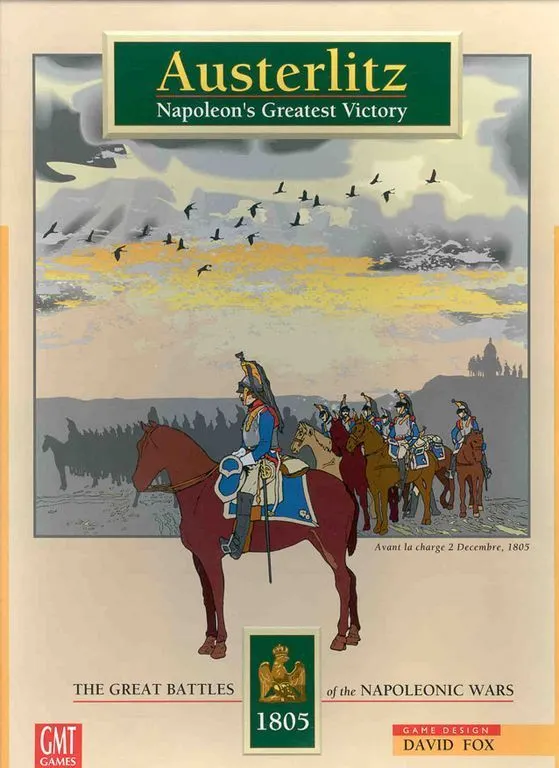
Austerlitz 1805: Napoleon's Greatest Victory ist ein Brettspiel aus dem Jahr 2000 für 1–2 Personen, mit 240–480 Minuten pro Partie und ab 12 Jahren. Entwickelt wurde es von David A. Fox; die wichtigsten Mechaniken sind Dice Rolling, Hexagon Grid und Simulation.





Auf Englisch
Before tomorrow evening, that army will be mine. So claimed Napoleon Bonaparte to his staff on the night of December 1, 1805, as he watched the Austro-Russian Allied army settle into its positions near Austerlitz for the battle that was certain to come the next morning. It was not an idle boast. Napoleon's Grande Armee mustered 75,000 men, well-led, superbly trained, and completely confident of victory. And the next day, they would win the most decisive victory of Napoleon's career. The Battle of Austerlitz was Napoleon's tactical masterpiece. Facing an Allied army 72,000 men strong, he blocked a massive Allied flanking movement aimed at his right wing, launched an attack that smashed the Allied center, and then scattered the remnants so thoroughly that by the night of December 2nd the Allied Third Coalition was in ruins. The battle contained many moments of high drama: the French right wing holding on despite 3-to-1 odds, desperately waiting for help from Davout's corps rushing to the battlefield after an epic forced march; a massive cavalry melee fought on the northern half of the field between the opposing cavalry reserves; the clash of the French and Russian Imperial Guards on the Pratzen Heights that decided the course of the battle. Austerlitz 1805 is a detailed wargame, on a tactical level, with infantry battalions, cavalry regiments, and artillery batteries, featuring... A chit-based Command system where players randomly draw command chits to determine which division or corps may activate at that moment -- activation is not automatic. Commanders must roll to activate when their chit is drawn, and missing the die-roll leads to the Command Breakdown Table -- disasters can happen. A Combat system that includes all of the detail that fans of Napoleonic tactics know and love. All of the formations are there -- line, column, skirmish -- each with their own advantages and disadvantages. Players will soon learn that proper unit interaction is crucial for victory, with artillery wearing down the enemy line, infantry creating a breakthrough, and cavalry exploiting the breakthrough with a thundering charge. Special units and rules to add a distinctive historical flavor: the Tirailleurs Po and Tirailleurs Corse, elite battalions of French skirmishers; the exotic Mamelukes of the French Imperial Guard, matched against the Russian Cossacks; the fearsome French Grand Battery; the early morning Fog that blanketed the battlefield and so bedeviled the battle's opening moves. Six scenarios -- two full-battle scenarios; three smaller one or two map scenarios covering the significant actions, plus a learning scenario providing an introduction to the game's mechanics. Game Scale: Game Turn: 20 minutes Hex: 150 yards / 137 meters Units: infantry battalions, cavalry regiments, and artillery batteries Solitaire Playability: High Complexity Level: Medium Players: 2 or more Playing Time: 4-8 hours
Laut Katalog unterstützt Austerlitz 1805: Napoleon's Greatest Victory 1–2 Personen. Diese Spanne entspricht der vom Verlag angegebenen Spielerzahl, das Spiel lässt sich also für jede Gruppengröße innerhalb dieser Spanne aufbauen. Aufbau, einzelne Regeln und Wertungsdetails können je nach Personenzahl trotzdem abweichen; prüfe daher die genaue Konfiguration in der Anleitung deiner Ausgabe.
Die angegebene Spieldauer für Austerlitz 1805: Napoleon's Greatest Victory beträgt 240–480 Minuten. Das ist die Schätzung des Verlags für eine vollständige Partie. Die tatsächliche Dauer hängt von der Gruppe, der Personenzahl und der Regelkenntnis ab: Erste Partien dauern meist länger, erfahrene Gruppen sind oft schneller fertig. Aufbau und Regelerklärung sind in dieser Schätzung nicht enthalten.
Im Katalog wird Austerlitz 1805: Napoleon's Greatest Victory ab 12 Jahren empfohlen. Das ist die Empfehlung des Verlags und berücksichtigt Leseanforderungen, Regelkomplexität und Kleinteile, nicht nur das Thema. Jüngere Kinder können oft mit Hilfe eines Erwachsenen mitspielen; beachte die Altersangabe deiner Ausgabe und die Brettspielerfahrung deiner Gruppe.
Austerlitz 1805: Napoleon's Greatest Victory hat bei BoardGameGeek eine Komplexitätswertung von 3,3 von 5 und gilt damit als mittelschweres Spiel. Die Wertung zeigt, wie viel Regelwissen, Planung und Entscheidungen eine typische Partie verlangt. Schwerere Spiele brauchen bei der ersten Erklärung mehr Zeit, daher hilft vor dem Spieleabend eine Vorbereitungsanleitung.
Austerlitz 1805: Napoleon's Greatest Victory gehört zu diesen Kategorien: Wargame und Napoleonic. Die wichtigsten Mechaniken sind Dice Rolling, Hexagon Grid und Simulation. Kategorien beschreiben Thema und Setting eines Spiels, Mechaniken dagegen, was die Spielenden in ihrem Zug tatsächlich tun. Jede Mechanik führt zu einer Katalogseite mit ähnlichen Spielen, falls du etwas Vergleichbares suchst.
Als Autoren von Austerlitz 1805: Napoleon's Greatest Victory sind angegeben: David A. Fox. Diese Angaben stammen aus den veröffentlichten Spieldaten und nennen die für das Spieldesign verantwortlichen Personen, nicht die Illustratoren oder Verlage. Die Autorenseiten auf MeepleRules sammeln weitere Titel derselben Autoren – praktisch, wenn dir ein Spiel gefällt und du ähnliche Spiele suchst.
Im Katalog ist Austerlitz 1805: Napoleon's Greatest Victory als Grundspiel aufgeführt. Es lässt sich eigenständig mit dem Material aus der Schachtel spielen und benötigt keinen weiteren Titel. Erweiterungen, sofern es welche gibt, ergänzen neues Material oder neue Regeln und sind im Katalog separat mit einem Verweis auf dieses Grundspiel aufgeführt.