
- BGG-Rang
- BGG #9.223
- BGG-Bewertung
- 6,3
The Maiden in the Forest
- 1 Spieler
- 15 Min.
- Komplexität 1,7/5
- 2015
2011
Regelhilfe für Bibliogamo
Verständliche Erklärungen zu Spielzügen, Karteneffekten und strittigen Situationen mit Verweisen auf offizielle Quellen und gespeichertem Fragenverlauf.
Für 1 Person
Was möchtest du wissen?
Antworten stammen aus dem offiziellen Regelheft, mit Seitenangabe zum Nachprüfen.
Bibliogamo ist ein Brettspiel aus dem Jahr 2011 für 1 Person, mit 20 Minuten pro Partie und ab 10 Jahren. Entwickelt wurde es von Todd Sanders; die wichtigsten Mechaniken sind Hand Management, Set Collection und Area Majority / Influence.






Auf Englisch
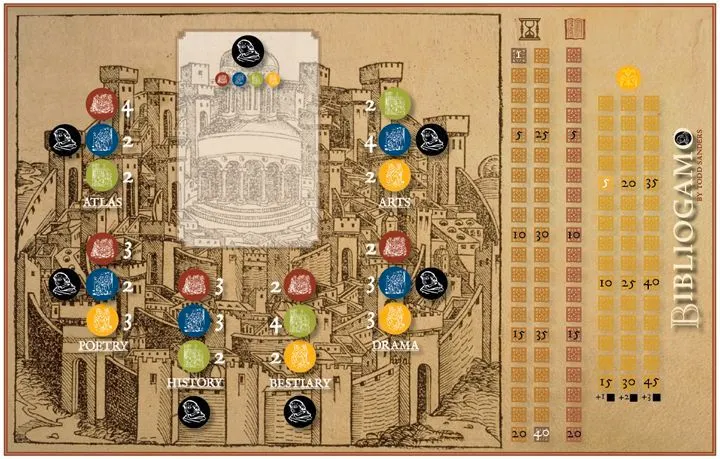
Bibliogamo is a solitaire game of book production and libraries. In this game you will play the role of a publisher in the city of Bibliogamo. Using cards to hire artisans, you will put them to work in six city tower workshops, each devoted to a different kind of book. The Chief Librarian of the City will, in turn, tour the city buying books at what he considers their proper value. Prestige Collection cards generate victory points depending on how well you can fulfill the requirements of the Chief Librarian’s collection. Needed to play: the game board showing the city of Bibliogamo, the 47 Artisan cards, the 7 Prestige Collection cards, 26 black eurocubes representing your Artisans, and 16 red eurocubes to act as track markers in the game. Additionally you’ll need one pawn to represent the Librarian. Win: The game is over when the Time Track eurocube reaches [40] and you complete your turn. For each book you produce, you gain 1VP. For each 5 Florins you have, you gain 1 VP. Prestige VP is awarded as indicated on the Prestige Collection card chosen at the start of the game. Your total VP is your score for the game. The Five Turn Phases: 1. Move the time track eurocube forward one day closer to [40]. 2. Move the Librarian Pawn clockwise 3 spaces, then turn over the top Artisan card from the draw pile on to the discard pile and move the Librarian accordingly as indicated by the Librarian icon on the left-hand side of the card. 3. Look at the small Artisan icon below the Librarian icon on this same card. You may not play any card with that Artisan symbol on it this turn unless you discard a card from your hand with a matching small Artisan icon. 4. You may now do any of the following, but in order: a. Pay 1 Florin to move the Librarian forward or backward one space. You may pay 1 Florin for each space you wish to move the Librarian. b. Sell a book, if completed, in the Tower the Librarian is currently standing on. Turn over the next 2 Artisan cards from the draw deck. Place the second card to the right of the first and look at the florin value on the second card as indicated by the Florin icon at on the first card. This is the amount the Librarian is willing to pay for this book. You may pay extra 1 day of time to turn over another card replacing the current Florin amount. You may continue to do this, paying 1 day of time per card turned over, until you are satisfied with the price. Mark this amount on your Florin Track and return all Artisan eurocubes from the completed book to your pool. Then mark the production of a book on your Book track, moving the red eurocube forward one space, and if the book is one of those needed for a Prestige Collection, mark that book on the Prestige Collection card as well with a red eurocube. Note: you may pay extra days of time only if they remain on the Time Track. Lastly, place all drawn cards used to calculate the Florin value on the discard pile. c. Discard one Artisan card from your hand to the discard pile and place that number of black eurocubes on the Artisans indicated by the card, on any one Tower. Then discard one more card from your hand to pay for those Artisans. You may do this action twice if you wish. You do not receive any surplus Artisans from the discarded card. Nor do you receive any surplus Artisans if your tower already has the number required for that Artisan type. The second time you do this action you may add Artisans to the same tower or a different one. 5. Draw back to a hand of 5 cards. If the draw deck is exhausted, shuffle the discard cards for a new draw deck.
Laut Katalog unterstützt Bibliogamo 1 Person. Das ist die vom Verlag angegebene Spielerzahl, das Spiel ist also genau für diese Anzahl von Mitspielenden ausgelegt. Varianten für andere Gruppengrößen sind, sofern vorhanden, in der Anleitung deiner Ausgabe beschrieben; prüfe sie, bevor du eine andere Konfiguration aufbaust.
Die angegebene Spieldauer für Bibliogamo beträgt 20 Minuten. Das ist die Schätzung des Verlags für eine vollständige Partie. Die tatsächliche Dauer hängt von der Gruppe, der Personenzahl und der Regelkenntnis ab: Erste Partien dauern meist länger, erfahrene Gruppen sind oft schneller fertig. Aufbau und Regelerklärung sind in dieser Schätzung nicht enthalten.
Im Katalog wird Bibliogamo ab 10 Jahren empfohlen. Das ist die Empfehlung des Verlags und berücksichtigt Leseanforderungen, Regelkomplexität und Kleinteile, nicht nur das Thema. Jüngere Kinder können oft mit Hilfe eines Erwachsenen mitspielen; beachte die Altersangabe deiner Ausgabe und die Brettspielerfahrung deiner Gruppe.
Bibliogamo hat bei BoardGameGeek eine Komplexitätswertung von 1,3 von 5 und gilt damit als leichtes Spiel. Die Wertung zeigt, wie viel Regelwissen, Planung und Entscheidungen eine typische Partie verlangt. Schwerere Spiele brauchen bei der ersten Erklärung mehr Zeit, daher hilft vor dem Spieleabend eine Vorbereitungsanleitung.
Bibliogamo gehört zu diesen Kategorien: Print & Play, Medieval und Renaissance. Die wichtigsten Mechaniken sind Hand Management, Set Collection und Area Majority / Influence. Kategorien beschreiben Thema und Setting eines Spiels, Mechaniken dagegen, was die Spielenden in ihrem Zug tatsächlich tun. Jede Mechanik führt zu einer Katalogseite mit ähnlichen Spielen, falls du etwas Vergleichbares suchst.
Als Autoren von Bibliogamo sind angegeben: Todd Sanders. Diese Angaben stammen aus den veröffentlichten Spieldaten und nennen die für das Spieldesign verantwortlichen Personen, nicht die Illustratoren oder Verlage. Die Autorenseiten auf MeepleRules sammeln weitere Titel derselben Autoren – praktisch, wenn dir ein Spiel gefällt und du ähnliche Spiele suchst.
Im Katalog ist Bibliogamo als Grundspiel aufgeführt. Es lässt sich eigenständig mit dem Material aus der Schachtel spielen und benötigt keinen weiteren Titel. Erweiterungen, sofern es welche gibt, ergänzen neues Material oder neue Regeln und sind im Katalog separat mit einem Verweis auf dieses Grundspiel aufgeführt.