
- BGG-Bewertung
- 7,3
Blitzkrieg Module System
- 2 Spieler
- 240 Min.
- Komplexität 3,6/5
- 1969
1965
Regelhilfe für Blitzkrieg
Verständliche Erklärungen zu Spielzügen, Karteneffekten und strittigen Situationen mit Verweisen auf offizielle Quellen und gespeichertem Fragenverlauf.
Für 2 Personen
Was möchtest du wissen?
Antworten stammen aus dem offiziellen Regelheft, mit Seitenangabe zum Nachprüfen.
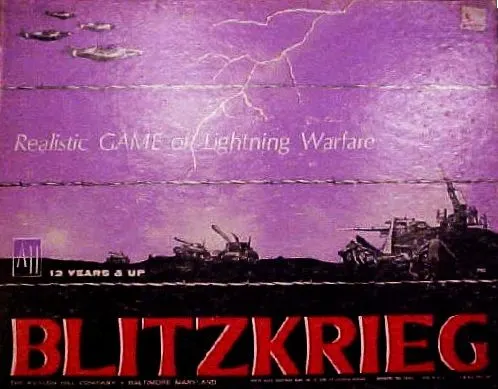
Blitzkrieg ist ein Brettspiel aus dem Jahr 1965 für 2 Personen, mit 90 Minuten pro Partie und ab 12 Jahren. Entwickelt wurde es von Larry Pinsky und Thomas N. Shaw; die wichtigsten Mechaniken sind Dice Rolling, Grid Movement und Hexagon Grid.







Auf Englisch
Blitzkrieg is one of Avalon Hill's earlier releases, and is a classic hex and counter board game. The game is a fictional representation of the breakout of World War II. Five minor countries become engulfed in a tremendous conflict for territory waged by Great Blue and Big Red, the major antagonists. Units represented are infantry, airborne, rangers, armor, artillery, fighters and bombers. Naval action is included but abstracted. Rules are introduced at three levels: the basic game, the advanced game, and a tournament game, as well as optional rules players can include as they choose. The advanced game adds special unit abilities, supply restrictions, air war and strategic bombing, naval invasions, commando raids, special desert supply restrictions, etc. Tournament play was intended for play at game conventions such as the annual world board-gaming convention in Harrisburg, Pa. The nice thing about Blitzkrieg is that it uses a system that is similar to most other hex and counter games, so once one learns one game, the learning curve of a similar game is not as steep. Such is the case with many of the old Avalon Hill Classics. Once you learned one game all of the others played the same way with some minor variation, only the campaign is different. The basic play used unit types and combat ratings. As expected, infantry would have different abilities from armor or artillery. Each unit had ratings printed in large print on the piece, ("chits" or counters as they are called). For example, take a 1-4 infantry brigade. The "4" is the movement factor per turn, so the unit can move four hexes in clear terrain per turn. Movement along a road is 1/3, so a 1-4 infantry can move 12 hexes if moved solely along a road. Each side is permitted to move all of their units up to their full movement allowance. The first rating, the "1" in this case, is the combat factor. Combat is worked out in odds, so that if one moves his 1-4 infantry next to the enemies’ 1-4 infantry, the combat odds are 1-1 (not very good in combat). There is nothing preventing one from ganging up on an enemy unit, and in fact this is the general tactic even in real life. So if one brought up another brigade into the attack there would be two 1-4 infantry brigades against the enemy's single brigade for 2-1 odds. For example, if the enemy had a 4-4 infantry division sitting on a clear hex and on their turn a player brings up three 4-4 infantry divisions adjacent to have combat, this would be at 12-4 odds, which reduce to 3-1. Then one would consult the combat results table under the 3-1 column and roll the die. The results would resolve the combat and tell what losses there were, and who had to retreat. Obviously, higher odds will favor that side. Also in combat, terrain affects combat. A defender in a city or mountain would have their defense rating doubled. For example, a 1-4 infantry in the mountains would defend as a combat rating of 2. Odds are rounded in favor of the defender. From the example above if that 4-4 infantry was defending in a city against those three 4-4 infantry, the odds would now be 12-8, only 1-1 odds (better bring up more attacking troops). When Blitzkrieg came out this type of map wargame was relatively new, so this game was very novel in its time. It is still a good two player game and there is enough variation so it won't get stale. It has a WWII or early cold war feel to it. The two antagonists are abstract, Big Red and Great Blue, which had more to do with the simple printing colors Avalon Hill used back in the early 1960's than any national commentary. In the late seventies and eighties many panned Blitzkrieg since many games seemed to grind to a stalemate in the middle of the map. But as a training game this isn't such a bad thing, since that can give a new gamer some confidence to play to a draw.
Laut Katalog unterstützt Blitzkrieg 2 Personen. Das ist die vom Verlag angegebene Spielerzahl, das Spiel ist also genau für diese Anzahl von Mitspielenden ausgelegt. Varianten für andere Gruppengrößen sind, sofern vorhanden, in der Anleitung deiner Ausgabe beschrieben; prüfe sie, bevor du eine andere Konfiguration aufbaust.
Die angegebene Spieldauer für Blitzkrieg beträgt 90 Minuten. Das ist die Schätzung des Verlags für eine vollständige Partie. Die tatsächliche Dauer hängt von der Gruppe, der Personenzahl und der Regelkenntnis ab: Erste Partien dauern meist länger, erfahrene Gruppen sind oft schneller fertig. Aufbau und Regelerklärung sind in dieser Schätzung nicht enthalten.
Im Katalog wird Blitzkrieg ab 12 Jahren empfohlen. Das ist die Empfehlung des Verlags und berücksichtigt Leseanforderungen, Regelkomplexität und Kleinteile, nicht nur das Thema. Jüngere Kinder können oft mit Hilfe eines Erwachsenen mitspielen; beachte die Altersangabe deiner Ausgabe und die Brettspielerfahrung deiner Gruppe.
Blitzkrieg hat bei BoardGameGeek eine Komplexitätswertung von 2,7 von 5 und gilt damit als eher leichtes Spiel. Die Wertung zeigt, wie viel Regelwissen, Planung und Entscheidungen eine typische Partie verlangt. Schwerere Spiele brauchen bei der ersten Erklärung mehr Zeit, daher hilft vor dem Spieleabend eine Vorbereitungsanleitung.
Blitzkrieg gehört zu diesen Kategorien: Wargame und World War II. Die wichtigsten Mechaniken sind Dice Rolling, Grid Movement und Hexagon Grid. Kategorien beschreiben Thema und Setting eines Spiels, Mechaniken dagegen, was die Spielenden in ihrem Zug tatsächlich tun. Jede Mechanik führt zu einer Katalogseite mit ähnlichen Spielen, falls du etwas Vergleichbares suchst.
Als Autoren von Blitzkrieg sind angegeben: Larry Pinsky und Thomas N. Shaw. Diese Angaben stammen aus den veröffentlichten Spieldaten und nennen die für das Spieldesign verantwortlichen Personen, nicht die Illustratoren oder Verlage. Die Autorenseiten auf MeepleRules sammeln weitere Titel derselben Autoren – praktisch, wenn dir ein Spiel gefällt und du ähnliche Spiele suchst.
Im Katalog ist Blitzkrieg als Grundspiel aufgeführt. Es lässt sich eigenständig mit dem Material aus der Schachtel spielen und benötigt keinen weiteren Titel. Erweiterungen, sofern es welche gibt, ergänzen neues Material oder neue Regeln und sind im Katalog separat mit einem Verweis auf dieses Grundspiel aufgeführt.