
- BGG-Bewertung
- 8,7
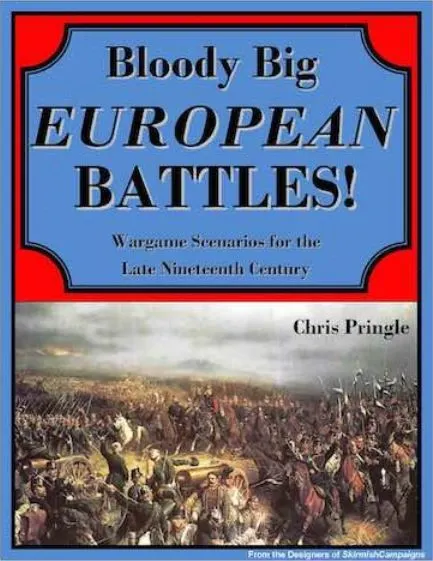
Bloody Big European Battles!: Wargame Scenarios for the Late Nineteenth Century
- 2 Spieler
- 90–360 Min.
- Komplexität 3,0/5
- 2014
2014
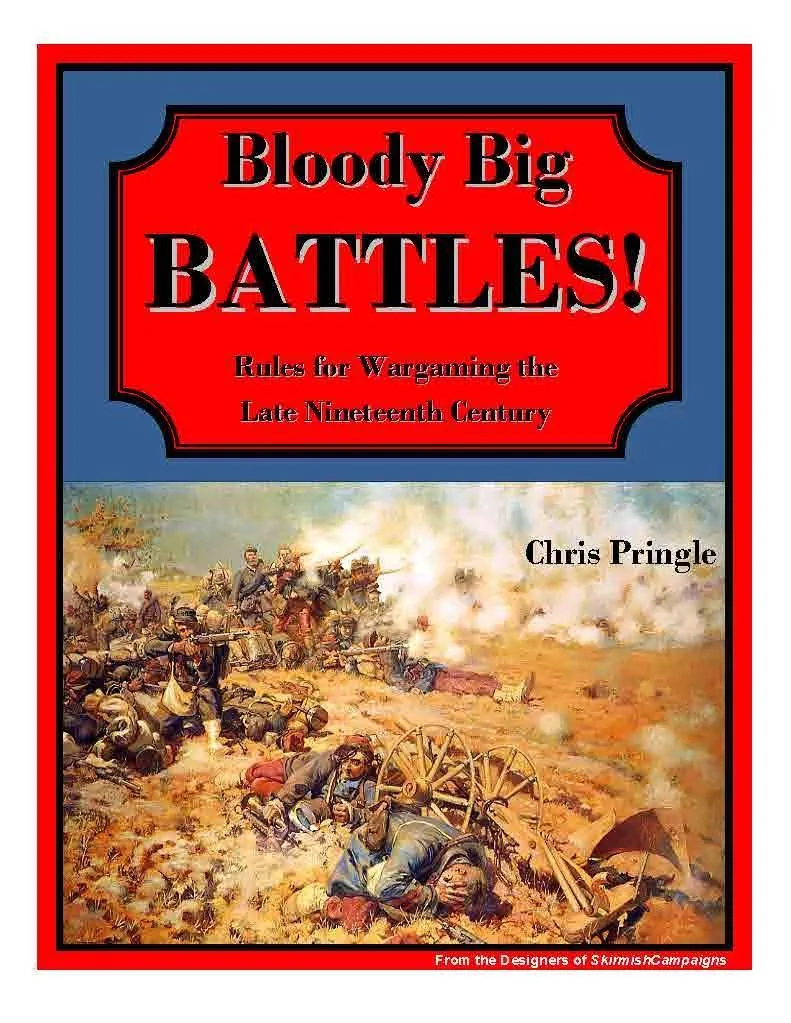
Regelhilfe für Bloody Big Battles!: Rules for Wargaming the Late Nineteenth Century
Verständliche Erklärungen zu Spielzügen, Karteneffekten und strittigen Situationen mit Verweisen auf offizielle Quellen und gespeichertem Fragenverlauf.
Was möchtest du wissen?
Antworten stammen aus dem offiziellen Regelheft, mit Seitenangabe zum Nachprüfen.
Bloody Big Battles!: Rules for Wargaming the Late Nineteenth Century ist ein Brettspiel aus dem Jahr 2014 für 2–8 Personen, mit 90–360 Minuten pro Partie und ab 10 Jahren. Entwickelt wurde es von Chris Pringle; die wichtigsten Mechaniken sind Dice Rolling, Simulation und Measurement Movement.





Auf Englisch
Rules for wargaming the Late Nineteenth Century with historical miniatures. Bloody Big Battles! (BBB) does exactly what its title says. It is intended for fighting the biggest, bloodiest battles of 1850-1900 in a manageable way. Specific design goals included: to tackle the major battles such as Solferino, Gettysburg, Königgrätz, Sedan or Plevna, often spanning several days’ combat; to fit them on a 6’x4’ tabletop; and to fight them in their entirety, in a single 3-to-4-hour session, with 2-6 players (typically 4). BBB is not intended for small actions of a few thousand men a side. There are plenty of rulesets that do that. But BBB is distinctive in: Enabling players to command entire armies of 100,000+ men; Fitting battlefields of up to 20km across on the table; While still producing a fast, fun, flavorful game and a result in an evening. Scale varies according to the battle but is typically: Figure scale 1,500 men or 36 cannon per 1” base (organized into multi-base division or brigade-sized units, usually of 3-7 infantry bases, 2-3 cavalry bases or 1 artillery base); Ground scale 1” per 200-250 yards; Timescale 1 hour per turn. BBB uses simple mechanisms and memorisable tables that fit on a clear 2-page QRC. Turn sequence: IGO-UGO Command and Control: reflected partly by how many generals get represented on table, partly by how units are rated. Movement: 2D6 movement table incorporates difficult terrain, generalship and doctrine, troop quality and morale, loss recovery. Fire Combat: calculated by adding fire points. 2D6 fire table to determine casualties, recorded by base removal. Assault: opposed D6 roll incorporating a few relevant factors. Night Interval rules to allow multi-day battles. BBB is meant for fighting historical battles. BBB and its companion volume, Bloody Big European Battles, therefore provide fully playtested scenarios for 25 of the most important battles of the period, linked into full campaigns. Further free scenarios are also available on the web. All the scenarios fit the battles they depict into a beautiful, tightly engineered game structure. They have clear, simple, but carefully thought-out victory conditions, designed both to recreate the historical situation and to generate an exciting and balanced game that can be completed in a sensible period of time. A particular joy of fighting historical actions on this scale is that usually both sides have several different viable strategies available, meaning the scenarios are full of replay value and can produce quite different games each time.
Laut Katalog unterstützt Bloody Big Battles!: Rules for Wargaming the Late Nineteenth Century 2–8 Personen. Diese Spanne entspricht der vom Verlag angegebenen Spielerzahl, das Spiel lässt sich also für jede Gruppengröße innerhalb dieser Spanne aufbauen. Aufbau, einzelne Regeln und Wertungsdetails können je nach Personenzahl trotzdem abweichen; prüfe daher die genaue Konfiguration in der Anleitung deiner Ausgabe.
Die angegebene Spieldauer für Bloody Big Battles!: Rules for Wargaming the Late Nineteenth Century beträgt 90–360 Minuten. Das ist die Schätzung des Verlags für eine vollständige Partie. Die tatsächliche Dauer hängt von der Gruppe, der Personenzahl und der Regelkenntnis ab: Erste Partien dauern meist länger, erfahrene Gruppen sind oft schneller fertig. Aufbau und Regelerklärung sind in dieser Schätzung nicht enthalten.
Im Katalog wird Bloody Big Battles!: Rules for Wargaming the Late Nineteenth Century ab 10 Jahren empfohlen. Das ist die Empfehlung des Verlags und berücksichtigt Leseanforderungen, Regelkomplexität und Kleinteile, nicht nur das Thema. Jüngere Kinder können oft mit Hilfe eines Erwachsenen mitspielen; beachte die Altersangabe deiner Ausgabe und die Brettspielerfahrung deiner Gruppe.
Bloody Big Battles!: Rules for Wargaming the Late Nineteenth Century hat bei BoardGameGeek eine Komplexitätswertung von 2,3 von 5 und gilt damit als eher leichtes Spiel. Die Wertung zeigt, wie viel Regelwissen, Planung und Entscheidungen eine typische Partie verlangt. Schwerere Spiele brauchen bei der ersten Erklärung mehr Zeit, daher hilft vor dem Spieleabend eine Vorbereitungsanleitung.
Bloody Big Battles!: Rules for Wargaming the Late Nineteenth Century gehört zu diesen Kategorien: Wargame, Miniatures und Civil War. Die wichtigsten Mechaniken sind Dice Rolling, Simulation und Measurement Movement. Kategorien beschreiben Thema und Setting eines Spiels, Mechaniken dagegen, was die Spielenden in ihrem Zug tatsächlich tun. Jede Mechanik führt zu einer Katalogseite mit ähnlichen Spielen, falls du etwas Vergleichbares suchst.
Als Autoren von Bloody Big Battles!: Rules for Wargaming the Late Nineteenth Century sind angegeben: Chris Pringle. Diese Angaben stammen aus den veröffentlichten Spieldaten und nennen die für das Spieldesign verantwortlichen Personen, nicht die Illustratoren oder Verlage. Die Autorenseiten auf MeepleRules sammeln weitere Titel derselben Autoren – praktisch, wenn dir ein Spiel gefällt und du ähnliche Spiele suchst.
Im Katalog ist Bloody Big Battles!: Rules for Wargaming the Late Nineteenth Century als Grundspiel aufgeführt. Es lässt sich eigenständig mit dem Material aus der Schachtel spielen und benötigt keinen weiteren Titel. Erweiterungen, sofern es welche gibt, ergänzen neues Material oder neue Regeln und sind im Katalog separat mit einem Verweis auf dieses Grundspiel aufgeführt.