

- BGG-Rang
- BGG #4.455
- BGG-Bewertung
- 8,7
Last Blitzkrieg: Wacht am Rhein, The Battle of the Bulge
- 2–4 Spieler
- 180–960 Min.
- Komplexität 3,8/5
- 2016
1999
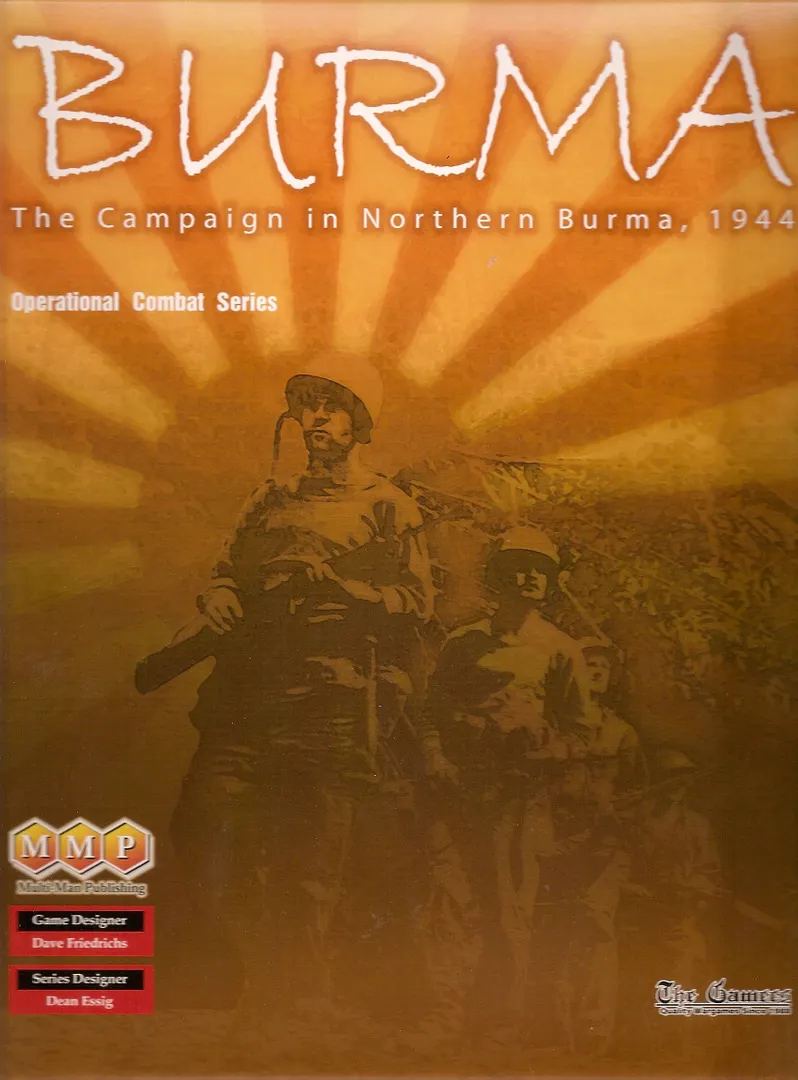
Regelhilfe für Burma: The Campaign in Northern Burma, 1944
Verständliche Erklärungen zu Spielzügen, Karteneffekten und strittigen Situationen mit Verweisen auf offizielle Quellen und gespeichertem Fragenverlauf.
Für 1 Person
Was möchtest du wissen?
Antworten stammen aus dem offiziellen Regelheft, mit Seitenangabe zum Nachprüfen.
Burma: The Campaign in Northern Burma, 1944 ist ein Brettspiel aus dem Jahr 1999 für 1–2 Personen, mit 60–3600 Minuten pro Partie und ab 12 Jahren. Entwickelt wurde es von Dean Essig und Dave Friedrichs; die wichtigsten Mechaniken sind Dice Rolling und Hexagon Grid.





Auf Englisch
Burma - The Campaign for Northern Burma, March-August, 1944, is the sixth game in the Operational Combat Series (OCS) from The Gamers, and covers covers the 1944 campaigns beginning with the Japanese "U-Go" offensive and ending up as what would be know as Imphal-Kohima, the most dramatic defeat ever inflicted on a Japanese army. In the spring of 1944, two equally matched opponents faced each other in the jungles and mountains of Northern Burma. During that spring and summer, three independent, but simultaneous, dramas unfolded. In the west, the Japanese launched an all-out offensive to capture Imphal. In the center, the Chindits landed in the Japanese rear area. In the east, the Chinese/US forces moved toward Myitkyina against stubborn Japanese defenses. These battles took place in horrible terrain under the most difficult conditions imaginable with troops whose quality ranged from the world’s best to the world’s worst. Burma contains British, Indian, US, and Chinese troops of varying qualities with ample opportunities for both sides to attack and defend. While mainly a British and Indian show, the campaign would end up involving US (Galahad) and Chinese troops as well. Burma is the most markedly different of the OCS games, with a wide variety of unit types and qualities, the extremely dense terrain and lack of roads creating a challenging supply situation for both sides, and a more balanced situation as both sides have opportunities to attack and defend. There is more of the "cool stuff" too, with Galahad, Chindits, Gurkhas, lots of air supply, elephant and oxen transport options creating some interesting situations, and the ever-enigmatic and unusual Japanese Army. Imphal-Kohima is by far the most interesting ground campaign of the PTO (from an operational perspective), and it's conversion to OCS is remarkably smooth, with a fairly modest set of game-specific rules. Unlike some other OCS games, Burma has an excellent range of scenarios, from a couple very short scenarios (1-2 hrs) through to a good selection of longer (6hr) scenarios and on up to 3 monster campaign games (30-60 hrs). Scenario Info: Learning Scenario: 1/8th of Map B; 5 turns Short Scenario 1 - Operation Thursday: 1/4 of Map B; 9 turns Short Scenario 2 - U-Go: 3/4 map of Map B; 10 turns Short Scenario 3 - Merril's Marauders: 3/4 map, but requires both maps to play; 24 turns Short Scenario 4 - Sato's Dilemna: 1/2 map of Map A; 11 turns Short Scenario 5 - Imphal: 1/2 map of Map A; 17 turns Campaign Scenarios 1, 2, and 3 (which use both maps, obviously); 45, 41, and 31 turns respectively Game Scale: Turn: 1/2 week Hex: 5 miles / 8 Km Units: Battalion to Division Game Inventory (Burma II - printed 2008): Two 22 x 34" full-color mapsheets Three dual-side printed countersheets (2 combat, 1 markers - 840 1/2" counters) One 48-page OCS version v4.0 rules booklet One 40-page Burma II specific rules booklet Two 4-sided OCS v4.0 Charts & Tables booklets Two 6-sided dice Players: 1 or more (also suitable for solitaire and team play) Playing Time: 1 to 60 hours Complexity: High Solitaire Suitability: Moderate
Laut Katalog unterstützt Burma: The Campaign in Northern Burma, 1944 1–2 Personen. Diese Spanne entspricht der vom Verlag angegebenen Spielerzahl, das Spiel lässt sich also für jede Gruppengröße innerhalb dieser Spanne aufbauen. Aufbau, einzelne Regeln und Wertungsdetails können je nach Personenzahl trotzdem abweichen; prüfe daher die genaue Konfiguration in der Anleitung deiner Ausgabe.
Die angegebene Spieldauer für Burma: The Campaign in Northern Burma, 1944 beträgt 60–3600 Minuten. Das ist die Schätzung des Verlags für eine vollständige Partie. Die tatsächliche Dauer hängt von der Gruppe, der Personenzahl und der Regelkenntnis ab: Erste Partien dauern meist länger, erfahrene Gruppen sind oft schneller fertig. Aufbau und Regelerklärung sind in dieser Schätzung nicht enthalten.
Im Katalog wird Burma: The Campaign in Northern Burma, 1944 ab 12 Jahren empfohlen. Das ist die Empfehlung des Verlags und berücksichtigt Leseanforderungen, Regelkomplexität und Kleinteile, nicht nur das Thema. Jüngere Kinder können oft mit Hilfe eines Erwachsenen mitspielen; beachte die Altersangabe deiner Ausgabe und die Brettspielerfahrung deiner Gruppe.
Burma: The Campaign in Northern Burma, 1944 hat bei BoardGameGeek eine Komplexitätswertung von 4,0 von 5 und gilt damit als schweres Spiel. Die Wertung zeigt, wie viel Regelwissen, Planung und Entscheidungen eine typische Partie verlangt. Schwerere Spiele brauchen bei der ersten Erklärung mehr Zeit, daher hilft vor dem Spieleabend eine Vorbereitungsanleitung.
Burma: The Campaign in Northern Burma, 1944 gehört zu diesen Kategorien: Wargame und World War II. Die wichtigsten Mechaniken sind Dice Rolling und Hexagon Grid. Kategorien beschreiben Thema und Setting eines Spiels, Mechaniken dagegen, was die Spielenden in ihrem Zug tatsächlich tun. Jede Mechanik führt zu einer Katalogseite mit ähnlichen Spielen, falls du etwas Vergleichbares suchst.
Als Autoren von Burma: The Campaign in Northern Burma, 1944 sind angegeben: Dean Essig und Dave Friedrichs. Diese Angaben stammen aus den veröffentlichten Spieldaten und nennen die für das Spieldesign verantwortlichen Personen, nicht die Illustratoren oder Verlage. Die Autorenseiten auf MeepleRules sammeln weitere Titel derselben Autoren – praktisch, wenn dir ein Spiel gefällt und du ähnliche Spiele suchst.
Im Katalog ist Burma: The Campaign in Northern Burma, 1944 als Grundspiel aufgeführt. Es lässt sich eigenständig mit dem Material aus der Schachtel spielen und benötigt keinen weiteren Titel. Erweiterungen, sofern es welche gibt, ergänzen neues Material oder neue Regeln und sind im Katalog separat mit einem Verweis auf dieses Grundspiel aufgeführt.