
- BGG-Rang
- BGG #4.606
- BGG-Bewertung
- 8,2
Commands & Colors Tricorne: The American Revolution
- 2 Spieler
- 60–90 Min.
- Komplexität 2,5/5
- 2017
2020
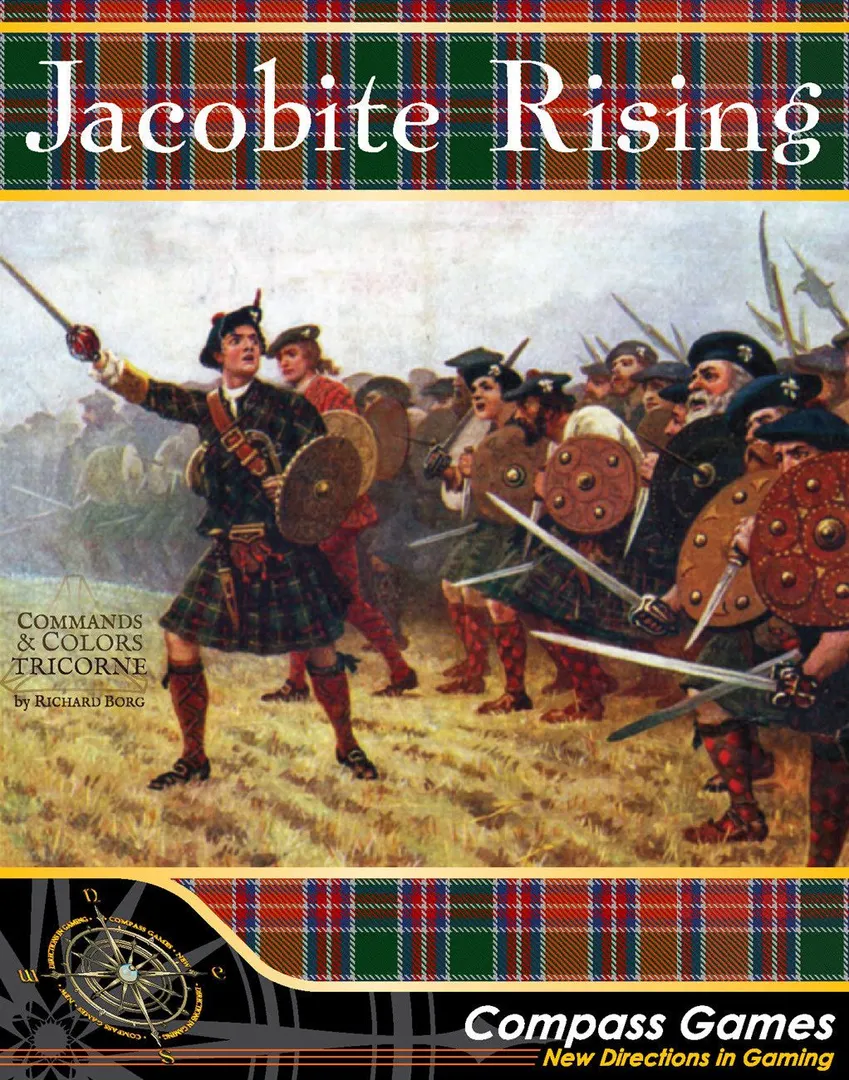
Regelhilfe für Commands & Colors Tricorne: Jacobite Rising
Verständliche Erklärungen zu Spielzügen, Karteneffekten und strittigen Situationen mit Verweisen auf offizielle Quellen und gespeichertem Fragenverlauf.
Für 2 Personen
Was möchtest du wissen?
Antworten stammen aus dem offiziellen Regelheft, mit Seitenangabe zum Nachprüfen.
Commands & Colors Tricorne: Jacobite Rising ist ein Brettspiel aus dem Jahr 2020 für 2 Personen und mit 60–90 Minuten pro Partie. Entwickelt wurde es von Richard Borg; die wichtigsten Mechaniken sind Hand Management, Dice Rolling und Modular Board.



Auf Englisch
By design, Jacobite Rising is not overly complex. In a battle scenario, two players will command either the Jacobite forces or the units of the Government army. There are 13 battle scenarios in the game. A scenario’s battle notes state which player takes the first turn and players will alternate taking turns thereafter until one player reaches the number of Victory Banners indicated in the scenario’s victory conditions. The Jacobite Rising battlefield game board has a hex grid of 13 hexes wide by 11 hexes deep. The battlefield is divided into three sections by two dotted lines, giving each player a Left Flank Section, a Center Section and a Right Flank Section. Where the dotted line cuts through a hex, the hex is considered to be part of both the flank section and the center section. Terrain Tiles represent a range of terrain features and are placed on the battlefield to recreate the historical scenario setting. A Command card is played each turn by the active player to order troops on a player’s side to move, battle, or do something special. The mix of units both players may have under their commands include; regular infantry, highland infantry, lowland infantry, militia infantry, battle cavalry, light cavalry, trained artillery, light artillery and leaders. Units are represented by a group of 4 blocks in a hex and a single block represents a leader. Units and leaders may only move and battle when given an order. During a turn when units are battling, the battle dice will resolve combat quickly and efficiently and when the last block of an opposition unit or leader block is eliminated, a player will gain one Victory Banner. Again the number of banners needed to win is detailed in a scenario’s victory conditions. In a Jacobite Rising Tricorne battle, unit morale is one of the main thematic concepts, as it was historically. It is possible that units which have taken few-- or even no-- losses will run off the battefield at the first combat, which will definitely keep players on the edge of their command chairs during an entire battle. To further emphasize the differences in battlefield doctrine between the Highland Clans and Government forces, each army has its own unique deck of Combat cards. These cards represent a mix of unit training, abilities, and surprising actions that take place during the course of a battle. As with other Commands & Colors games, the scale of the game fluctuates, which allows players to effectively portray some of the larger historical Jacobite Rising battles, like Culloden and Falkirk, as well as smaller size skirmish actions. The 13 battle scenarios in the game present a stylized battlefield map that emphasize the important terrain features and highlights the historical deployment of forces in scale with the game system. Still the tactics of the period, that players will need to execute to gain victory, conform remarkably well to the advantages and limitations inherent to the various armies of the day and the battlefield terrain features on which they fought. Here is the list of 13 battles and smaller skirmish actions included with Jacobite Rising: Killicrankie - 27 July 1689 Dunkeld - 21 August 1689 Cromdale - 1 May 1690 Alness - 10 July 1715 Sheriffmuir - 13 November 1715 Glen Shiel - 10 June 1719 Prestonpans - September 1745 Clifton - 18 December 1745 Inverurie - 23 December 1745 Falkirk (Stage 1) - 17 January 1746 Falkirk (Stage 2) - 17 January 1746 Culloden - 16 April 1746 Culloden (Flanking Move) - 16 April 1746 Again, owners of Compass Games The American Revolution Commands & Colors: Tricorne will find many familiar game mechanics in this stand-alone game product, but there are also plenty of new and interesting play concepts, which add historical depth and will provide even the most veteran Commands & Colors players new experiences and challenges as they are introduced into the world of the Highland Clans in the time of the Jacobite Risings. —description from the publisher
Laut Katalog unterstützt Commands & Colors Tricorne: Jacobite Rising 2 Personen. Das ist die vom Verlag angegebene Spielerzahl, das Spiel ist also genau für diese Anzahl von Mitspielenden ausgelegt. Varianten für andere Gruppengrößen sind, sofern vorhanden, in der Anleitung deiner Ausgabe beschrieben; prüfe sie, bevor du eine andere Konfiguration aufbaust.
Die angegebene Spieldauer für Commands & Colors Tricorne: Jacobite Rising beträgt 60–90 Minuten. Das ist die Schätzung des Verlags für eine vollständige Partie. Die tatsächliche Dauer hängt von der Gruppe, der Personenzahl und der Regelkenntnis ab: Erste Partien dauern meist länger, erfahrene Gruppen sind oft schneller fertig. Aufbau und Regelerklärung sind in dieser Schätzung nicht enthalten.
Commands & Colors Tricorne: Jacobite Rising hat bei BoardGameGeek eine Komplexitätswertung von 2,5 von 5 und gilt damit als eher leichtes Spiel. Die Wertung zeigt, wie viel Regelwissen, Planung und Entscheidungen eine typische Partie verlangt. Schwerere Spiele brauchen bei der ersten Erklärung mehr Zeit, daher hilft vor dem Spieleabend eine Vorbereitungsanleitung.
Commands & Colors Tricorne: Jacobite Rising gehört zu diesen Kategorien: Wargame und Age of Reason. Die wichtigsten Mechaniken sind Hand Management, Dice Rolling und Modular Board. Kategorien beschreiben Thema und Setting eines Spiels, Mechaniken dagegen, was die Spielenden in ihrem Zug tatsächlich tun. Jede Mechanik führt zu einer Katalogseite mit ähnlichen Spielen, falls du etwas Vergleichbares suchst.
Als Autoren von Commands & Colors Tricorne: Jacobite Rising sind angegeben: Richard Borg. Diese Angaben stammen aus den veröffentlichten Spieldaten und nennen die für das Spieldesign verantwortlichen Personen, nicht die Illustratoren oder Verlage. Die Autorenseiten auf MeepleRules sammeln weitere Titel derselben Autoren – praktisch, wenn dir ein Spiel gefällt und du ähnliche Spiele suchst.
Im Katalog ist Commands & Colors Tricorne: Jacobite Rising als Grundspiel aufgeführt. Es lässt sich eigenständig mit dem Material aus der Schachtel spielen und benötigt keinen weiteren Titel. Erweiterungen, sofern es welche gibt, ergänzen neues Material oder neue Regeln und sind im Katalog separat mit einem Verweis auf dieses Grundspiel aufgeführt.