
- BGG-Rang
- BGG #3.399
- BGG-Bewertung
- 6,8
Tao Long: The Way of the Dragon
- 2 Spieler
- 10–30 Min.
- Komplexität 2,7/5
- 2017
1400
Regelhilfe für Congkak
Verständliche Erklärungen zu Spielzügen, Karteneffekten und strittigen Situationen mit Verweisen auf offizielle Quellen und gespeichertem Fragenverlauf.
Für 2 Personen
Was möchtest du wissen?
Antworten stammen aus dem offiziellen Regelheft, mit Seitenangabe zum Nachprüfen.
Congkak ist ein Brettspiel aus dem Jahr 1400 für 2 Personen und ab 6 Jahren. Die wichtigsten Mechaniken sind Mancala.





Auf Englisch
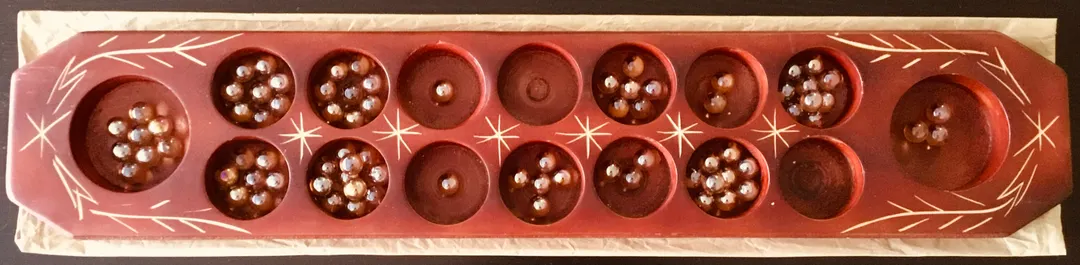
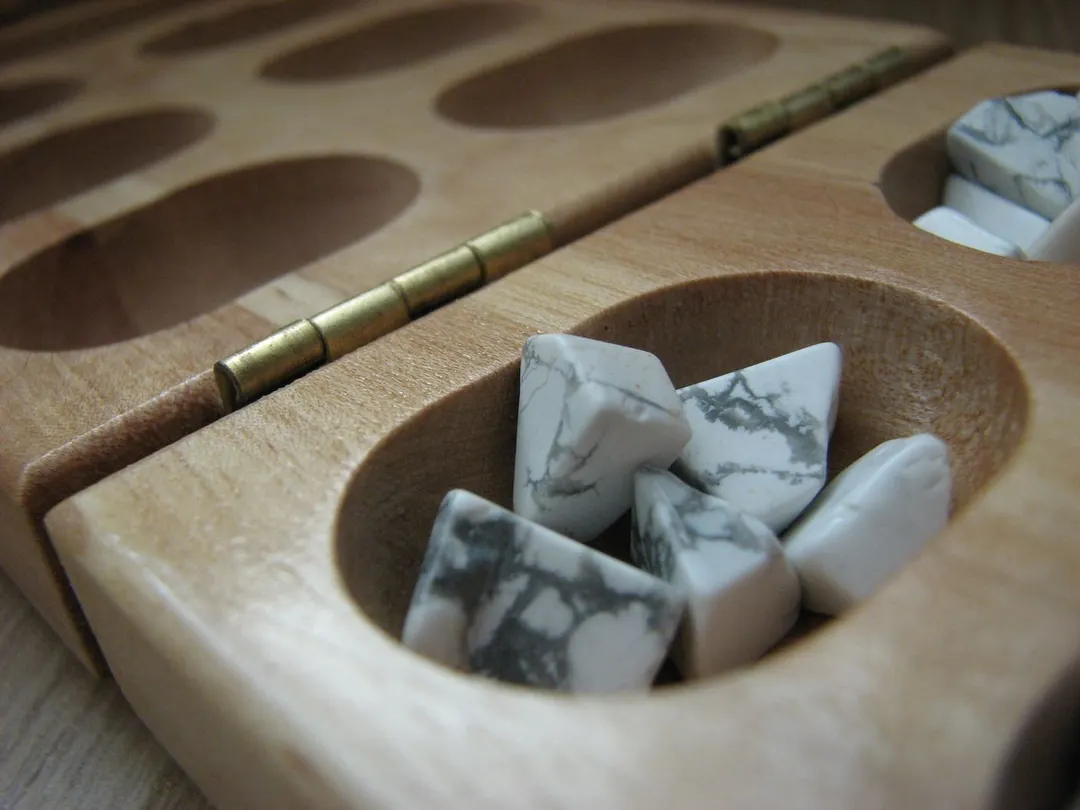
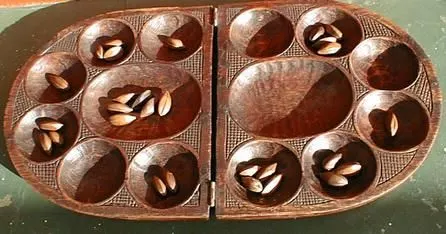
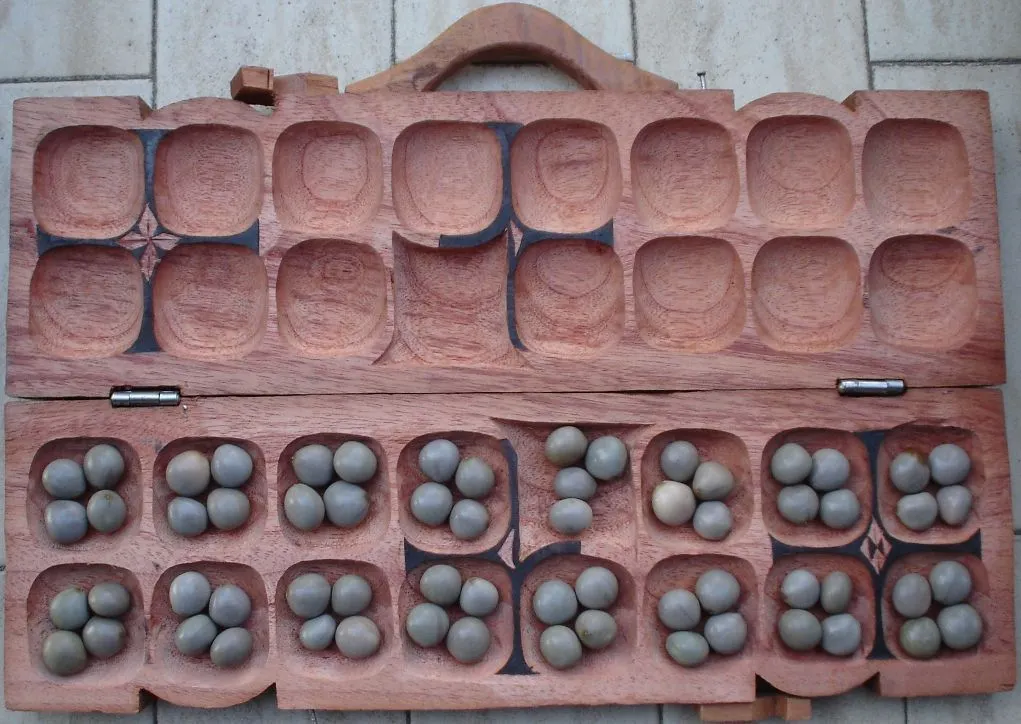
Congkak (also known as Sungka and Chongka among others), is a multi-lap sowing game likely derived from Mancala in the 15th century. Most Congkak or Sungka boards have seven pits on each of two sides, with a storehouse on each end of the board for each player. However, some boards have more or less pits. Each side of the board belongs to one player. Boards are usually made of wood and carved into different designs. The seeds are cowrie shells, though other items can be used. The game is played similar to Mancala with some notable differences. The goal of the game is to obtain the most seeds. The game starts off with seven seeds in each pit. Players get seeds by placing seeds into their storehouse. Players take the first turn simultaneously. During a player's turn, a player picks up pieces on their side of the board and drops a seed in each pit clockwise, placing a seed in their storehouse, but skipping the opponent's storehouse. If a player drops the final seed in a pit with seeds, the player picks up the seeds in the pit and continues their turn, distributing the picked up seeds in another lap. If a player drops the final seed in an empty pit on their side of the board, they capture all the seeds in the corresponding pit on the opponent's side of the board (as well as the seed they placed in an empty pit). A player's turn ends when a seed lands in an empty pit regardless of which side it lands. Play proceeds until all the seeds on one side of the board are empty. If there are still seeds on a side of the board, the player who owns the side gets all those sides. Games can also be played in rounds. At the end of a round, each player fills up each pit on their side with the seeds they had in their storehouse; each pit gets seven seeds as in setup. Leftover seeds remain in their storehouse. If there are not enough seeds to fill a pit, the pit gets burned and removed from play. Players cannot put seeds into the burned pit. The series of rounds can be finished when a player can no longer sufficiently fill one pit with seven seeds.
Laut Katalog unterstützt Congkak 2 Personen. Das ist die vom Verlag angegebene Spielerzahl, das Spiel ist also genau für diese Anzahl von Mitspielenden ausgelegt. Varianten für andere Gruppengrößen sind, sofern vorhanden, in der Anleitung deiner Ausgabe beschrieben; prüfe sie, bevor du eine andere Konfiguration aufbaust.
Im Katalog wird Congkak ab 6 Jahren empfohlen. Das ist die Empfehlung des Verlags und berücksichtigt Leseanforderungen, Regelkomplexität und Kleinteile, nicht nur das Thema. Jüngere Kinder können oft mit Hilfe eines Erwachsenen mitspielen; beachte die Altersangabe deiner Ausgabe und die Brettspielerfahrung deiner Gruppe.
Congkak hat bei BoardGameGeek eine Komplexitätswertung von 3,0 von 5 und gilt damit als mittelschweres Spiel. Die Wertung zeigt, wie viel Regelwissen, Planung und Entscheidungen eine typische Partie verlangt. Schwerere Spiele brauchen bei der ersten Erklärung mehr Zeit, daher hilft vor dem Spieleabend eine Vorbereitungsanleitung.
Congkak gehört zu diesen Kategorien: Abstract Strategy. Die wichtigsten Mechaniken sind Mancala. Kategorien beschreiben Thema und Setting eines Spiels, Mechaniken dagegen, was die Spielenden in ihrem Zug tatsächlich tun. Jede Mechanik führt zu einer Katalogseite mit ähnlichen Spielen, falls du etwas Vergleichbares suchst.
Im Katalog ist Congkak als Grundspiel aufgeführt. Es lässt sich eigenständig mit dem Material aus der Schachtel spielen und benötigt keinen weiteren Titel. Erweiterungen, sofern es welche gibt, ergänzen neues Material oder neue Regeln und sind im Katalog separat mit einem Verweis auf dieses Grundspiel aufgeführt.