
- BGG-Rang
- BGG #18.635
- BGG-Bewertung
- 6,5
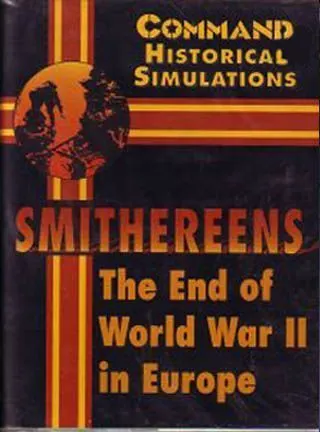
Smithereens: The End of World War II in Europe
- 1–3 Spieler
- 360 Min.
- Komplexität 2,3/5
- 1993
2005
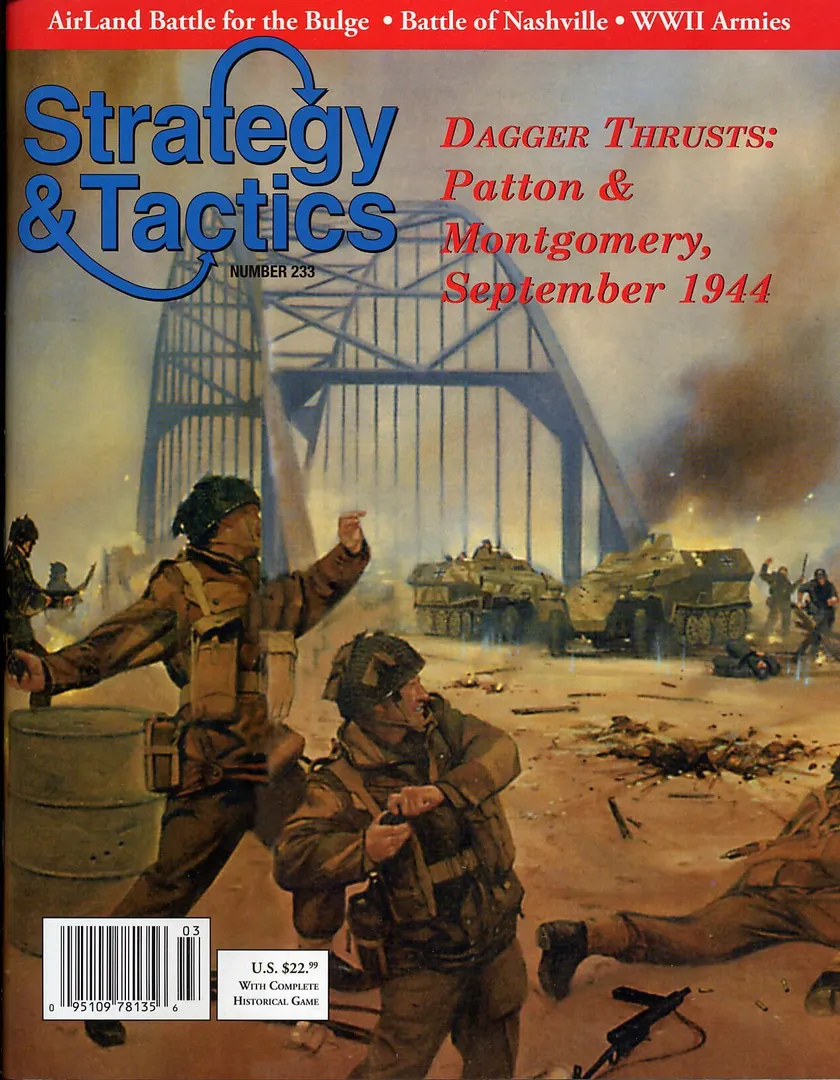
Regelhilfe für Dagger Thrusts: Patton & Montgomery, September 1944
Verständliche Erklärungen zu Spielzügen, Karteneffekten und strittigen Situationen mit Verweisen auf offizielle Quellen und gespeichertem Fragenverlauf.
Was möchtest du wissen?
Antworten stammen aus dem offiziellen Regelheft, mit Seitenangabe zum Nachprüfen.
Dagger Thrusts: Patton & Montgomery, September 1944 ist ein Brettspiel aus dem Jahr 2005 für 1–2 Personen, mit 180 Minuten pro Partie und ab 12 Jahren. Entwickelt wurde es von Ty Bomba; die wichtigsten Mechaniken sind Secret Unit Deployment, Hexagon Grid und Simulation.


Auf Englisch
This is low-to intermediate-complexity, two-player, examination of the historic alternative to Montgomery's ill-fated Operation Market Garden. Instead of his left-jab through lowland Holland to the Rhine, we have Patton's proposed right-hook, starting at Metz and swinging north and east toward the Ruhr for a war-winning knockout blow. Or, as an alternative within an alternative, the Allied player may try for a more conservative push straight east to the Rhine, there to create a bridgehead over that German river, thereby likely advancing the advent of V-E Day by at least three or four months. As soon as you begin to game Patton's alternative to Montgomery's all or nothing plan, it becomes clear what a huge opportunity Eisenhower missed by backing the wrong subordinate. That is, for the British field marshal's plan to have succeeded, it really did have to go all the way, or at least get across the Rhine in some significant way. Failing short of both the Rhine and the Ruhr, as happened historically, meant a month had been wasted and a lot of lives lost only to create a salient to nowhere. Had Patton's idea been tried, only to fail as badly, a salient of that same size – but jutting north into the Rhineland from a base at Metz – would've done much more for the Allied cause. We've broadened the appeal of this design beyond those who enjoy alternative history by including a second, historical, scenario. At first we were only going to cover the actual Market-Garden portion of Montgomery's operations in September 1944. It quickly became apparent, however, portrayed at these time, space and unit scales, such a game would be a dud, with a map only nine hexes long and three wide. So we broadened the thing's shoulders by expanding the coverage to take in all Montgomery's possibilities that fateful month. So now you can choose a straight-up historic approach, or you can have alternative history within your actual history. Each hex on the map equals seven miles from side to opposite side. Each game turn represents three days. Playing pieces represent divisions, brigades, combat commands, Kampfgruppen and regiments of various kinds of infantry and armor formations, each containing from about 3,000 to 14,000 men and 50 to 400 or so armored fighting vehicles.
Laut Katalog unterstützt Dagger Thrusts: Patton & Montgomery, September 1944 1–2 Personen. Diese Spanne entspricht der vom Verlag angegebenen Spielerzahl, das Spiel lässt sich also für jede Gruppengröße innerhalb dieser Spanne aufbauen. Aufbau, einzelne Regeln und Wertungsdetails können je nach Personenzahl trotzdem abweichen; prüfe daher die genaue Konfiguration in der Anleitung deiner Ausgabe.
Die angegebene Spieldauer für Dagger Thrusts: Patton & Montgomery, September 1944 beträgt 180 Minuten. Das ist die Schätzung des Verlags für eine vollständige Partie. Die tatsächliche Dauer hängt von der Gruppe, der Personenzahl und der Regelkenntnis ab: Erste Partien dauern meist länger, erfahrene Gruppen sind oft schneller fertig. Aufbau und Regelerklärung sind in dieser Schätzung nicht enthalten.
Im Katalog wird Dagger Thrusts: Patton & Montgomery, September 1944 ab 12 Jahren empfohlen. Das ist die Empfehlung des Verlags und berücksichtigt Leseanforderungen, Regelkomplexität und Kleinteile, nicht nur das Thema. Jüngere Kinder können oft mit Hilfe eines Erwachsenen mitspielen; beachte die Altersangabe deiner Ausgabe und die Brettspielerfahrung deiner Gruppe.
Dagger Thrusts: Patton & Montgomery, September 1944 hat bei BoardGameGeek eine Komplexitätswertung von 2,6 von 5 und gilt damit als eher leichtes Spiel. Die Wertung zeigt, wie viel Regelwissen, Planung und Entscheidungen eine typische Partie verlangt. Schwerere Spiele brauchen bei der ersten Erklärung mehr Zeit, daher hilft vor dem Spieleabend eine Vorbereitungsanleitung.
Dagger Thrusts: Patton & Montgomery, September 1944 gehört zu diesen Kategorien: Wargame und World War II. Die wichtigsten Mechaniken sind Secret Unit Deployment, Hexagon Grid und Simulation. Kategorien beschreiben Thema und Setting eines Spiels, Mechaniken dagegen, was die Spielenden in ihrem Zug tatsächlich tun. Jede Mechanik führt zu einer Katalogseite mit ähnlichen Spielen, falls du etwas Vergleichbares suchst.
Als Autoren von Dagger Thrusts: Patton & Montgomery, September 1944 sind angegeben: Ty Bomba. Diese Angaben stammen aus den veröffentlichten Spieldaten und nennen die für das Spieldesign verantwortlichen Personen, nicht die Illustratoren oder Verlage. Die Autorenseiten auf MeepleRules sammeln weitere Titel derselben Autoren – praktisch, wenn dir ein Spiel gefällt und du ähnliche Spiele suchst.
Im Katalog ist Dagger Thrusts: Patton & Montgomery, September 1944 als Grundspiel aufgeführt. Es lässt sich eigenständig mit dem Material aus der Schachtel spielen und benötigt keinen weiteren Titel. Erweiterungen, sofern es welche gibt, ergänzen neues Material oder neue Regeln und sind im Katalog separat mit einem Verweis auf dieses Grundspiel aufgeführt.