
- BGG-Rang
- BGG #21.246
- BGG-Bewertung
- 6,6
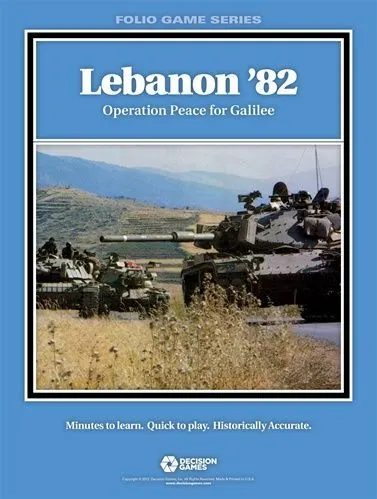
Lebanon '82: Operation Peace for Galilee
- 2 Spieler
- 90 Min.
- Komplexität 2,1/5
- 2012
2010
Regelhilfe für DMZ: The Next Korean War
Verständliche Erklärungen zu Spielzügen, Karteneffekten und strittigen Situationen mit Verweisen auf offizielle Quellen und gespeichertem Fragenverlauf.
Was möchtest du wissen?
Antworten stammen aus dem offiziellen Regelheft, mit Seitenangabe zum Nachprüfen.
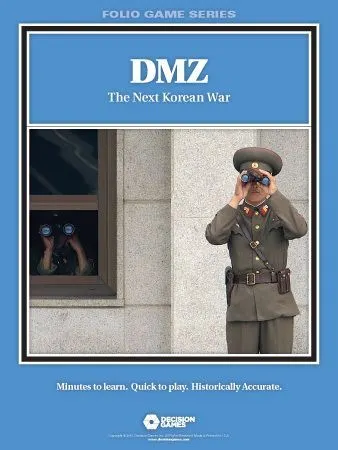
DMZ: The Next Korean War ist ein Brettspiel aus dem Jahr 2010 für 1–2 Personen und mit 60–120 Minuten pro Partie. Entwickelt wurde es von Eric R. Harvey; die wichtigsten Mechaniken sind Dice Rolling und Hexagon Grid.




Auf Englisch
From the Decision Games' website: Technically speaking, the Korean War has remained active since the cease-fire agreement of 1953: the belligerents have never actually ratified a final peace accord. Since 1953, the Korean peninsula has remained devoid of open war, though only South Korea has prospered during that time. In contrast, North Korea has become isolated, bankrupt and confrontational. Indeed, as the North Korean economy continues to implode, and more starvation ensues, it's conceivable a desperate North Korea could resort to war to try to avoid its own final collapse. DMZ utilizes the new Fire & Movement combat system that's designed so players can augment their units with "support fire" during the course of the turns. From artillery to helicopter gunships, units can receive support to engage enemy positions and formations, allowing combat to develop at all levels. A single armor brigade, for example — perhaps with close air support — could be tasked to assault a lone enemy infantry corps defending an airbase. As that attack gets underway, that armor brigade may find itself under fire from rocket batteries; more support fire will be necessary to take the airbase, but assets are limited. In DMZ, the attritional design of the new Combat Results Table simulates the true nature of modern warfare. Units are typically two-sided formations that can incur casualties, accurately replicating the realities of combat and the high losses likely to be sustained by both sides during another Korean War. Winning a battle is thus a matter of maneuver, firepower and asset management. Re-implements: DMZ: The Battle for South Korea, late 1970s
Laut Katalog unterstützt DMZ: The Next Korean War 1–2 Personen. Diese Spanne entspricht der vom Verlag angegebenen Spielerzahl, das Spiel lässt sich also für jede Gruppengröße innerhalb dieser Spanne aufbauen. Aufbau, einzelne Regeln und Wertungsdetails können je nach Personenzahl trotzdem abweichen; prüfe daher die genaue Konfiguration in der Anleitung deiner Ausgabe.
Die angegebene Spieldauer für DMZ: The Next Korean War beträgt 60–120 Minuten. Das ist die Schätzung des Verlags für eine vollständige Partie. Die tatsächliche Dauer hängt von der Gruppe, der Personenzahl und der Regelkenntnis ab: Erste Partien dauern meist länger, erfahrene Gruppen sind oft schneller fertig. Aufbau und Regelerklärung sind in dieser Schätzung nicht enthalten.
DMZ: The Next Korean War hat bei BoardGameGeek eine Komplexitätswertung von 2,2 von 5 und gilt damit als eher leichtes Spiel. Die Wertung zeigt, wie viel Regelwissen, Planung und Entscheidungen eine typische Partie verlangt. Schwerere Spiele brauchen bei der ersten Erklärung mehr Zeit, daher hilft vor dem Spieleabend eine Vorbereitungsanleitung.
DMZ: The Next Korean War gehört zu diesen Kategorien: Wargame und Modern Warfare. Die wichtigsten Mechaniken sind Dice Rolling und Hexagon Grid. Kategorien beschreiben Thema und Setting eines Spiels, Mechaniken dagegen, was die Spielenden in ihrem Zug tatsächlich tun. Jede Mechanik führt zu einer Katalogseite mit ähnlichen Spielen, falls du etwas Vergleichbares suchst.
Als Autoren von DMZ: The Next Korean War sind angegeben: Eric R. Harvey. Diese Angaben stammen aus den veröffentlichten Spieldaten und nennen die für das Spieldesign verantwortlichen Personen, nicht die Illustratoren oder Verlage. Die Autorenseiten auf MeepleRules sammeln weitere Titel derselben Autoren – praktisch, wenn dir ein Spiel gefällt und du ähnliche Spiele suchst.
Im Katalog ist DMZ: The Next Korean War als Grundspiel aufgeführt. Es lässt sich eigenständig mit dem Material aus der Schachtel spielen und benötigt keinen weiteren Titel. Erweiterungen, sofern es welche gibt, ergänzen neues Material oder neue Regeln und sind im Katalog separat mit einem Verweis auf dieses Grundspiel aufgeführt.