
- BGG-Rang
- BGG #2.742
- BGG-Bewertung
- 7,3
Dungeon Twister 2: Prison
- 1–2 Spieler
- 60 Min.
- Komplexität 3,2/5
- 2009
Regelhilfe für Dungeon Twister: Room P1
Verständliche Erklärungen zu Spielzügen, Karteneffekten und strittigen Situationen mit Verweisen auf offizielle Quellen und gespeichertem Fragenverlauf.
Was möchtest du wissen?
Antworten stammen aus dem offiziellen Regelheft, mit Seitenangabe zum Nachprüfen.
Dungeon Twister: Room P1 ist eine Erweiterung für Dungeon Twister aus dem Jahr 2005 für 2–4 Personen, mit 60 Minuten pro Partie und ab 11 Jahren. Entwickelt wurde es von Christophe Boelinger; die wichtigsten Mechaniken sind Hand Management, Tile Placement und Secret Unit Deployment.


Auf Englisch
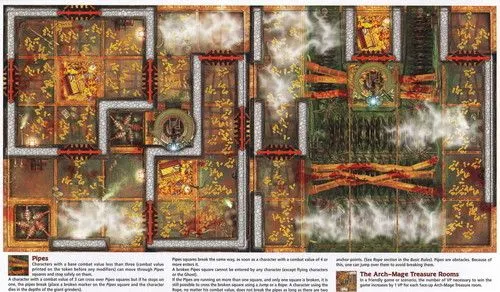
Arch-Mage Treasure Rooms (Rooms P1, Goodies 2004-2005) The number of VP necessary to win the game is increased by 1 VP for each face-up Arch-Mage Treasure room. For example, if the game is being played to 5 VP and both Arch-Mage Treasure rooms are visible, the game is now played to 7 VP. Giant Grinders: The Giant Grinders work exactly like rifts. A flying character (Wizard, Ghost, Specter, etc...) can fly over a Giant Grinder during his movement, but cannot stop there. Characters who can move over pit traps, like the Thief or Elf Scout, cannot more over a Giant Grinder square. A character carrying a rope can move over a Giant Grinder or stop there as long as there are two valid attachment points available. However, his movement must be from one valid square to another valid square. The Giant Grinders are obstacles. Pipes: Pipes are not normal floor squares. Pipes do not block line of sight. Pipes are obstacles for characters with a combat value of 3 or more (only the unmodified combat value on the character counts). Characters of combat value 0,1,or 2 (only the unmodified combat value on the character counts) can use Pipes like normal ground. Characters of combat value 0,1, or 2 can stop on Pipes. Characters of combat value 3 can move over Pipes like normal ground. Characters of combat value 3 cannot stop on Pipes. If they do stop on the Pipes, the Pipes break (place a broken marker) and the character falls into the giant grinders, which causes immediate death. Characters of combat value 4 or more can use Pipes, but as soon as they step on them, the Pipes break and the character is killed. When Pipes break, only the square where the character was standing is broken (not all of the Pipes). That can lead to a strange situation (but legal) where a piece of Pipes is all alone because the Pipes on each side were broken. Arch-Mage Treasure: A character standing on an Arch-Mage Treasure square can pick up the treasure for 1 AP. Place a Treasure token under the character. Each Arch-Mage Treasure square can only offer one Treasure per game. Pace a broken marker on the Arch-Mage treasure square to indicate that this square was already looted. If the Disciple "forgets" this room and it contains a looted (with a broken marker) Arch-Mage Treasure square, the broken marker is withdrawn. The square will provide another treasure once the room is discovered again. The Arch-Mage Treasure squares are considered to be normal floor squares only with regards to movement and line of sight. The Arch-Mage Treasure squares are not obstacles.
Laut Katalog unterstützt Dungeon Twister: Room P1 2–4 Personen. Diese Spanne entspricht der vom Verlag angegebenen Spielerzahl, das Spiel lässt sich also für jede Gruppengröße innerhalb dieser Spanne aufbauen. Aufbau, einzelne Regeln und Wertungsdetails können je nach Personenzahl trotzdem abweichen; prüfe daher die genaue Konfiguration in der Anleitung deiner Ausgabe.
Die angegebene Spieldauer für Dungeon Twister: Room P1 beträgt 60 Minuten. Das ist die Schätzung des Verlags für eine vollständige Partie. Die tatsächliche Dauer hängt von der Gruppe, der Personenzahl und der Regelkenntnis ab: Erste Partien dauern meist länger, erfahrene Gruppen sind oft schneller fertig. Aufbau und Regelerklärung sind in dieser Schätzung nicht enthalten.
Im Katalog wird Dungeon Twister: Room P1 ab 11 Jahren empfohlen. Das ist die Empfehlung des Verlags und berücksichtigt Leseanforderungen, Regelkomplexität und Kleinteile, nicht nur das Thema. Jüngere Kinder können oft mit Hilfe eines Erwachsenen mitspielen; beachte die Altersangabe deiner Ausgabe und die Brettspielerfahrung deiner Gruppe.
Dungeon Twister: Room P1 gehört zu diesen Kategorien: Fantasy, Fighting und Exploration. Die wichtigsten Mechaniken sind Hand Management, Tile Placement und Secret Unit Deployment. Kategorien beschreiben Thema und Setting eines Spiels, Mechaniken dagegen, was die Spielenden in ihrem Zug tatsächlich tun. Jede Mechanik führt zu einer Katalogseite mit ähnlichen Spielen, falls du etwas Vergleichbares suchst.
Als Autoren von Dungeon Twister: Room P1 sind angegeben: Christophe Boelinger. Diese Angaben stammen aus den veröffentlichten Spieldaten und nennen die für das Spieldesign verantwortlichen Personen, nicht die Illustratoren oder Verlage. Die Autorenseiten auf MeepleRules sammeln weitere Titel derselben Autoren – praktisch, wenn dir ein Spiel gefällt und du ähnliche Spiele suchst.
Im Katalog ist Dungeon Twister: Room P1 als Erweiterung zu Dungeon Twister aufgeführt. Erweiterungen ergänzen das Grundspiel um neues Material, neue Regeln oder Szenarien und sind meist nicht eigenständig spielbar; du brauchst also Dungeon Twister, um sie zu nutzen. Prüfe, ob deine Ausgabe von Dungeon Twister kompatibel ist, da manche Erweiterungen zwischen den Auflagen überarbeitet wurden.