

- BGG-Rang
- BGG #5.135
- BGG-Bewertung
- 7,3
Stalingrad Pocket: 2nd Edition – The Wehrmacht's Greatest Disaster
- 1–2 Spieler
- 180–900 Min.
- Komplexität 2,6/5
- 1996
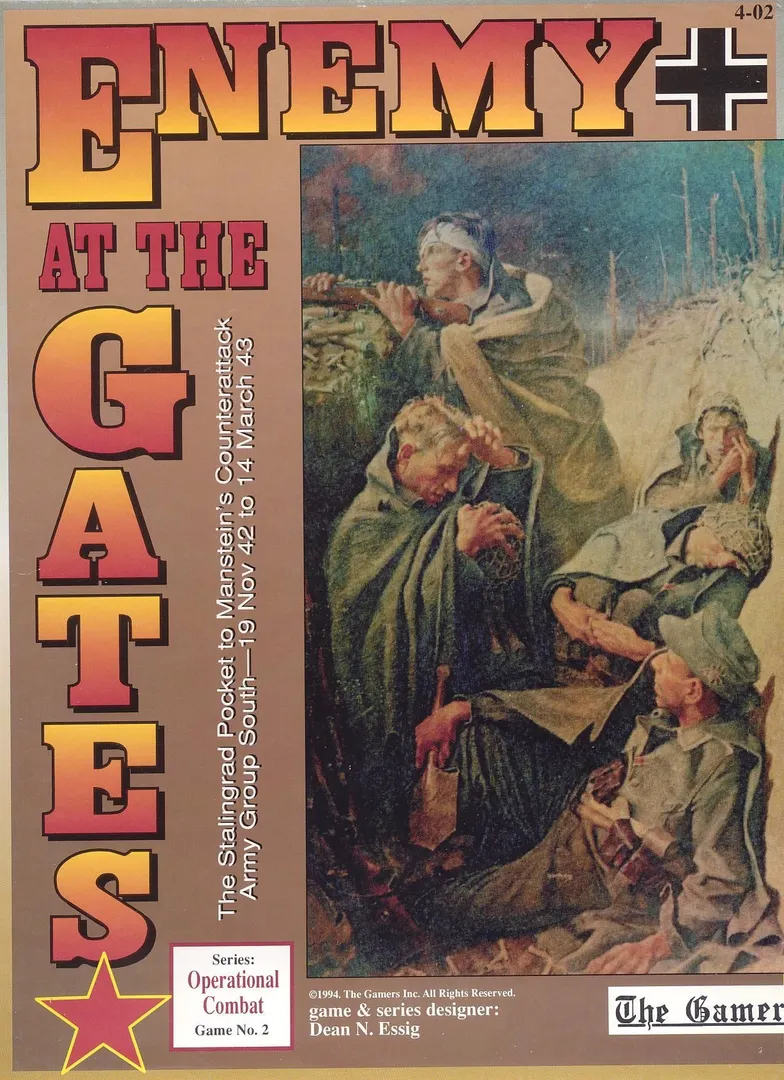
1994
Regelhilfe für Enemy at the Gates
Verständliche Erklärungen zu Spielzügen, Karteneffekten und strittigen Situationen mit Verweisen auf offizielle Quellen und gespeichertem Fragenverlauf.
Für 1 Person
Was möchtest du wissen?
Antworten stammen aus dem offiziellen Regelheft, mit Seitenangabe zum Nachprüfen.
Enemy at the Gates ist ein Brettspiel aus dem Jahr 1994 für 1–4 Personen, mit 240–6000 Minuten pro Partie und ab 12 Jahren. Entwickelt wurde es von Dean Essig; die wichtigsten Mechaniken sind Dice Rolling, Hexagon Grid und Simulation.




Auf Englisch
On a cold, foggy morning in November, 1942, a four-hour artillery barrage rocked the Rumanian lines north and south of Stalingrad. Countless swarms of Red infantry, tanks, and guns then swept the lines. In four days, the pincers met near Kalach-um-Don – entombing the 6th Army in Stalingrad. During the next three months, the Germans will reel from successive Soviet hammer blows, try in vain to relieve the 6th Army, and fail to supply it from the air. The 6th Army surrenders, and only the counter-attack by von Manstein’s panzers stop the red tide. The turning point of World War II in Europe has passed. Enemy at the Gates, the second Operational Combat Series release by The Gamers, offers players different challenges from those in the very popular game Guderian’s Blitzkrieg. The Soviet army has rearmed and reorganized their Tank Corps – their challenge to the Panzer Divisions. The unique force structures of each side force players to fight differently in order to maximize their strengths. And, of course, players must face the toughest operation and strategic choices they have ever faced. When to stand, when to run…and when to strike. Enemy at the Gates covers the entire period from 19 November 1942 to mid-March 1943. There are numerous one and two map scenarios. The game covers Operation Uranus, Operation Little Saturn, the German Relief and airlift efforts, and Operation Star and Gallup (to include von Manstein’s famous “backhand blow”). Extensively researched, playtested, and developed, Enemy at the Gates will satisfy the Eastern Front interest of any gamer who wants to know more than the pulp-history version of these pivotal events! Features: Dynamic and fluid situation All of the pivotal battles in AG South The creation of the Stalingrad pocket The relief effort and airlift Mansteins famous Backhand Blow! Follow-on to the popular Guderian's Blitzkrieg: The Drive on Moscow game and system- refined based on player feedback Player skill is highly rewarded Game Scale: Turn: Half-week Hex: 5 miles / 8 Km Units: Battalion to Army Game Inventory: Four 22 x 34" maps (Maps A, B, C & D) One 8 x 11" Stalingrad 'Blow-Up' map Eight dual-side printed countersheets (5 combat, 3 markers - 2,800 1/2" counters) One 36-page OCS rules booklet One 36-page Enemy at the Gate game specific rules booklet Two 6-page OCS version 2.0 Charts & Tables Folders Four Player Aid cards Two 6-sided dice Complexity: High Solitaire Suitability: High Playing Time: 4-100 hours Players: 1 or more (from the Game Box) All 4 maps were changed and reprinted in 2001. Updated and replaced by Case Blue.
Laut Katalog unterstützt Enemy at the Gates 1–4 Personen. Diese Spanne entspricht der vom Verlag angegebenen Spielerzahl, das Spiel lässt sich also für jede Gruppengröße innerhalb dieser Spanne aufbauen. Aufbau, einzelne Regeln und Wertungsdetails können je nach Personenzahl trotzdem abweichen; prüfe daher die genaue Konfiguration in der Anleitung deiner Ausgabe.
Die angegebene Spieldauer für Enemy at the Gates beträgt 240–6000 Minuten. Das ist die Schätzung des Verlags für eine vollständige Partie. Die tatsächliche Dauer hängt von der Gruppe, der Personenzahl und der Regelkenntnis ab: Erste Partien dauern meist länger, erfahrene Gruppen sind oft schneller fertig. Aufbau und Regelerklärung sind in dieser Schätzung nicht enthalten.
Im Katalog wird Enemy at the Gates ab 12 Jahren empfohlen. Das ist die Empfehlung des Verlags und berücksichtigt Leseanforderungen, Regelkomplexität und Kleinteile, nicht nur das Thema. Jüngere Kinder können oft mit Hilfe eines Erwachsenen mitspielen; beachte die Altersangabe deiner Ausgabe und die Brettspielerfahrung deiner Gruppe.
Enemy at the Gates hat bei BoardGameGeek eine Komplexitätswertung von 4,3 von 5 und gilt damit als schweres Spiel. Die Wertung zeigt, wie viel Regelwissen, Planung und Entscheidungen eine typische Partie verlangt. Schwerere Spiele brauchen bei der ersten Erklärung mehr Zeit, daher hilft vor dem Spieleabend eine Vorbereitungsanleitung.
Enemy at the Gates gehört zu diesen Kategorien: Wargame und World War II. Die wichtigsten Mechaniken sind Dice Rolling, Hexagon Grid und Simulation. Kategorien beschreiben Thema und Setting eines Spiels, Mechaniken dagegen, was die Spielenden in ihrem Zug tatsächlich tun. Jede Mechanik führt zu einer Katalogseite mit ähnlichen Spielen, falls du etwas Vergleichbares suchst.
Als Autoren von Enemy at the Gates sind angegeben: Dean Essig. Diese Angaben stammen aus den veröffentlichten Spieldaten und nennen die für das Spieldesign verantwortlichen Personen, nicht die Illustratoren oder Verlage. Die Autorenseiten auf MeepleRules sammeln weitere Titel derselben Autoren – praktisch, wenn dir ein Spiel gefällt und du ähnliche Spiele suchst.
Im Katalog ist Enemy at the Gates als Grundspiel aufgeführt. Es lässt sich eigenständig mit dem Material aus der Schachtel spielen und benötigt keinen weiteren Titel. Erweiterungen, sofern es welche gibt, ergänzen neues Material oder neue Regeln und sind im Katalog separat mit einem Verweis auf dieses Grundspiel aufgeführt.