- BGG-Rang
- BGG #273
- BGG-Bewertung
- 7,7
Turbo-Flitzpiepen 2000
- 2–6 Spieler
- 30 Min.
- Komplexität 1,2/5
- 2025

Regelhilfe für Four Twenty-one
Verständliche Erklärungen zu Spielzügen, Karteneffekten und strittigen Situationen mit Verweisen auf offizielle Quellen und gespeichertem Fragenverlauf.
Was möchtest du wissen?
Antworten stammen aus dem offiziellen Regelheft, mit Seitenangabe zum Nachprüfen.
Four Twenty-one ist ein Brettspiel für 2–8 Personen und mit 5 Minuten pro Partie. Die wichtigsten Mechaniken sind Dice Rolling.





Auf Englisch
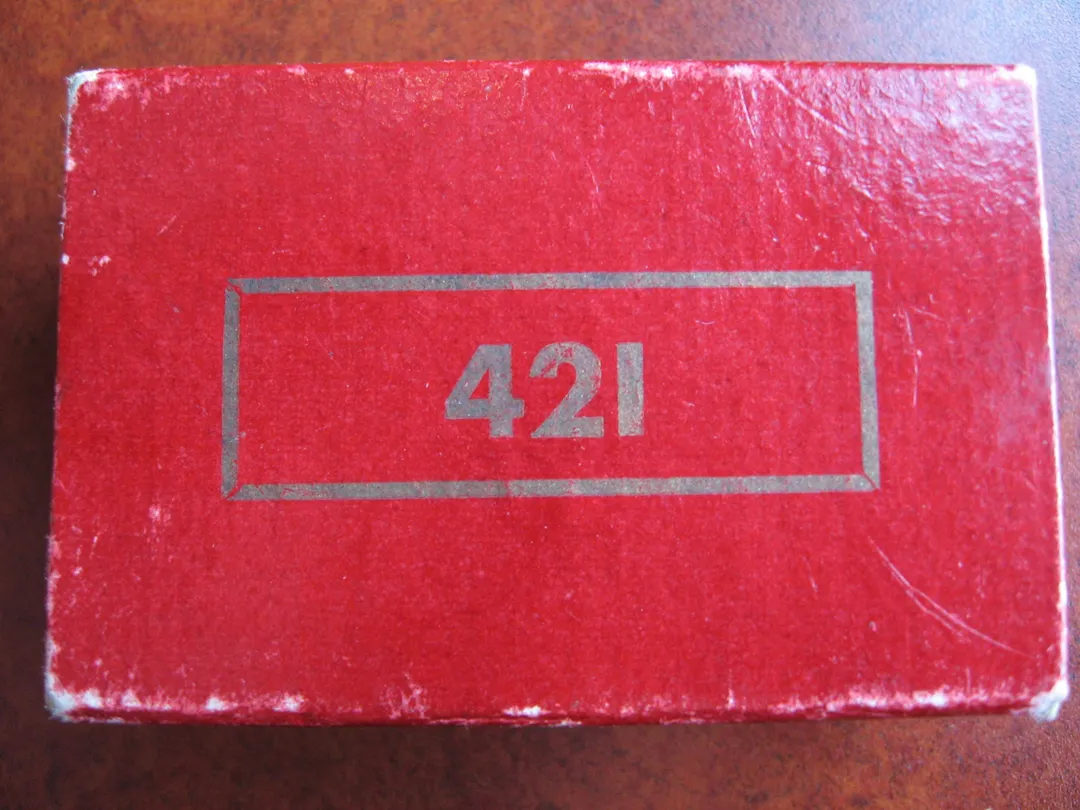
This game is popular in Europe. It is played with three dice and an number of tokens ("fiches", usually 11 or 21) and it is not uncommon to find special porcelain boxes, marked with the dice numbers 4-2-1. Play is in two phases. "Charge" and "Décharge" (discharge). Charge phase : all players roll the dice once and only once, each. The biggest hand takes as many tokens as the value in points of his or her hand. This process is repeated until all tokens have been distributed (with the last hand taking has many tokens as are available). If a player has all tokens at the end of the charge, the game is finished (and he or she pays a round of drinks). Discharge phase : The player with the biggest number of tokens has the first roll and then clockwise. The first player of a round of rolls decide for one or two rerolls. A reroll meaning rerolling one, two or all dice, to try to achieve the best hand. By electing to have rerolls, he or she allows the same number of rerolls to the other players. The one who rolls the biggest hand gives a number of tokens equal to the value of his hand (or all of his tokens if not enough) to the player who rolled the lowest hand. That player becomes first player. The game ends when one player has all tokens. He's the loser of the game and pays the next round. If at some point a player has no tokens, play continues without him/her ("saved"). Hands rank as follows (from biggest to smallest): 1. 421 2. 3 aces (1-1-1) 3. 2 aces-six (1-1-6) 4. 3 six (6-6-6) 5. 2 aces-five (1-1-5) 6. 3 fives (5-5-5) 7. 2 aces-four (1-1-4) 8. 3 fours (4-4-4) 9. 2 aces-three (1-1-3) 10. 3 threes (3-3-3) 11. 2 aces-two (1-1-2) 12. 3 two (2-2-2) 13. 6-5-4 14. 5-4-3 15. 4-3-2 16. 3-2-1 Others hands are by decreasing order of values the dice, from 665 to 221 (which is "nenette"). For info, the last value before 221 is 322. 1-1-x are called "fiches" x-x-x are called "baraques" 6-5-4 and the like are called "tierces" 421 is worth 11 points (sometimes 10 or 8 in variants) 111 is worth 7 points x-x-x is worth x points (except for 111, see above) 1-1-x is also worth x points (except, again, for 111) The difference is that for x, 1-1-x>x-x-x as explained in the order of hands above. Tierces are worth 2 and the rest is worth 1.
Laut Katalog unterstützt Four Twenty-one 2–8 Personen. Diese Spanne entspricht der vom Verlag angegebenen Spielerzahl, das Spiel lässt sich also für jede Gruppengröße innerhalb dieser Spanne aufbauen. Aufbau, einzelne Regeln und Wertungsdetails können je nach Personenzahl trotzdem abweichen; prüfe daher die genaue Konfiguration in der Anleitung deiner Ausgabe.
Die angegebene Spieldauer für Four Twenty-one beträgt 5 Minuten. Das ist die Schätzung des Verlags für eine vollständige Partie. Die tatsächliche Dauer hängt von der Gruppe, der Personenzahl und der Regelkenntnis ab: Erste Partien dauern meist länger, erfahrene Gruppen sind oft schneller fertig. Aufbau und Regelerklärung sind in dieser Schätzung nicht enthalten.
Four Twenty-one hat bei BoardGameGeek eine Komplexitätswertung von 1,0 von 5 und gilt damit als leichtes Spiel. Die Wertung zeigt, wie viel Regelwissen, Planung und Entscheidungen eine typische Partie verlangt. Schwerere Spiele brauchen bei der ersten Erklärung mehr Zeit, daher hilft vor dem Spieleabend eine Vorbereitungsanleitung.
Four Twenty-one gehört zu diesen Kategorien: Party Game und Dice. Die wichtigsten Mechaniken sind Dice Rolling. Kategorien beschreiben Thema und Setting eines Spiels, Mechaniken dagegen, was die Spielenden in ihrem Zug tatsächlich tun. Jede Mechanik führt zu einer Katalogseite mit ähnlichen Spielen, falls du etwas Vergleichbares suchst.
Im Katalog ist Four Twenty-one als Grundspiel aufgeführt. Es lässt sich eigenständig mit dem Material aus der Schachtel spielen und benötigt keinen weiteren Titel. Erweiterungen, sofern es welche gibt, ergänzen neues Material oder neue Regeln und sind im Katalog separat mit einem Verweis auf dieses Grundspiel aufgeführt.


