
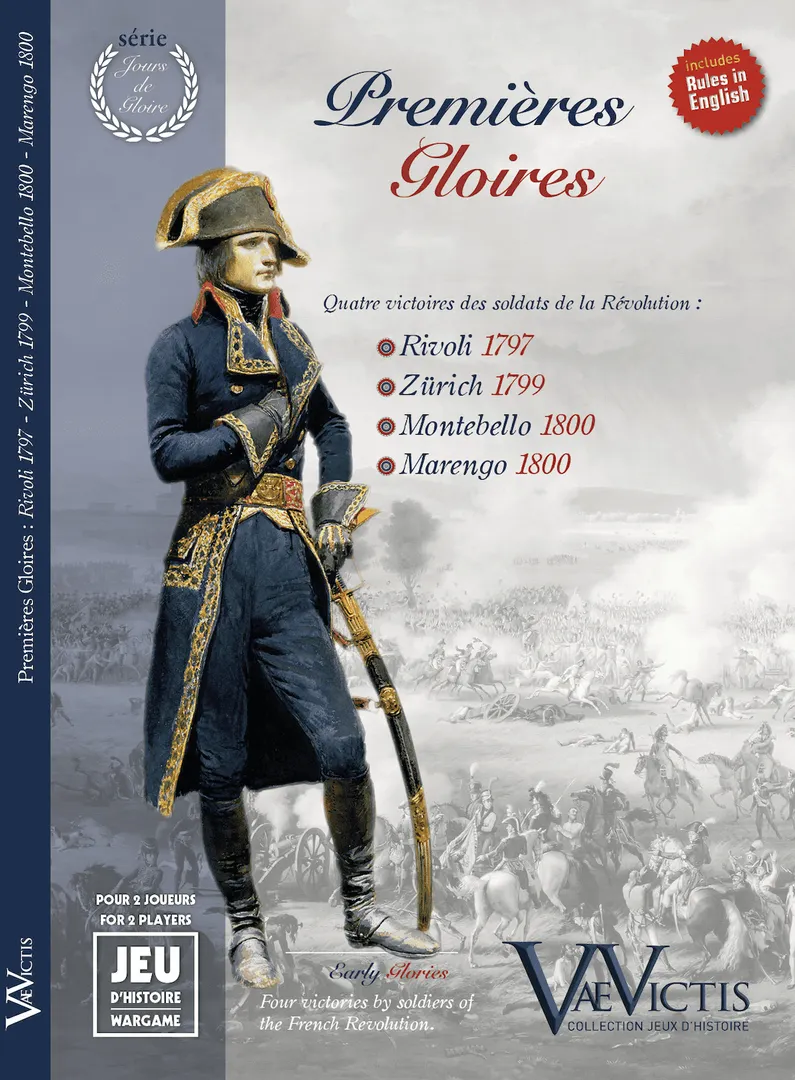
- BGG-Rang
- BGG #10.068
- BGG-Bewertung
- 8,1
Premières Gloires
- 2 Spieler
- Komplexität 3,4/5
- 2017
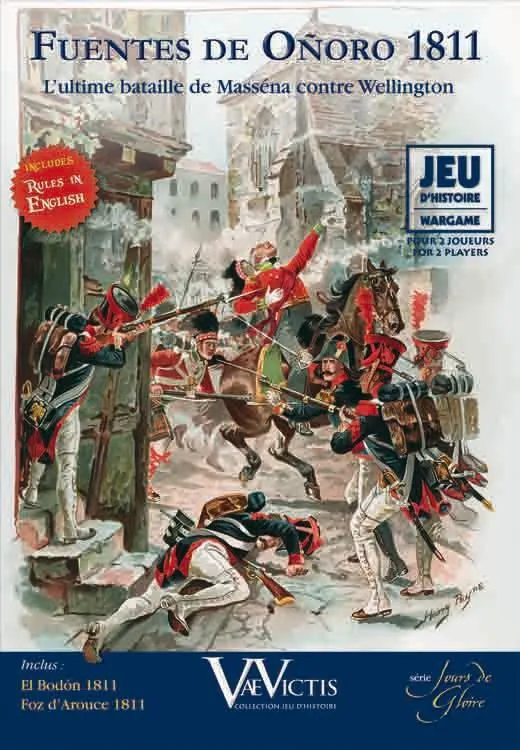
2011
Regelhilfe für Fuentes de Onoro 1811
Verständliche Erklärungen zu Spielzügen, Karteneffekten und strittigen Situationen mit Verweisen auf offizielle Quellen und gespeichertem Fragenverlauf.
Für 2 Personen
Was möchtest du wissen?
Antworten stammen aus dem offiziellen Regelheft, mit Seitenangabe zum Nachprüfen.
Fuentes de Onoro 1811 ist ein Brettspiel aus dem Jahr 2011 für 2 Personen und mit 240 Minuten pro Partie. Entwickelt wurde es von Frédéric Bey; die wichtigsten Mechaniken sind Hexagon Grid und Chit-Pull System.
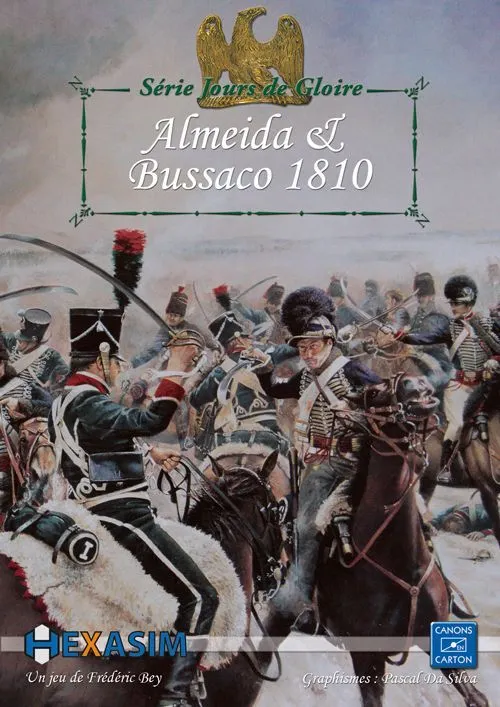
Auf Englisch
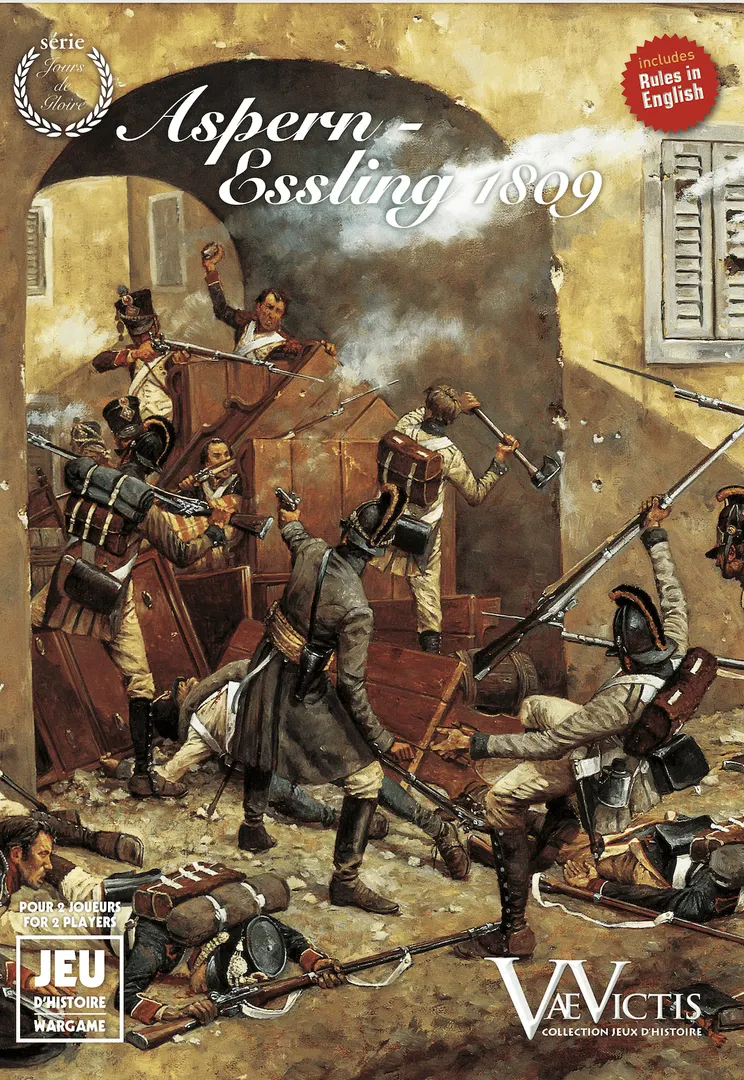
Fuentes de Onoro 1811 focus on the last events of the fight between Masséna and Wellington in Portugal and Spain. It includes three battles: Foz do Arouce, Fuentes de Oñoro and El Bodon 1811 which are thus be the 32nd, 33rd and 34th battles of the series. The game is also the 6th entry in the Vae Victis Wargame Collection. The main battle, Fuentes de Oñoro, has an A2 map and the two smaller ones have A3 maps. The game include 216 counters and markers. Foz do Arouce, 15th March 1811 The fight took place just after Redhina and Casal Novo but before Sabugal and Fuentes de Onoro, as Wellington followed Massena out of the lines of Torres Vedras. It included two popular British divisions, the 3rd and the Light. The French under Ney held a ridge with a river behind it that was crossed by a single bridge. The French ridge on their left was much higher than the one on the right. In the centre there was a gap of about 200 yards, occupied by the village of Foz d'Arouce. Some companies of the 95th rifles penetrated down a hollow road there, almost unopposed, quite close to the bridge. The rest of the Light division held Marchand in a frontal fight on the French right. Half of Mermet’s division on the French left faced the 3rd Division. The 39th lost its eagle in the river as they tried to cross a deep ford below the bridge, and many men were drowned. Fuentes de Oñoro, 3rd to 5th May 1811 On the 3rd of May, Masséna launched a frontal assault against the British-Portuguese pickets holding the barricaded village, while subjecting the British-Portuguese on the heights east of the village to a heavy artillery bombardment. The village was the centre of the fighting for the whole day, with French soldiers of Ferey's and Marchand's divisions clashing with the British redcoats of the 1st and 3rd Divisions. May 4 saw little combat. Both sides recovered from the ferocity of the previous day of fighting and reconsidered their options and battle plans. A French reconnaissance revealed that Wellington's right flank was weakly held by a unit of partisans near the hamlet of Pozo Bello. Action began again at dawn on the 5th of May. Wellington had left the 7th Division exposed on his right flank. Masséna launched a heavy attack on the weak British-Portuguese flank, led by Montbrun's dragoons and supported by the infantry divisions of Marchand, Mermet and Solignac. Right away, two 7th Division battalions were roughed up by French light cavalry. This compelled Wellington to send reinforcements to save the 7th Division from annihilation. This was only achieved by the efforts of the Light Division and the British and King's German Legion cavalry. In response, Wellington counterattacked with units from the 1st and 3rd Divisions, plus the Portuguese 6th Caçadores. Led by the 88th Connaught Rangers Foot, this effort broke Drouet's attack and the tide began to turn. Low on ammunition, the French had to resort to the bayonet in a futile attempt to drive the British back. Drouet launched a second attack on the town. This time it was led by three battalions of converged grenadiers from IX Corps. With their old-fashioned bearskin hats, the grenadiers were mistaken for the Imperial Guard. Again, the British fell back. Drouet threw in about half of the battalions from both Conroux and Claparède's divisions, seizing almost the entire town. The French artillery tried to bombard the new British line into submission, but they were outgunned by Wellington's cannon. Finally, with their artillery ammunition dangerously low, the French attacks came to an end. Wellington's men entrenched during the evening. El Bodon 25th September 1811 The fight included a French cavalry force of 2500, against a mixed force of Picton’s 3rd Division consisting of 1000 men, 500 cavalry and two Portuguese batteries. The French attacked in 3 columns of cavalry with a 4th column in reserve, "since only parts of the hillside were open ground suitable for cavalry." The attack fell upon the isolated part of Wallace’s Brigade covering the road. As the French columns came up the slope they were attacked by Alten’s light cavalry one squadron at a time "with the slope in their favour.” The individual squadrons then rallied behind their supports. The British had to hold on, to allow time for the widely separated parts of 3rd Division to retire. Fuentes de Onoro 1811 includes: A 59 x 40 cm map, 216 double-sided die-cut counters and markers, A color rulebook with scenarios and a player aid. Units : Regiments and brigades Map scale : 500 m/hex. Turn : 120 minutes Complexity : 6 / 9 Bilingual Rules and Charts (English/French).
Laut Katalog unterstützt Fuentes de Onoro 1811 2 Personen. Das ist die vom Verlag angegebene Spielerzahl, das Spiel ist also genau für diese Anzahl von Mitspielenden ausgelegt. Varianten für andere Gruppengrößen sind, sofern vorhanden, in der Anleitung deiner Ausgabe beschrieben; prüfe sie, bevor du eine andere Konfiguration aufbaust.
Die angegebene Spieldauer für Fuentes de Onoro 1811 beträgt 240 Minuten. Das ist die Schätzung des Verlags für eine vollständige Partie. Die tatsächliche Dauer hängt von der Gruppe, der Personenzahl und der Regelkenntnis ab: Erste Partien dauern meist länger, erfahrene Gruppen sind oft schneller fertig. Aufbau und Regelerklärung sind in dieser Schätzung nicht enthalten.
Fuentes de Onoro 1811 hat bei BoardGameGeek eine Komplexitätswertung von 2,7 von 5 und gilt damit als eher leichtes Spiel. Die Wertung zeigt, wie viel Regelwissen, Planung und Entscheidungen eine typische Partie verlangt. Schwerere Spiele brauchen bei der ersten Erklärung mehr Zeit, daher hilft vor dem Spieleabend eine Vorbereitungsanleitung.
Fuentes de Onoro 1811 gehört zu diesen Kategorien: Wargame und Napoleonic. Die wichtigsten Mechaniken sind Hexagon Grid und Chit-Pull System. Kategorien beschreiben Thema und Setting eines Spiels, Mechaniken dagegen, was die Spielenden in ihrem Zug tatsächlich tun. Jede Mechanik führt zu einer Katalogseite mit ähnlichen Spielen, falls du etwas Vergleichbares suchst.
Als Autoren von Fuentes de Onoro 1811 sind angegeben: Frédéric Bey. Diese Angaben stammen aus den veröffentlichten Spieldaten und nennen die für das Spieldesign verantwortlichen Personen, nicht die Illustratoren oder Verlage. Die Autorenseiten auf MeepleRules sammeln weitere Titel derselben Autoren – praktisch, wenn dir ein Spiel gefällt und du ähnliche Spiele suchst.
Im Katalog ist Fuentes de Onoro 1811 als Grundspiel aufgeführt. Es lässt sich eigenständig mit dem Material aus der Schachtel spielen und benötigt keinen weiteren Titel. Erweiterungen, sofern es welche gibt, ergänzen neues Material oder neue Regeln und sind im Katalog separat mit einem Verweis auf dieses Grundspiel aufgeführt.