- BGG-Rang
- BGG #2.859
- BGG-Bewertung
- 7,9
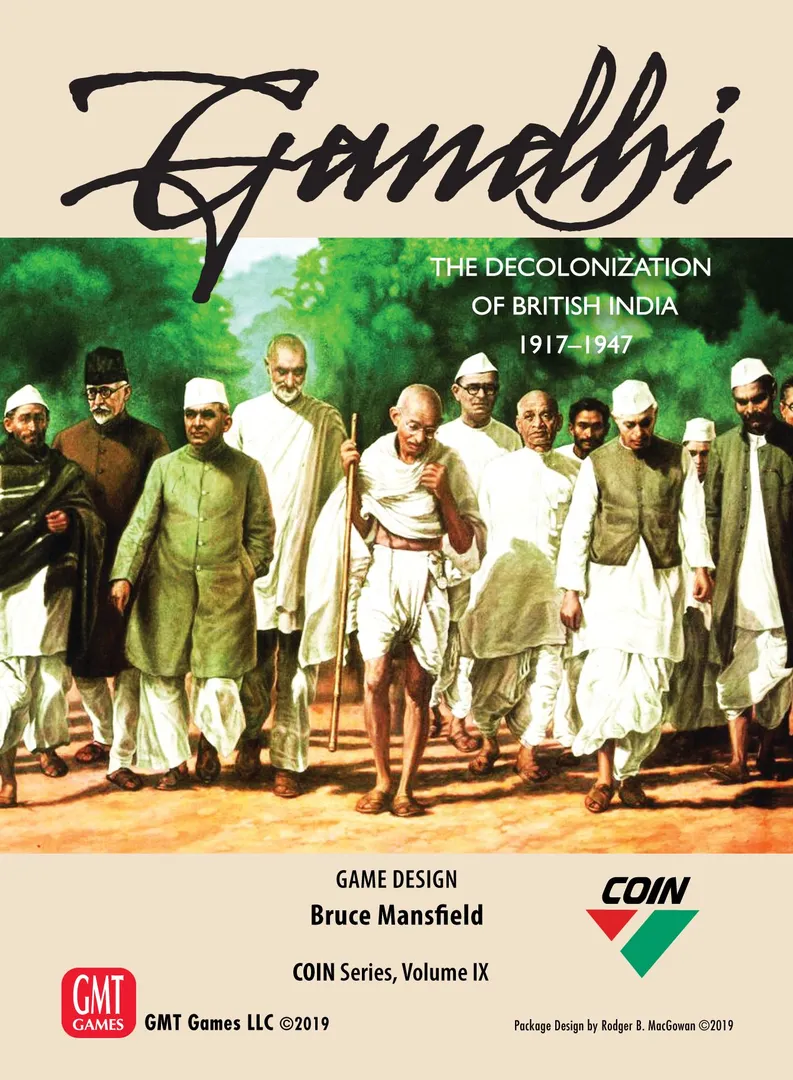
Gandhi: The Decolonization of British India, 1917 – 1947
2019
Regelhilfe für Gandhi: The Decolonization of British India, 1917 – 1947
Verständliche Erklärungen zu Spielzügen, Karteneffekten und strittigen Situationen mit Verweisen auf offizielle Quellen und gespeichertem Fragenverlauf.
- 1–4 Spieler
- 90–240 Min.
- 14+
- Komplexität 4,2/5

Für 1 Person
Regelassistent für Gandhi: The Decolonization of British India, 1917 – 1947
Was möchtest du wissen?
Antworten stammen aus dem offiziellen Regelheft, mit Seitenangabe zum Nachprüfen.
Gandhi: The Decolonization of British India, 1917 – 1947 ist ein Brettspiel aus dem Jahr 2019 für 1–4 Personen, mit 90–240 Minuten pro Partie und ab 14 Jahren. Entwickelt wurde es von Bruce Mansfield; die wichtigsten Mechaniken sind Variable Player Powers, Area Movement und Dice Rolling.
Über das Spiel
Auf Englisch
Gandhi: The Decolonization of British India, 1917–1947 is Volume IX in GMT’s acclaimed COIN Series. Exploring one of the world’s most prominent experiments with nonviolent resistance, Gandhi takes us to the subcontinent of India, the jewel in the crown of the British Empire, for a detailed look at the final decades of the British Raj. 1 to 4 players compete to determine the future of India; will the transition to home rule be a peaceful one, will India be split apart by partition or civil war, or will it remain firmly in the grip of empire? Gandhi offers a fresh perspective on the history of insurgency with the addition of a new type of faction to the COIN Series, the Nonviolent (NV) faction, while retaining the multi-faction, asymmetrical, card-assisted system of earlier titles in the COIN Series. COIN veterans will be able to jump right in. Other features include: Gandhi as the game’s sole leader piece. Nonviolent operations and special activities. Nonviolent activists that are always active, but generally immune from Raj actions until engaged in protests (or caught up in post-terror reprisals). Protests that erode support but leave activists vulnerable to arrest by Raj forces. A Hindu-Muslim Unity track that measures tensions between these two communities, affecting resources, operations, and victory. A British Rule track that reflects shifts in colonial policy in response to events on the map, from resolve to restraint, affecting the cost of several actions. British Viceroys who come and go with each passing campaign and have their own unique effects on each faction. An out-of-play jail space that holds nonviolent forces arrested during martial law. Pieces can be kept in jail over several campaigns, but at a cost to the Raj. Independent Princely States that are never controlled by any faction, yet offer a haven for violent and nonviolent insurgents alike. Short and medium-length scenarios that allow for the study of different periods of the struggle against British rule in India. Support for solitaire, 2-player, 3-player, and 4-player games. In Gandhi, players will face a range of difficult and interesting strategic choices. Following in the innovative footsteps of previous COIN titles, Gandhi weaves together historical, political, and cultural threads and offers an opportunity to study nonviolent and violent resistance in one of the most significant colonial possessions from the age of European imperialism. Civil disobedience and non-cooperation, protests and terror, imperialism and constructive programme, growing unrest, negotiation, agitation, assassination, persuasion, boycotts, martial law, and many other options await. “Gandhi made it impossible for us to go on ruling India, but at the same time he made it possible for us to abdicate without rancor and without dishonour.” — British Historian Arnold Toynbee
Kategorien
Mechanismen
Autoren
Verlage
- GMT Games
Fragen und Antworten
Laut Katalog unterstützt Gandhi: The Decolonization of British India, 1917 – 1947 1–4 Personen. Diese Spanne entspricht der vom Verlag angegebenen Spielerzahl, das Spiel lässt sich also für jede Gruppengröße innerhalb dieser Spanne aufbauen. Aufbau, einzelne Regeln und Wertungsdetails können je nach Personenzahl trotzdem abweichen; prüfe daher die genaue Konfiguration in der Anleitung deiner Ausgabe.
Die angegebene Spieldauer für Gandhi: The Decolonization of British India, 1917 – 1947 beträgt 90–240 Minuten. Das ist die Schätzung des Verlags für eine vollständige Partie. Die tatsächliche Dauer hängt von der Gruppe, der Personenzahl und der Regelkenntnis ab: Erste Partien dauern meist länger, erfahrene Gruppen sind oft schneller fertig. Aufbau und Regelerklärung sind in dieser Schätzung nicht enthalten.
Im Katalog wird Gandhi: The Decolonization of British India, 1917 – 1947 ab 14 Jahren empfohlen. Das ist die Empfehlung des Verlags und berücksichtigt Leseanforderungen, Regelkomplexität und Kleinteile, nicht nur das Thema. Jüngere Kinder können oft mit Hilfe eines Erwachsenen mitspielen; beachte die Altersangabe deiner Ausgabe und die Brettspielerfahrung deiner Gruppe.
Gandhi: The Decolonization of British India, 1917 – 1947 hat bei BoardGameGeek eine Komplexitätswertung von 4,2 von 5 und gilt damit als schweres Spiel. Die Wertung zeigt, wie viel Regelwissen, Planung und Entscheidungen eine typische Partie verlangt. Schwerere Spiele brauchen bei der ersten Erklärung mehr Zeit, daher hilft vor dem Spieleabend eine Vorbereitungsanleitung.
Gandhi: The Decolonization of British India, 1917 – 1947 gehört zu diesen Kategorien: Wargame und Modern Warfare. Die wichtigsten Mechaniken sind Variable Player Powers, Area Movement und Dice Rolling. Kategorien beschreiben Thema und Setting eines Spiels, Mechaniken dagegen, was die Spielenden in ihrem Zug tatsächlich tun. Jede Mechanik führt zu einer Katalogseite mit ähnlichen Spielen, falls du etwas Vergleichbares suchst.
Als Autoren von Gandhi: The Decolonization of British India, 1917 – 1947 sind angegeben: Bruce Mansfield. Diese Angaben stammen aus den veröffentlichten Spieldaten und nennen die für das Spieldesign verantwortlichen Personen, nicht die Illustratoren oder Verlage. Die Autorenseiten auf MeepleRules sammeln weitere Titel derselben Autoren – praktisch, wenn dir ein Spiel gefällt und du ähnliche Spiele suchst.
Im Katalog ist Gandhi: The Decolonization of British India, 1917 – 1947 als Grundspiel aufgeführt. Es lässt sich eigenständig mit dem Material aus der Schachtel spielen und benötigt keinen weiteren Titel. Erweiterungen, sofern es welche gibt, ergänzen neues Material oder neue Regeln und sind im Katalog separat mit einem Verweis auf dieses Grundspiel aufgeführt.