

- BGG-Rang
- BGG #4.479
- BGG-Bewertung
- 7,2
Battle for Germany
- 2–4 Spieler
- 180 Min.
- Komplexität 2,1/5
- 1975
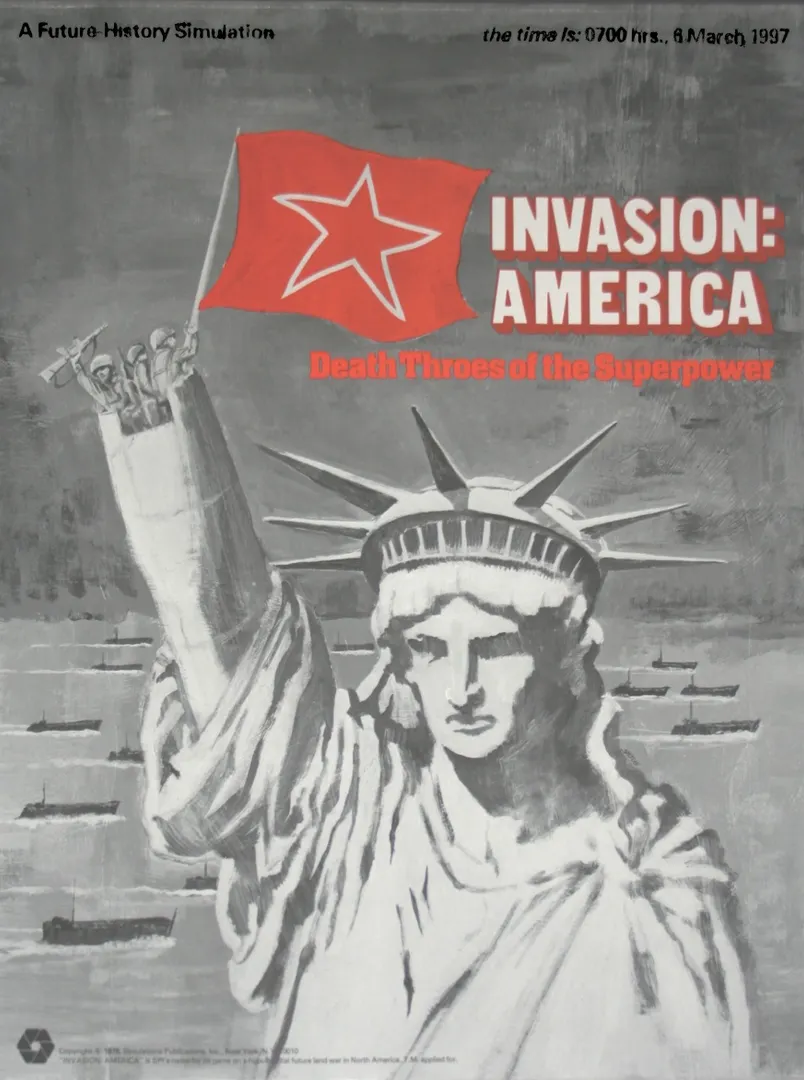
1976
Regelhilfe für Invasion: America – Death Throes of the Superpower
Verständliche Erklärungen zu Spielzügen, Karteneffekten und strittigen Situationen mit Verweisen auf offizielle Quellen und gespeichertem Fragenverlauf.
Für 2 Personen
Was möchtest du wissen?
Antworten stammen aus dem offiziellen Regelheft, mit Seitenangabe zum Nachprüfen.
Invasion: America – Death Throes of the Superpower ist ein Brettspiel aus dem Jahr 1976 für 2–5 Personen, mit 240 Minuten pro Partie und ab 12 Jahren. Entwickelt wurde es von Jim Dunnigan; die wichtigsten Mechaniken sind Hexagon Grid und Zone of Control.




Auf Englisch
Invasion: America is a "mini-monster" wargame designed by Jim Dunnigan and published by SPI in 1976. It depicts a hypothetical corps-level invasion of North America by a coalition of three invaders: The European Socialist Coalition (ESC) staging their invasion from Cuba, the South American Union (SAU) invading from Columbia, and the Pan Asiatic League (PAL) invading along the Pacific coast. Defending North America is a coalition of the United States and Canada, with Central America and Mexico having been annexed earlier in the alternate history timeline. It can be played by 2, 3, or 4 players. The game is played on a 35 inch by 42 inch map of North America in which each 'hex' is approximately 130 kilometers (81 mi) from side to side. Distinctive color and symbology is used to represent which of the nine different terrain types dominates the hex. There is additional symbology for ports, supply sources, resource centers and amphibious landing zones. There are also map features along the hexsides including rivers, borders, and and other boundaries. Both movement and combat are affected by terrain. There are 400 (7 are blank) 1/2-inch cardboard pieces (unit counters) representing the land, air, and naval military and logistics units of each combatant. The unit counters have numerical combat and movement ratings. Land and Air units are double-sided with their actual combat values on one side, and a question mark on the other side to indicate the unit's "untried" status, making it the first game to have this feature. Units are initially deployed as untried, and only when they are committed to combat is their true strength revealed. On each turn players may move all, some or none of their units through a number of hexes equal to or less than its movement rating allows. After movement is completed units that are adjacent to enemy units may engage in combat. Combat strengths are totaled for all participating units on each side and the relative strengths are expressed as a simplified odds ratio. A 6-sided die is rolled and the appropriate odds column is consulted to determine the combat result. Combat may result in retreats and/or losses to attacker, defender or both. Invasion: America includes six different scenarios lasting 8 turns and a campaign game of 60 turns. Each turn of the game represents one month. Scenario instructions define each side's order of battle and initial deployment, their unit replacement rates and victory conditions. Victory is determined by control of urban, supply and resource hexes that yield victory points. Invasion: America was a popular game for SPI and led to a larger, more complicated sequel in 1978, Objective Moscow, in which it was the Soviet Union that was being invaded.
Laut Katalog unterstützt Invasion: America – Death Throes of the Superpower 2–5 Personen. Diese Spanne entspricht der vom Verlag angegebenen Spielerzahl, das Spiel lässt sich also für jede Gruppengröße innerhalb dieser Spanne aufbauen. Aufbau, einzelne Regeln und Wertungsdetails können je nach Personenzahl trotzdem abweichen; prüfe daher die genaue Konfiguration in der Anleitung deiner Ausgabe.
Die angegebene Spieldauer für Invasion: America – Death Throes of the Superpower beträgt 240 Minuten. Das ist die Schätzung des Verlags für eine vollständige Partie. Die tatsächliche Dauer hängt von der Gruppe, der Personenzahl und der Regelkenntnis ab: Erste Partien dauern meist länger, erfahrene Gruppen sind oft schneller fertig. Aufbau und Regelerklärung sind in dieser Schätzung nicht enthalten.
Im Katalog wird Invasion: America – Death Throes of the Superpower ab 12 Jahren empfohlen. Das ist die Empfehlung des Verlags und berücksichtigt Leseanforderungen, Regelkomplexität und Kleinteile, nicht nur das Thema. Jüngere Kinder können oft mit Hilfe eines Erwachsenen mitspielen; beachte die Altersangabe deiner Ausgabe und die Brettspielerfahrung deiner Gruppe.
Invasion: America – Death Throes of the Superpower hat bei BoardGameGeek eine Komplexitätswertung von 3,2 von 5 und gilt damit als mittelschweres Spiel. Die Wertung zeigt, wie viel Regelwissen, Planung und Entscheidungen eine typische Partie verlangt. Schwerere Spiele brauchen bei der ersten Erklärung mehr Zeit, daher hilft vor dem Spieleabend eine Vorbereitungsanleitung.
Invasion: America – Death Throes of the Superpower gehört zu diesen Kategorien: Wargame und Modern Warfare. Die wichtigsten Mechaniken sind Hexagon Grid und Zone of Control. Kategorien beschreiben Thema und Setting eines Spiels, Mechaniken dagegen, was die Spielenden in ihrem Zug tatsächlich tun. Jede Mechanik führt zu einer Katalogseite mit ähnlichen Spielen, falls du etwas Vergleichbares suchst.
Als Autoren von Invasion: America – Death Throes of the Superpower sind angegeben: Jim Dunnigan. Diese Angaben stammen aus den veröffentlichten Spieldaten und nennen die für das Spieldesign verantwortlichen Personen, nicht die Illustratoren oder Verlage. Die Autorenseiten auf MeepleRules sammeln weitere Titel derselben Autoren – praktisch, wenn dir ein Spiel gefällt und du ähnliche Spiele suchst.
Im Katalog ist Invasion: America – Death Throes of the Superpower als Grundspiel aufgeführt. Es lässt sich eigenständig mit dem Material aus der Schachtel spielen und benötigt keinen weiteren Titel. Erweiterungen, sofern es welche gibt, ergänzen neues Material oder neue Regeln und sind im Katalog separat mit einem Verweis auf dieses Grundspiel aufgeführt.