
- BGG-Rang
- BGG #823
- BGG-Bewertung
- 7,0
Mr. Jack
- 2 Spieler
- 30 Min.
- Komplexität 2,2/5
- 2006
2013
Regelhilfe für Le Fantôme de l'Opéra
Verständliche Erklärungen zu Spielzügen, Karteneffekten und strittigen Situationen mit Verweisen auf offizielle Quellen und gespeichertem Fragenverlauf.
Für 2 Personen
Was möchtest du wissen?
Antworten stammen aus dem offiziellen Regelheft, mit Seitenangabe zum Nachprüfen.
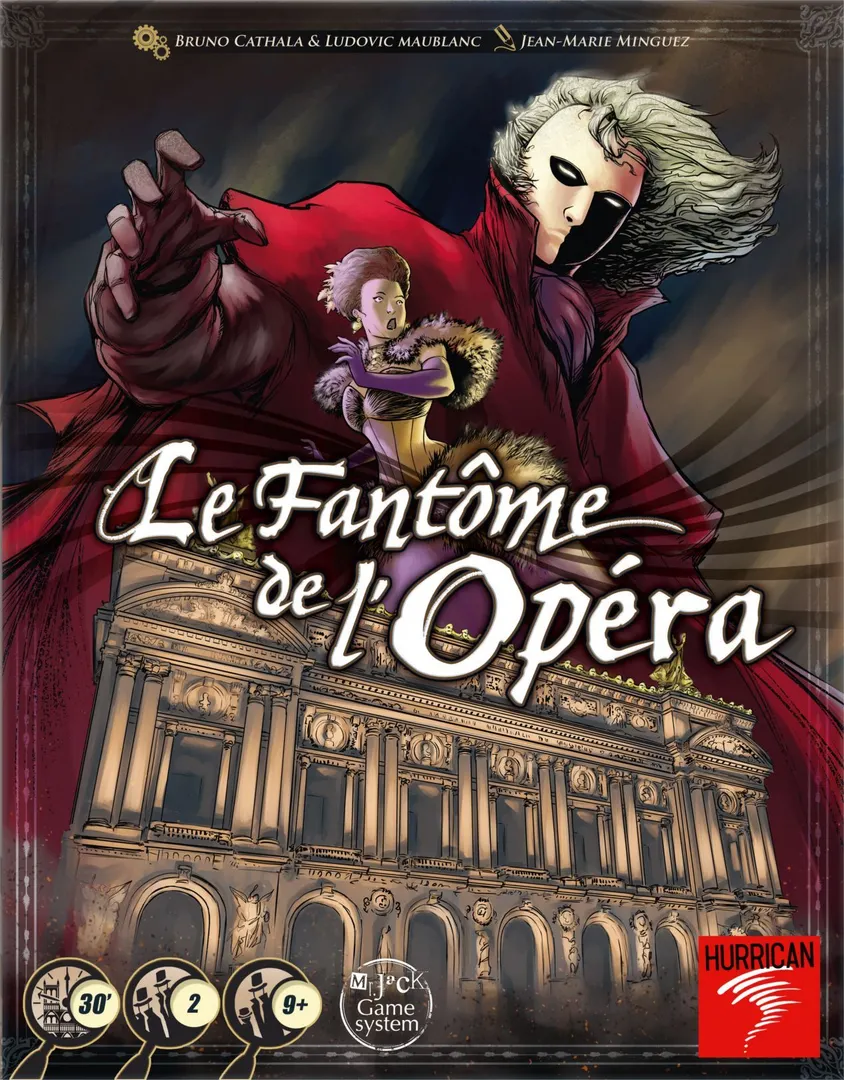
Le Fantôme de l'Opéra ist ein Brettspiel aus dem Jahr 2013 für 2 Personen, mit 30 Minuten pro Partie und ab 9 Jahren. Entwickelt wurde es von Bruno Cathala und Ludovic Maublanc; die wichtigsten Mechaniken sind Variable Player Powers und Grid Movement.






Auf Englisch
Le Fantôme de l’Opéra is a two-player game based on the Mr. Jack game system – that is, the game is an asymmetric affair in which one player wants to reveal which suspect token on the game board represents the opponent, with both players taking turns moving all of the suspects to alternately reveal and hide information. That said, the game differs in a number of ways from Mr. Jack. In more detail... In Le Fantôme de l’Opéra, eight suspect tokens stand in the ten rooms of the Opéra Garnier. Each suspect has a reason to drive the opera singer La Carlotta away from the production, and at the start of the game one of the suspects is randomly determined to be the true identity of the Phantom player. The other player is the Investigator, and he wants to discover the Phantom's identity; if he does so before La Carlotta flees the Opéra Garnier, then he wins. Otherwise, he loses. (To balance play between newcomers and experienced players La Carlotta's starting position can changed.) At the start of each odd round, eight suspect cards are shuffled and four of them revealed. The Investigator moves one suspect and (likely) uses this suspect's unique ability, then the Phantom moves two of the remaining three suspects, then the Investigator moves the final suspect. The Phantom player then reveals whether he can or cannot cause a disturbance in the Opéra Garnier, thus scaring La Carlotta; he can cause a disturbance only if he's alone or if he's in the room with the blackout token. If he can cause a disturbance, the Investigator clears all suspects sharing a lit room; if not, the Investigator clears all suspects in the dark or on their own. After this, La Carlotta moves one step closer to fleeing for each suspect that hasn't been declared innocent (and an additional step if the Phantom did create a disturbance). For each even round, the remaining four suspect cards are revealed, and the players again move characters and use their special abilities, with the Phantom going first. The game continues until only a single suspect is not innocent or La Carlotta flees France for the safety of Milan. When a character moves, it can move up to as many spaces as the number of characters in the room from which it moves. Most characters can move only through open corridors, but Meg Giry can use secret passageways that connect many of the rooms. The players must use Meg's ability and the other characters' special abilities to hide or reveal information. One character, for example, moves a padlock that blocks one corridor, while another is responsible for the roaming blackout that allows the Phantom to operate in darkness (or at least provide cover for his activity elsewhere). One sweet character can draw everyone from adjacent rooms to her side, while an unpleasant fellow can drive everyone away. Still another reveals (or hides) an alibi card, clearing one suspect (or keeping his true nature unknown). Every character is useful in the right situation. You just have to learn what those situations are...
Laut Katalog unterstützt Le Fantôme de l'Opéra 2 Personen. Das ist die vom Verlag angegebene Spielerzahl, das Spiel ist also genau für diese Anzahl von Mitspielenden ausgelegt. Varianten für andere Gruppengrößen sind, sofern vorhanden, in der Anleitung deiner Ausgabe beschrieben; prüfe sie, bevor du eine andere Konfiguration aufbaust.
Die angegebene Spieldauer für Le Fantôme de l'Opéra beträgt 30 Minuten. Das ist die Schätzung des Verlags für eine vollständige Partie. Die tatsächliche Dauer hängt von der Gruppe, der Personenzahl und der Regelkenntnis ab: Erste Partien dauern meist länger, erfahrene Gruppen sind oft schneller fertig. Aufbau und Regelerklärung sind in dieser Schätzung nicht enthalten.
Im Katalog wird Le Fantôme de l'Opéra ab 9 Jahren empfohlen. Das ist die Empfehlung des Verlags und berücksichtigt Leseanforderungen, Regelkomplexität und Kleinteile, nicht nur das Thema. Jüngere Kinder können oft mit Hilfe eines Erwachsenen mitspielen; beachte die Altersangabe deiner Ausgabe und die Brettspielerfahrung deiner Gruppe.
Le Fantôme de l'Opéra hat bei BoardGameGeek eine Komplexitätswertung von 2,2 von 5 und gilt damit als eher leichtes Spiel. Die Wertung zeigt, wie viel Regelwissen, Planung und Entscheidungen eine typische Partie verlangt. Schwerere Spiele brauchen bei der ersten Erklärung mehr Zeit, daher hilft vor dem Spieleabend eine Vorbereitungsanleitung.
Le Fantôme de l'Opéra gehört zu diesen Kategorien: Deduction, Music und Novel-based. Die wichtigsten Mechaniken sind Variable Player Powers und Grid Movement. Kategorien beschreiben Thema und Setting eines Spiels, Mechaniken dagegen, was die Spielenden in ihrem Zug tatsächlich tun. Jede Mechanik führt zu einer Katalogseite mit ähnlichen Spielen, falls du etwas Vergleichbares suchst.
Als Autoren von Le Fantôme de l'Opéra sind angegeben: Bruno Cathala und Ludovic Maublanc. Diese Angaben stammen aus den veröffentlichten Spieldaten und nennen die für das Spieldesign verantwortlichen Personen, nicht die Illustratoren oder Verlage. Die Autorenseiten auf MeepleRules sammeln weitere Titel derselben Autoren – praktisch, wenn dir ein Spiel gefällt und du ähnliche Spiele suchst.
Im Katalog ist Le Fantôme de l'Opéra als Grundspiel aufgeführt. Es lässt sich eigenständig mit dem Material aus der Schachtel spielen und benötigt keinen weiteren Titel. Erweiterungen, sofern es welche gibt, ergänzen neues Material oder neue Regeln und sind im Katalog separat mit einem Verweis auf dieses Grundspiel aufgeführt.