
- BGG-Rang
- BGG #9.591
- BGG-Bewertung
- 7,4
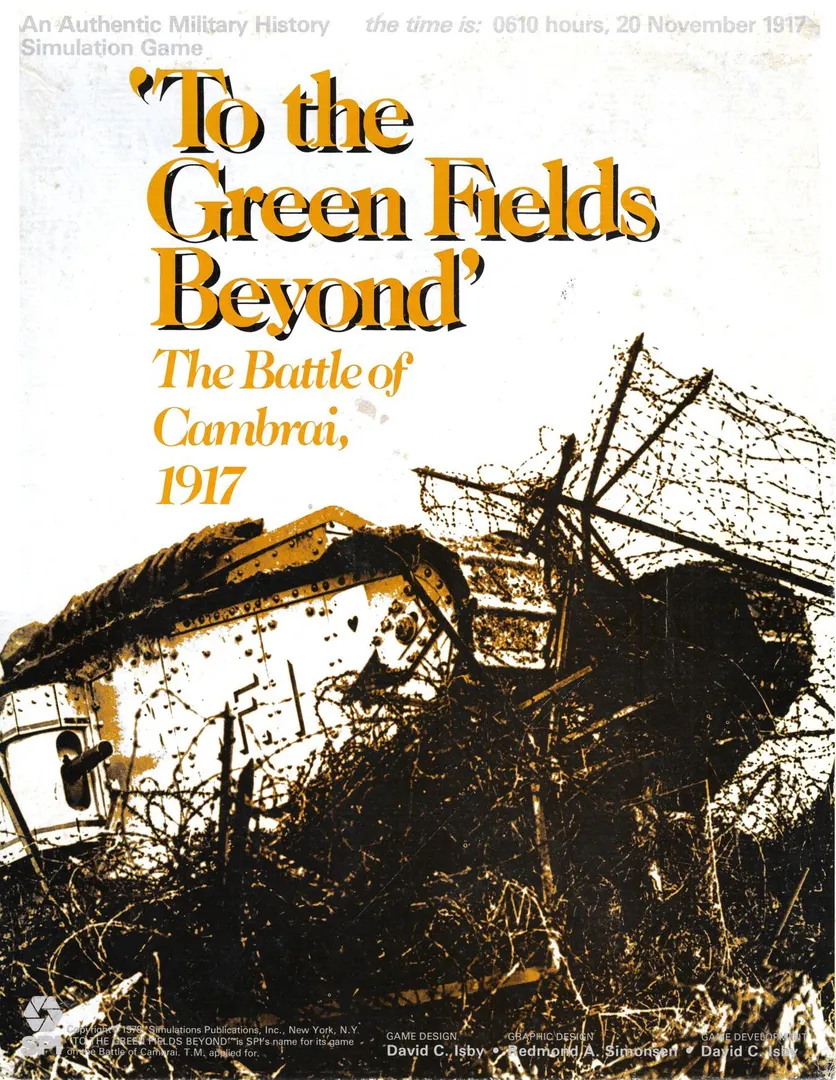
To the Green Fields Beyond: The Battle of Cambrai, 1917
- 2 Spieler
- 240–1020 Min.
- Komplexität 3,6/5
- 1978

1974
Regelhilfe für Lee vs. Meade: The Battle of Gettysburg
Verständliche Erklärungen zu Spielzügen, Karteneffekten und strittigen Situationen mit Verweisen auf offizielle Quellen und gespeichertem Fragenverlauf.
Für 2 Personen
Was möchtest du wissen?
Antworten stammen aus dem offiziellen Regelheft, mit Seitenangabe zum Nachprüfen.
Lee vs. Meade: The Battle of Gettysburg ist ein Brettspiel aus dem Jahr 1974 für 2 Personen, mit 360 Minuten pro Partie und ab 12 Jahren. Entwickelt wurde es von Phil Orbanes Sr. und David C. Isby; die wichtigsten Mechaniken sind Square Grid und Simulation.




Auf Englisch
The Battle of Gettysburg was fought in July 1, 1863 until July 3rd of the same year. It took place in and around the town of Gettysburg, Pennsylvania. It was the battle with the largest number of casualties in the American Civil War and is often described as the war's turning point. Union Major General George Gordon Meade's Army of the Potomac defeated attacks by Confederate General Robert E. Lee's Army of Northern Virginia. This battle put an end to Lee's plans for an invasion of the North. Lee vs Meade is a game that covers the Battle of Gettysburg. It was the first game in a series of games put out by Rand known as the 'Command Series Volume I'. The later version put out by Gamut of Games featured a mounted map-board while the original Rand Games version had a map on heavy paper. Lee vs. Meade has a 17"X17" map 72 counters(36 for each player) combat charts and turn records charts along with a rulebook. The scale used is 1/2 mile per square and each unit is considered to be an entire division. The two-color map is mainly green but there are also some hills and ridges. There is a clearly shown road network of the area as well as terrain that are suitable for defensive outposts. The map of the Gettysburg area is broken up into a 12x12 square grid. This grid system was used in several of the games developed by Rand Game Associates and was called the Time/Space Grid. Movement costs necessary to go from one square to the next are visible on the grid at the edges and corners between the squares making it easier to move without the use of a movement chart. Unlike some games that use a square grid, diagonal movement is permitted. Another feature common to most of the games offered by Rand Games was fairly elaborate combat sub-routine in which the attacker and defender would each pick a combat method from a 6x6 matrix called the Tactical Analysis Chart and draw the appropriate "Tac Card." These "Tac Cards" are numbered from 1 to 6. The cell on the Tactical Analysis Chart that corresponds to the intersection of the two players' combat methods determines which combat results table is used. There are 6 different types of CRT used in this game. The turn sequence is easy. Firstly the Confederate army moves.Any combat resulting is resolved and then the Union army moves and any combat is resolved. In order to initiate a combat you have to move your units onto a square edge that contains enemy units. There are four different scenarios in the game. A different time of the battle is used in each one and different victory conditions are required for each one.
Laut Katalog unterstützt Lee vs. Meade: The Battle of Gettysburg 2 Personen. Das ist die vom Verlag angegebene Spielerzahl, das Spiel ist also genau für diese Anzahl von Mitspielenden ausgelegt. Varianten für andere Gruppengrößen sind, sofern vorhanden, in der Anleitung deiner Ausgabe beschrieben; prüfe sie, bevor du eine andere Konfiguration aufbaust.
Die angegebene Spieldauer für Lee vs. Meade: The Battle of Gettysburg beträgt 360 Minuten. Das ist die Schätzung des Verlags für eine vollständige Partie. Die tatsächliche Dauer hängt von der Gruppe, der Personenzahl und der Regelkenntnis ab: Erste Partien dauern meist länger, erfahrene Gruppen sind oft schneller fertig. Aufbau und Regelerklärung sind in dieser Schätzung nicht enthalten.
Im Katalog wird Lee vs. Meade: The Battle of Gettysburg ab 12 Jahren empfohlen. Das ist die Empfehlung des Verlags und berücksichtigt Leseanforderungen, Regelkomplexität und Kleinteile, nicht nur das Thema. Jüngere Kinder können oft mit Hilfe eines Erwachsenen mitspielen; beachte die Altersangabe deiner Ausgabe und die Brettspielerfahrung deiner Gruppe.
Lee vs. Meade: The Battle of Gettysburg hat bei BoardGameGeek eine Komplexitätswertung von 2,0 von 5 und gilt damit als eher leichtes Spiel. Die Wertung zeigt, wie viel Regelwissen, Planung und Entscheidungen eine typische Partie verlangt. Schwerere Spiele brauchen bei der ersten Erklärung mehr Zeit, daher hilft vor dem Spieleabend eine Vorbereitungsanleitung.
Lee vs. Meade: The Battle of Gettysburg gehört zu diesen Kategorien: Wargame und American Civil War. Die wichtigsten Mechaniken sind Square Grid und Simulation. Kategorien beschreiben Thema und Setting eines Spiels, Mechaniken dagegen, was die Spielenden in ihrem Zug tatsächlich tun. Jede Mechanik führt zu einer Katalogseite mit ähnlichen Spielen, falls du etwas Vergleichbares suchst.
Als Autoren von Lee vs. Meade: The Battle of Gettysburg sind angegeben: Phil Orbanes Sr. und David C. Isby. Diese Angaben stammen aus den veröffentlichten Spieldaten und nennen die für das Spieldesign verantwortlichen Personen, nicht die Illustratoren oder Verlage. Die Autorenseiten auf MeepleRules sammeln weitere Titel derselben Autoren – praktisch, wenn dir ein Spiel gefällt und du ähnliche Spiele suchst.
Im Katalog ist Lee vs. Meade: The Battle of Gettysburg als Grundspiel aufgeführt. Es lässt sich eigenständig mit dem Material aus der Schachtel spielen und benötigt keinen weiteren Titel. Erweiterungen, sofern es welche gibt, ergänzen neues Material oder neue Regeln und sind im Katalog separat mit einem Verweis auf dieses Grundspiel aufgeführt.