- BGG-Rang
- BGG #22.303
- BGG-Bewertung
- 6,4
Binomial
- 1–7 Spieler
- 15–25 Min.
- Komplexität 1,0/5
- 2020
1887
Regelhilfe für Lotería
Verständliche Erklärungen zu Spielzügen, Karteneffekten und strittigen Situationen mit Verweisen auf offizielle Quellen und gespeichertem Fragenverlauf.
Was möchtest du wissen?
Antworten stammen aus dem offiziellen Regelheft, mit Seitenangabe zum Nachprüfen.
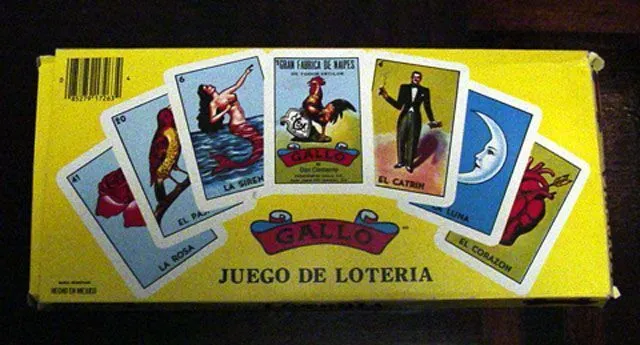
Lotería ist ein Brettspiel aus dem Jahr 1887 für 2–10 Personen, mit 10 Minuten pro Partie und ab 4 Jahren. Die wichtigsten Mechaniken sind Modular Board, Betting and Bluffing und Bingo.






Auf Englisch
Loteria is a traditional Mexican game combining cards and Bingo, and it has been played as a game of chance, as a pastime and for educational purposes. Cards are drawn and the illustrations matched to Bingo-like grid cards, each showing 16 of the 54 possible cards. Like Bingo, one may win by matching all of the fields on the grid-card, or by matching a horizontal, vertical or diagonal line. The cards themselves are colourfully and engagingly illustrated, and the Spanish captions will be helpful to anyone studying that language. Because the Lotería cards include the name of the item beneath its illustration, they are used to teach reading, writing, history and social values. Many bilingual teachers use the game as a teaching tool in the United States. The most recognized version of Lotería is the "Don Clemente Gallo" version, introduced in Mexico in 1887 by French businessman Don Clemente Jacques. The owners of Don Clemente Gallo Pasatiempos have continued this version through three generations. Throughout the past hundred years, the original artwork found on its 54 cards has remained the same, though the company issued a special edition in 2002 featuring the paintings of artist Teresa Villegas. [For the game Lotto, go to its separate entry.] The traditional Mexican game Loteria is slightly different from Lotto, and the origin of modern Lotto, and eventually Bingo... A popular attraction at Mexican fairs and events, as many as ten participants play at a time. The artwork is typically beautiful and tied closely to the cultural mythology and traditions of Mexican culture. This is the biggest departure which modern Lotto and Bingo have made from the traditional "Loteria". It can be played with as few as three persons: one who "sings" the lottery verses and the remainder who place a chip or a dried bean on its "tabla" every time that one of the figures pictured on the cards is mentioned. Example: The number 7 card entitled, El Luchador (the wrestler), and name is announced, and the song which is sung when it is drawn is, "Blue Demon es mi favorito!" (The wrestler, Blue Demon is my favorite one!) The cards are formatted differently, as they utilize four columns of four numbered figures, chosen randomly from a lot of 54 possible different items--each with its own name and song. Common variations of play, due to the 4X4 grid are: Tabla Completa = filling the complete grid. Linea Horizontal, Vertical, o Diagonal = the same as in English. Forma de Letra = where participants form the capital letter "A", "Z", "C", "L" or "O" on the board. As in lottery or bingo, the participant who completes the agreed upon "tabla" requirement wins, and must shout "LOTERIA!"
Laut Katalog unterstützt Lotería 2–10 Personen. Diese Spanne entspricht der vom Verlag angegebenen Spielerzahl, das Spiel lässt sich also für jede Gruppengröße innerhalb dieser Spanne aufbauen. Aufbau, einzelne Regeln und Wertungsdetails können je nach Personenzahl trotzdem abweichen; prüfe daher die genaue Konfiguration in der Anleitung deiner Ausgabe.
Die angegebene Spieldauer für Lotería beträgt 10 Minuten. Das ist die Schätzung des Verlags für eine vollständige Partie. Die tatsächliche Dauer hängt von der Gruppe, der Personenzahl und der Regelkenntnis ab: Erste Partien dauern meist länger, erfahrene Gruppen sind oft schneller fertig. Aufbau und Regelerklärung sind in dieser Schätzung nicht enthalten.
Im Katalog wird Lotería ab 4 Jahren empfohlen. Das ist die Empfehlung des Verlags und berücksichtigt Leseanforderungen, Regelkomplexität und Kleinteile, nicht nur das Thema. Jüngere Kinder können oft mit Hilfe eines Erwachsenen mitspielen; beachte die Altersangabe deiner Ausgabe und die Brettspielerfahrung deiner Gruppe.
Lotería hat bei BoardGameGeek eine Komplexitätswertung von 1,1 von 5 und gilt damit als leichtes Spiel. Die Wertung zeigt, wie viel Regelwissen, Planung und Entscheidungen eine typische Partie verlangt. Schwerere Spiele brauchen bei der ersten Erklärung mehr Zeit, daher hilft vor dem Spieleabend eine Vorbereitungsanleitung.
Lotería gehört zu diesen Kategorien: Card Game. Die wichtigsten Mechaniken sind Modular Board, Betting and Bluffing und Bingo. Kategorien beschreiben Thema und Setting eines Spiels, Mechaniken dagegen, was die Spielenden in ihrem Zug tatsächlich tun. Jede Mechanik führt zu einer Katalogseite mit ähnlichen Spielen, falls du etwas Vergleichbares suchst.
Im Katalog ist Lotería als Grundspiel aufgeführt. Es lässt sich eigenständig mit dem Material aus der Schachtel spielen und benötigt keinen weiteren Titel. Erweiterungen, sofern es welche gibt, ergänzen neues Material oder neue Regeln und sind im Katalog separat mit einem Verweis auf dieses Grundspiel aufgeführt.