
- BGG-Bewertung
- 6,8
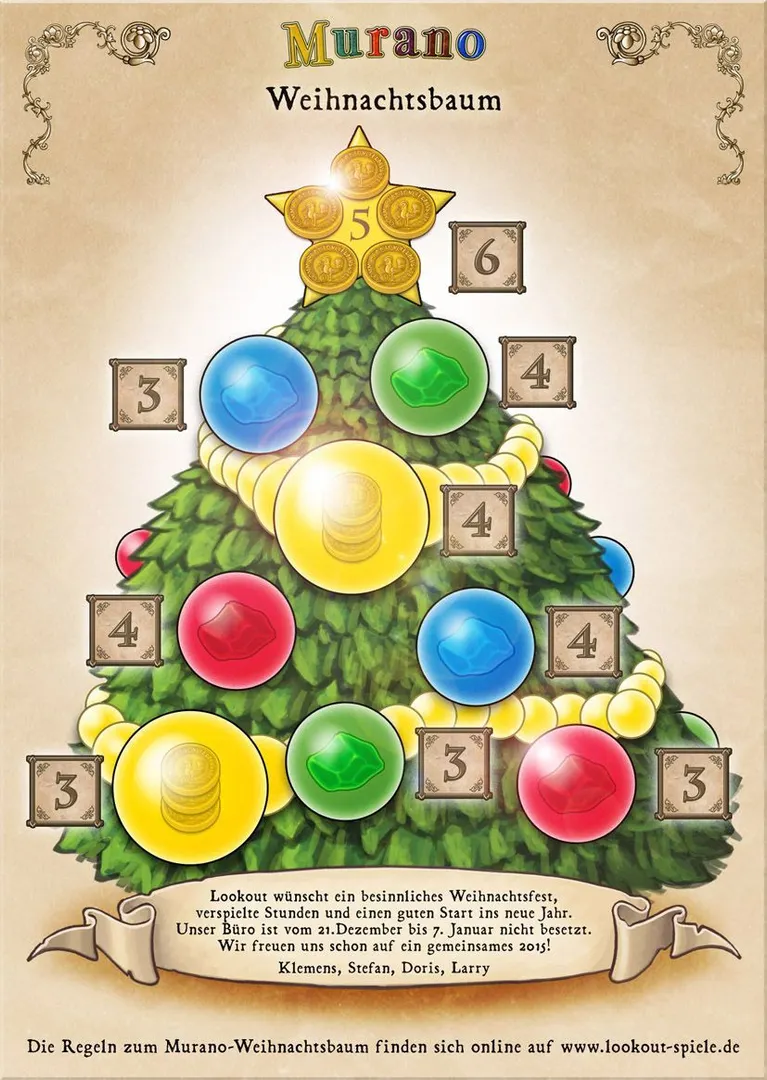
Murano: The Christmas Tree
- 2–4 Spieler
- 60 Min.
- Komplexität 2,3/5
- 2014
2014
Regelhilfe für Murano
Verständliche Erklärungen zu Spielzügen, Karteneffekten und strittigen Situationen mit Verweisen auf offizielle Quellen und gespeichertem Fragenverlauf.
Für 2 Personen
Was möchtest du wissen?
Antworten stammen aus dem offiziellen Regelheft, mit Seitenangabe zum Nachprüfen.
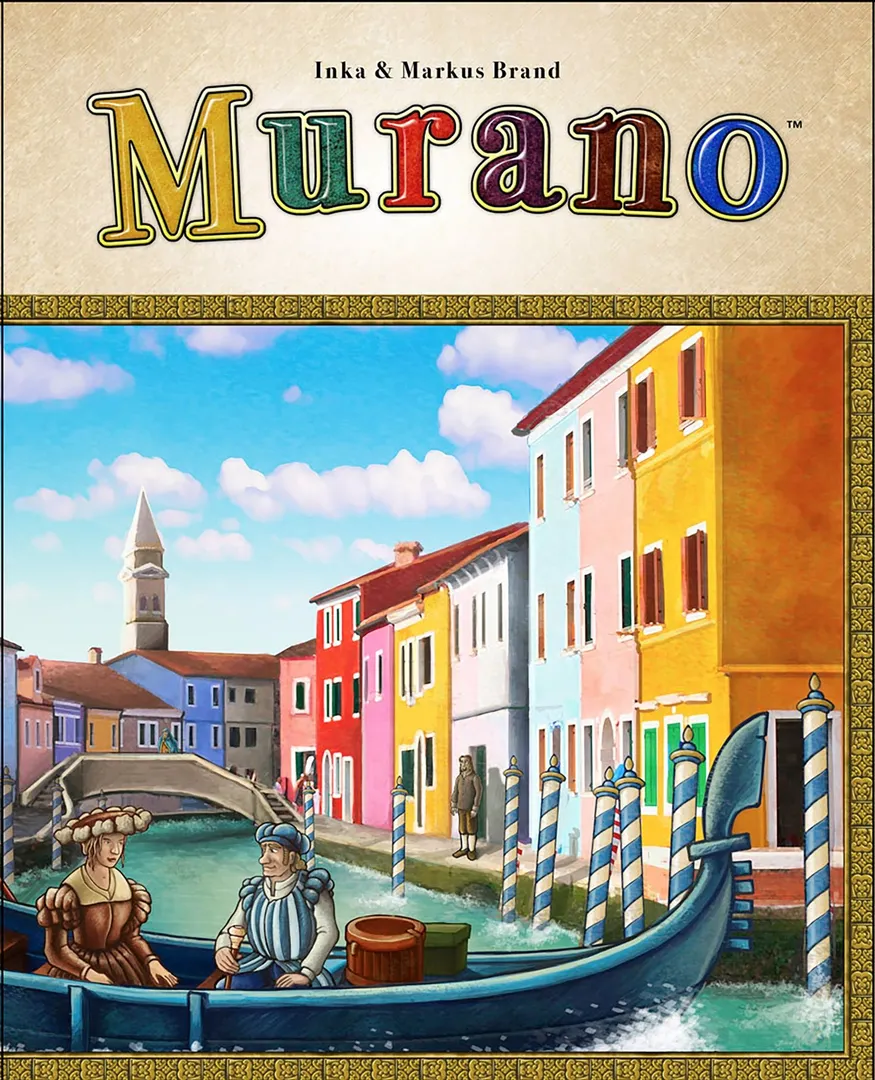
Murano ist ein Brettspiel aus dem Jahr 2014 für 2–4 Personen, mit 60–75 Minuten pro Partie und ab 10 Jahren. Entwickelt wurde es von Inka Brand und Markus Brand; die wichtigsten Mechaniken sind Track Movement, Tile Placement und End Game Bonuses.
Auf Englisch
Murano the game is set in Murano, a small group of seven islands near Venice that's well-known by tourists for its glassmaking. As in Venice, the islands of Murano are separated by canals, so gondolas and transportation are at the heart of this game. The game board depicts the islands of Murano, with the islands being divided up into building sites and walkways. Surrounding the islands is a series of action spaces, with gondolas being present in some number of them at the start of play. On a turn, you move one of the gondolas in the direction of play to an empty space, then take the action shown there. You can't pass another gondola while moving or land in an occupied space, but for a coin you can move a gondola that's in front of the gondola you want to move, and you can pay to move multiple gondolas, if needed. Some actions place shops on the islands, with shops coming in different types. You mark a shop to show ownership, and when tourists show up later, they will shop at various stores depending on their proximity and the goods they offer. You also need to take actions to move your personal gondolas to islands so that you can take actions there. Why are you doing all of this activity? To score victory point cards in hand, and actions on the board will let you gain additional VP cards to give you direction to your actions or let you profit from what you've already done. You can also use some of the buildings to create glassworks, and those glassworks come into play on the VP cards, through tourist sales, and via an action space shown at the bottom of the game board image that lets you sell different types of glass for money. The Complete Edition from 2020 contains Murano: Promo Cards and Murano: The Christmas Tree packaged inside the box and may be found here: Murano: Complete Edition.
Laut Katalog unterstützt Murano 2–4 Personen. Diese Spanne entspricht der vom Verlag angegebenen Spielerzahl, das Spiel lässt sich also für jede Gruppengröße innerhalb dieser Spanne aufbauen. Aufbau, einzelne Regeln und Wertungsdetails können je nach Personenzahl trotzdem abweichen; prüfe daher die genaue Konfiguration in der Anleitung deiner Ausgabe.
Die angegebene Spieldauer für Murano beträgt 60–75 Minuten. Das ist die Schätzung des Verlags für eine vollständige Partie. Die tatsächliche Dauer hängt von der Gruppe, der Personenzahl und der Regelkenntnis ab: Erste Partien dauern meist länger, erfahrene Gruppen sind oft schneller fertig. Aufbau und Regelerklärung sind in dieser Schätzung nicht enthalten.
Im Katalog wird Murano ab 10 Jahren empfohlen. Das ist die Empfehlung des Verlags und berücksichtigt Leseanforderungen, Regelkomplexität und Kleinteile, nicht nur das Thema. Jüngere Kinder können oft mit Hilfe eines Erwachsenen mitspielen; beachte die Altersangabe deiner Ausgabe und die Brettspielerfahrung deiner Gruppe.
Murano hat bei BoardGameGeek eine Komplexitätswertung von 2,7 von 5 und gilt damit als eher leichtes Spiel. Die Wertung zeigt, wie viel Regelwissen, Planung und Entscheidungen eine typische Partie verlangt. Schwerere Spiele brauchen bei der ersten Erklärung mehr Zeit, daher hilft vor dem Spieleabend eine Vorbereitungsanleitung.
Murano gehört zu diesen Kategorien: Economic und City Building. Die wichtigsten Mechaniken sind Track Movement, Tile Placement und End Game Bonuses. Kategorien beschreiben Thema und Setting eines Spiels, Mechaniken dagegen, was die Spielenden in ihrem Zug tatsächlich tun. Jede Mechanik führt zu einer Katalogseite mit ähnlichen Spielen, falls du etwas Vergleichbares suchst.
Als Autoren von Murano sind angegeben: Inka Brand und Markus Brand. Diese Angaben stammen aus den veröffentlichten Spieldaten und nennen die für das Spieldesign verantwortlichen Personen, nicht die Illustratoren oder Verlage. Die Autorenseiten auf MeepleRules sammeln weitere Titel derselben Autoren – praktisch, wenn dir ein Spiel gefällt und du ähnliche Spiele suchst.
Im Katalog ist Murano als Grundspiel aufgeführt. Es lässt sich eigenständig mit dem Material aus der Schachtel spielen und benötigt keinen weiteren Titel. Erweiterungen, sofern es welche gibt, ergänzen neues Material oder neue Regeln und sind im Katalog separat mit einem Verweis auf dieses Grundspiel aufgeführt.