

- BGG-Rang
- BGG #317
- BGG-Bewertung
- 7,3
Santorini
- 2–4 Spieler
- 20 Min.
- Komplexität 1,7/5
- 2016
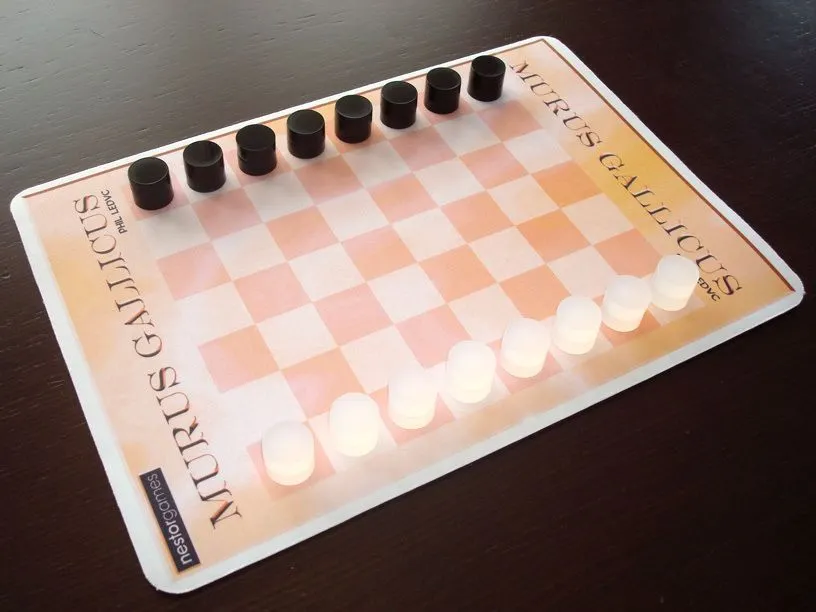
2009
Regelhilfe für Murus Gallicus
Verständliche Erklärungen zu Spielzügen, Karteneffekten und strittigen Situationen mit Verweisen auf offizielle Quellen und gespeichertem Fragenverlauf.
Für 2 Personen
Was möchtest du wissen?
Antworten stammen aus dem offiziellen Regelheft, mit Seitenangabe zum Nachprüfen.
Murus Gallicus ist ein Brettspiel aus dem Jahr 2009 für 2 Personen, mit 20 Minuten pro Partie und ab 10 Jahren. Entwickelt wurde es von Phil Leduc; die wichtigsten Mechaniken sind Square Grid und Grid Movement.




Auf Englisch
Murus Gallicus is a two-player breakthrough game in which players try to create impenetrable walls of stone reminiscent of Julius Caesar’s Gallic Wars. The object of the Murus Gallicus is to reach your opponent's home row or to stalemate your opponent. The game is played on a rectangular board consisting of an 8x7 array of cells. Each player starts with a set of 16 tokens referred to as stones; one light set and one dark set. The board is placed between players so that there are seven rows and eight columns. To start the game, each player takes a set of stones and stacks two stones on each of their eight home cells; their nearest row. The Roman player uses the light set and goes first. The Gaul player uses the dark set. Players alternate turns. The basic units of the game are towers and walls. A tower consists of two like-colored stones in a cell. A wall is a single stone in a cell. Only towers move. The main function of walls is to block the opponent's movement and secondarily they act as stepping stones which can be used later on to create new towers. Towers move by sowing as in Mancala with a stacking limit of two and only like-colored stones may be stacked. Each of the destination cells must be empty or contain a friendly wall. Tower stones can be used to remove adjacent opponent walls. This is done by sacrifice! Material remains equal throughout the game but slowly erodes for both players as players defuse threats. A player is stalemated if unable to move/sow or sacrifice at the start of his or her turn. Going flat out (stalemating yourself) in order to stalemate your opponent can be very satisfying. Murus Gallicus is a game of balance, space and timing. Players must balance defense and offense. By controlling the board's center, a player can gain mobility. Players must wait for the right moment to squeeze through the opponent's defense. The endgame can be very tense thanks to the balance in material. There are several useful structures players can employ. The Gallic Wall consisting of orthogonally connected walls (and sometimes towers) requires the opponent to go around the wall or blast his or her way thorough using a sacrificed stone. The Chariot consists of a tower, wall and empty space aligned. By sowing the towers stones in the direction of the wall, the two-celled formation glides forward. The battering ram consists of two towers and an opponent wall aligned. By sacrificing a tower stone, the opponent's wall can be removed. The remaining chariot formation can then move through the breach on the player's next turn. Lastly, a siege tower is a tower sitting within striking distance of the opponent's home row. Such a tower can tie up many of your opponent's pieces. The true excitement of the game is in the playing. A sneak attack that squeezes through a breach or a well-timed all out assault can be quite satisfying.
Laut Katalog unterstützt Murus Gallicus 2 Personen. Das ist die vom Verlag angegebene Spielerzahl, das Spiel ist also genau für diese Anzahl von Mitspielenden ausgelegt. Varianten für andere Gruppengrößen sind, sofern vorhanden, in der Anleitung deiner Ausgabe beschrieben; prüfe sie, bevor du eine andere Konfiguration aufbaust.
Die angegebene Spieldauer für Murus Gallicus beträgt 20 Minuten. Das ist die Schätzung des Verlags für eine vollständige Partie. Die tatsächliche Dauer hängt von der Gruppe, der Personenzahl und der Regelkenntnis ab: Erste Partien dauern meist länger, erfahrene Gruppen sind oft schneller fertig. Aufbau und Regelerklärung sind in dieser Schätzung nicht enthalten.
Im Katalog wird Murus Gallicus ab 10 Jahren empfohlen. Das ist die Empfehlung des Verlags und berücksichtigt Leseanforderungen, Regelkomplexität und Kleinteile, nicht nur das Thema. Jüngere Kinder können oft mit Hilfe eines Erwachsenen mitspielen; beachte die Altersangabe deiner Ausgabe und die Brettspielerfahrung deiner Gruppe.
Murus Gallicus hat bei BoardGameGeek eine Komplexitätswertung von 2,9 von 5 und gilt damit als eher leichtes Spiel. Die Wertung zeigt, wie viel Regelwissen, Planung und Entscheidungen eine typische Partie verlangt. Schwerere Spiele brauchen bei der ersten Erklärung mehr Zeit, daher hilft vor dem Spieleabend eine Vorbereitungsanleitung.
Murus Gallicus gehört zu diesen Kategorien: Abstract Strategy. Die wichtigsten Mechaniken sind Square Grid und Grid Movement. Kategorien beschreiben Thema und Setting eines Spiels, Mechaniken dagegen, was die Spielenden in ihrem Zug tatsächlich tun. Jede Mechanik führt zu einer Katalogseite mit ähnlichen Spielen, falls du etwas Vergleichbares suchst.
Als Autoren von Murus Gallicus sind angegeben: Phil Leduc. Diese Angaben stammen aus den veröffentlichten Spieldaten und nennen die für das Spieldesign verantwortlichen Personen, nicht die Illustratoren oder Verlage. Die Autorenseiten auf MeepleRules sammeln weitere Titel derselben Autoren – praktisch, wenn dir ein Spiel gefällt und du ähnliche Spiele suchst.
Im Katalog ist Murus Gallicus als Grundspiel aufgeführt. Es lässt sich eigenständig mit dem Material aus der Schachtel spielen und benötigt keinen weiteren Titel. Erweiterungen, sofern es welche gibt, ergänzen neues Material oder neue Regeln und sind im Katalog separat mit einem Verweis auf dieses Grundspiel aufgeführt.