- BGG-Rang
- BGG #3.646
- BGG-Bewertung
- 8,0
Mus
1745
Regelhilfe für Mus
Verständliche Erklärungen zu Spielzügen, Karteneffekten und strittigen Situationen mit Verweisen auf offizielle Quellen und gespeichertem Fragenverlauf.
- 4 Spieler
- 10 Min.
- 7+
- Komplexität 2,3/5

Für 4 Personen
Regelassistent für Mus
Was möchtest du wissen?
Antworten stammen aus dem offiziellen Regelheft, mit Seitenangabe zum Nachprüfen.
Mus ist ein Brettspiel aus dem Jahr 1745 für 4 Personen, mit 10 Minuten pro Partie und ab 7 Jahren. Die wichtigsten Mechaniken sind Team-Based Game und Betting and Bluffing.
Über das Spiel
Auf Englisch
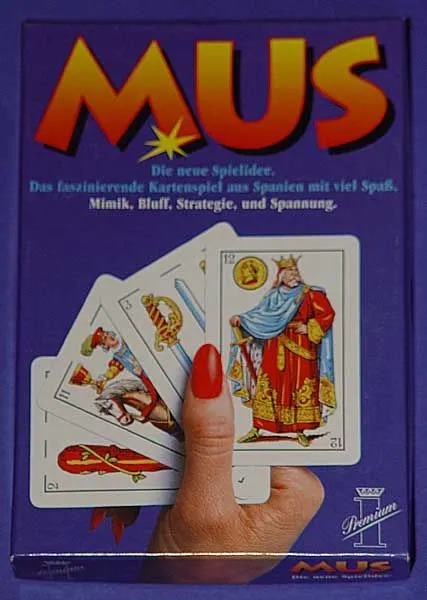
This is a Spanish card game born in Basque Country. The first reference about this game goes back to 1745, when Don Manuel de Larramendi, philologist and Jesuit basque, quoted it in the trilingual dictionary (Basque-Spanish-Latin). It is played by two opposing pairs of players with the Spanish deck, which is a deck of 40 cards without eights or nines and no jokers. Usually all 4 "3" cards count as kings and all four "2" cards count as aces. It has a variety of different rules in the different regions of Spain. In every round of the game Mus (discard) is either agreed or stopped. Then, four bets are made on the same hand of cards: * Grande (Biggest): playing for the highest combination of cards; handiak (big ones) in Basque. * Pequeña or Chica (Smallest): playing for the lowest combination of cards. * Pares (Pairs): playing for the best matching card combination; pareak in Basque. * Juego (Game): playing for cards total values of 31 or more. Sometimes replaced by a Punto (Point) special round; jokua in Basque. At last, accepted bets and passes are counted until one of the pairs of players reaches the previously agreed amount (different standards in different regions of Spain, but most commonly 30). The pair of players winning most out of three games wins a vaca (which means cow in spanish), and the pair winning most out of three vacas win the match. One other special feature of Mus is that it is a mostly verbal game, with little card-involving action, limited to deal and discard (if any). After cards are dealt and Mus (discard) is stopped, all rounds are played verbally, bets are called, passed, accepted or rejected but cards are not shown, dealt or touched in any further way, and the player only is obliged to show them in the end of the round if needed in order to resolve any accepted bet. This makes it a poor card game to watch other people play, and learning to play it through only watching is rather difficult in comparison with other card games.
Kategorien
Mechanismen
Verlage
- (Public Domain)
- Heraclio Fournier
- King Cards
Fragen und Antworten
Laut Katalog unterstützt Mus 4 Personen. Das ist die vom Verlag angegebene Spielerzahl, das Spiel ist also genau für diese Anzahl von Mitspielenden ausgelegt. Varianten für andere Gruppengrößen sind, sofern vorhanden, in der Anleitung deiner Ausgabe beschrieben; prüfe sie, bevor du eine andere Konfiguration aufbaust.
Die angegebene Spieldauer für Mus beträgt 10 Minuten. Das ist die Schätzung des Verlags für eine vollständige Partie. Die tatsächliche Dauer hängt von der Gruppe, der Personenzahl und der Regelkenntnis ab: Erste Partien dauern meist länger, erfahrene Gruppen sind oft schneller fertig. Aufbau und Regelerklärung sind in dieser Schätzung nicht enthalten.
Im Katalog wird Mus ab 7 Jahren empfohlen. Das ist die Empfehlung des Verlags und berücksichtigt Leseanforderungen, Regelkomplexität und Kleinteile, nicht nur das Thema. Jüngere Kinder können oft mit Hilfe eines Erwachsenen mitspielen; beachte die Altersangabe deiner Ausgabe und die Brettspielerfahrung deiner Gruppe.
Mus hat bei BoardGameGeek eine Komplexitätswertung von 2,3 von 5 und gilt damit als eher leichtes Spiel. Die Wertung zeigt, wie viel Regelwissen, Planung und Entscheidungen eine typische Partie verlangt. Schwerere Spiele brauchen bei der ersten Erklärung mehr Zeit, daher hilft vor dem Spieleabend eine Vorbereitungsanleitung.
Mus gehört zu diesen Kategorien: Card Game. Die wichtigsten Mechaniken sind Team-Based Game und Betting and Bluffing. Kategorien beschreiben Thema und Setting eines Spiels, Mechaniken dagegen, was die Spielenden in ihrem Zug tatsächlich tun. Jede Mechanik führt zu einer Katalogseite mit ähnlichen Spielen, falls du etwas Vergleichbares suchst.
Im Katalog ist Mus als Grundspiel aufgeführt. Es lässt sich eigenständig mit dem Material aus der Schachtel spielen und benötigt keinen weiteren Titel. Erweiterungen, sofern es welche gibt, ergänzen neues Material oder neue Regeln und sind im Katalog separat mit einem Verweis auf dieses Grundspiel aufgeführt.