
- BGG-Rang
- BGG #11.214
- BGG-Bewertung
- 7,8
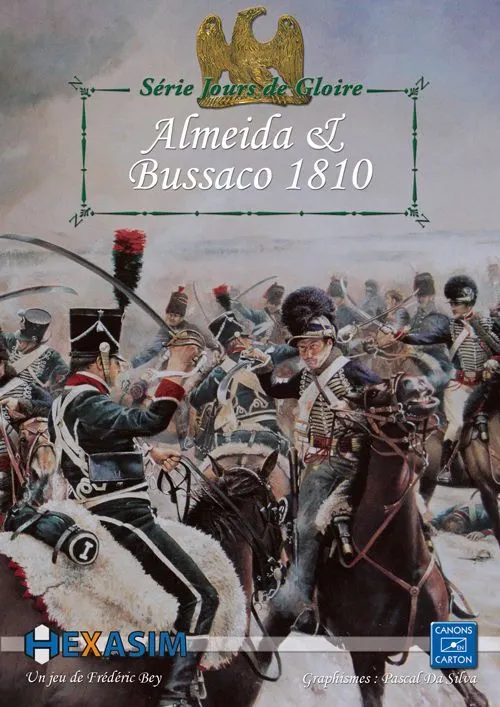
Almeida et Bussaco 1810
- 2 Spieler
- 120–240 Min.
- Komplexität 2,4/5
- 2010
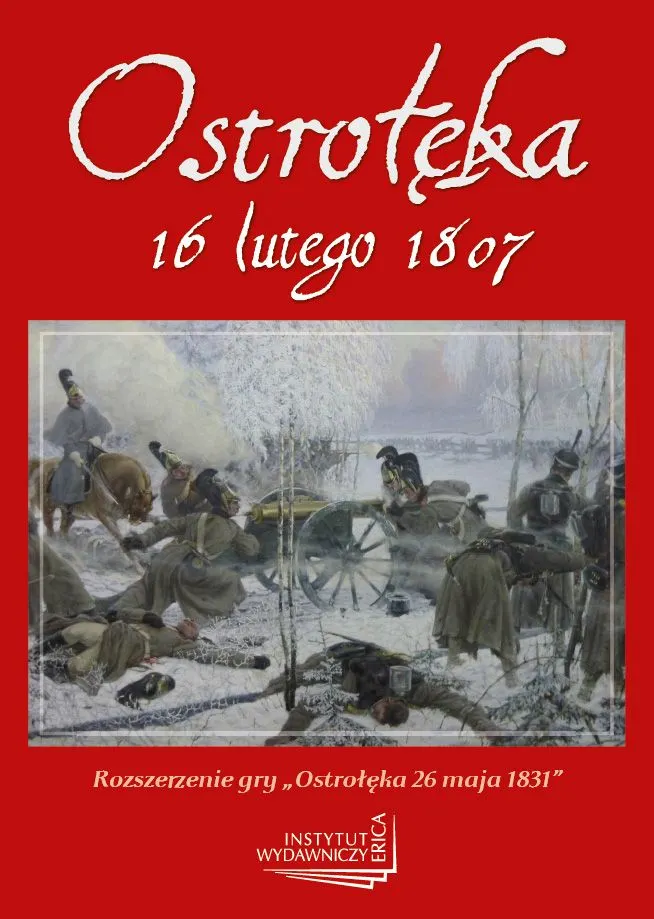
Regelhilfe für Ostroleka 16 lutego 1807
Verständliche Erklärungen zu Spielzügen, Karteneffekten und strittigen Situationen mit Verweisen auf offizielle Quellen und gespeichertem Fragenverlauf.
Was möchtest du wissen?
Antworten stammen aus dem offiziellen Regelheft, mit Seitenangabe zum Nachprüfen.
Ostroleka 16 lutego 1807 ist eine Erweiterung für Ostroleka 26 maja 1831 aus dem Jahr 2019 für 2–4 Personen, mit 150–600 Minuten pro Partie und ab 16 Jahren. Entwickelt wurde es von Ryszard Kita; die wichtigsten Mechaniken sind Dice Rolling, Hexagon Grid und Simulation.





Auf Englisch
Ostrołęka 16 lutego 1807 covers the battle of Ostrołęka, fought on Feb. 16, 1807 between the French 5th Corps commanded by Gen. Jean-Anne-Marie Savary and the Russian Corps commanded by Gen. Ivan N. Essen. The main goal of the French Corps was to secure the supply line of Napoleon’s main army fighting with Gen. Bennigsen. Just after the bloody battle of Preussisch Eylau (Feb. 7-8, 1807) both sides started to look for possibilities of taking advantage over the enemy and draw away some opposite forces from the main theater before the next expected battle. After set of back and forth operations in the north Mazovia, Russians decided to launch an offensive against units of the Frech 5th Corps situated near Ostrołęka. Russian commander, Gen. Essen, strengthened by the 6th Division of Gen. Sedmioradski, prepared a plan of attack. He decided to divide his forces into two wings. One of them (6th Division and a part of 9th Division), commanded by Gen. Wolkonski, had to attack the town Ostrołęka from the north, approaching along the west bank of Narew river. The other wing (10th Division and a part of 9th Division), commanded by Gen. Essen, approaching along the east bank of Narew river, had to attack the town Ostrołęka from the east. Russians had significant numerical advantage but their problem was that both operational groups were completely separated by the impassable river with marshy banks and in effect could not suport each other. Before the battle started, Russians had made feign attacks near Myszyniec along the line of communication of the main French army, north-west of Ostrołęka, fooling the French command. Gen. Savary decided to send there whole 1st Infantry Division of Gen. Suchet. Before the battle started, two events had taken place that had great impact on the course of it. The first one caused that Russians completely lost surprise effect. French caught the Russian messanger with letter from Essen to Bennigsen, from which they got to know the plan of the offensive. However we do not know how many details of it. The second event was also disadvantageous for the Russian Corps command. Gen. Bennigsen, who was the commander-in-chief of all Russian forces operating against Napoleon, recalled 6th Division of Gen. Sedmioradski to the main Russian army, to the north. Gen. Wolkonski, supported by Gen. Essen, tried to convince Gen. Sedmioradski to postpone execution of this order and take part in the planned ofensive against French 5th Corps, but Sedmioradski decided to obey strictly order from the upper commander and had marched to the north just befeore the offensive started. The effect was that Wolkonski’s group which had to advance along the west bank of Narew river was reduced to 1/3 of its units. The battle of Ostrołęka fought in 1807 is a classical example of the maneuver from a central position. Knowing more or less enemy’s plans, early morning of Feb. 16, 1807, near 4 AM Gen. Savary also decided to divide his forces into two groups. He found the Russian wing approaching along the west bank of the Narew river as more dangerous because it could had cut him off from his line of communication. That is why he decided to march with the majority of his forces to the north, defeat it as the first and then revert back to the Ostrołęka to fight with the rest of the Russians. In Ostrołęka Savary left only 8 battalions with some artillery and cavalry. They had to defend and keep the town until he had defeated the enemy approaching from the north. Battle fought by Savary with Wolkonski’s group near Stanisławów was quick. Russian General, seeing enemy strongly outnumbering his group, after short combat started retreat. It was 10 AM when being near Stanisławów Savary heard the sound of cannonade coming from Ostrołęka. At that moment he realised the Russian group he defeated was the smaller one and the main Russian forces were at Ostrołęka attacking small French contingent he had left there in the morning to defend the town and area around it. Leaving some units to pursuit Wolkonski’s group Savary ordered force march to Ostrołęka. It was noon when the first units of his group appeared near the town where they met coming back from the north west 1st Infantry Division of Gen. Suchet. How defenders of the town were able to keep control of it to that time is another story. Some historical sources mention that although outnumbered, they even attacked Russians in the first part of the battle, confusing them and disturbing the decisive attack. Also some parts of Essen’s group were delayed. Finally, near noon, when the defenders were about to lose, suprisingly Russian attacks on the town stopped. Russian command decided to withdraw to the positions to the east of Ostrołęka, stay there until the end ot the day and make retreat during night. When Savary’s group and the 1st Infantry Division crossed the Narew river and formed the battle line, the last part of the battle commenced. There were no more than 2 hours to the dusk but it was enough for the French to break Essen’s group, however in effect of darkness, early coming during winter, the victory was not so overwhelming as it had been if the French had had more time. It is estimated that Russian lost 2500-3000 casualties, while French 1500-2000 ones. The game is an expansion for Ostrołęka 26 maja 1831. It means that Ostrołęka 16 lutego 1807 uses system rules (also charts & tables), markers and the board which are in Ostrołęka 26 maja 1831. There are special rules for this historical period and battle (2 pages only). There are three scenarios in the game: - The Defense of Ostrołęka, - Operational, - The Battle on the East Bank of the Narew River. The first scenario covers the initial part of the battle. Its feature is a chit-pull system, used to simulate activity of the French units at the beginning of the combat and their better command system. The second scenario, the largest one, allows to play the whole battle. Its aim is also to show the operational background around the battlefield. It tries to join two levels of warfare: tactical and operational. In fact it is a kind of scenario generator: each player can choose among few options how to divide his forces among two groups. This decision has a great impact on the course of the game. Another important decision up to the Russian player is possible bringing to the battle Russian 6th Division of Gen. Sedmioradski, what gives him more forces but changes victory conditions to more demanding for the Russians. There is a plenty of additional options for this scenario. The third scenario depicts the last part of the battle, great frontal struggle on the east bank of the Narew river with most of the units participating in it. The playing time varies depending on the scenario, style of play and many other factors. The third scenario is the shortest while the second scenario as a whole is definitely the longest one. However in case of lack time, basing on the second scenario you can create little battles which can be played in 2-3 hours. Components (all packed in ziplock): - 324 die-cut counters (9 small counter sheets) - One rulebook and scenariobook (both in one book) - Two sheets with unit rosters (for French and Russians) - One sheet with turn tracks - Four bags for counters
Laut Katalog unterstützt Ostroleka 16 lutego 1807 2–4 Personen. Diese Spanne entspricht der vom Verlag angegebenen Spielerzahl, das Spiel lässt sich also für jede Gruppengröße innerhalb dieser Spanne aufbauen. Aufbau, einzelne Regeln und Wertungsdetails können je nach Personenzahl trotzdem abweichen; prüfe daher die genaue Konfiguration in der Anleitung deiner Ausgabe.
Die angegebene Spieldauer für Ostroleka 16 lutego 1807 beträgt 150–600 Minuten. Das ist die Schätzung des Verlags für eine vollständige Partie. Die tatsächliche Dauer hängt von der Gruppe, der Personenzahl und der Regelkenntnis ab: Erste Partien dauern meist länger, erfahrene Gruppen sind oft schneller fertig. Aufbau und Regelerklärung sind in dieser Schätzung nicht enthalten.
Im Katalog wird Ostroleka 16 lutego 1807 ab 16 Jahren empfohlen. Das ist die Empfehlung des Verlags und berücksichtigt Leseanforderungen, Regelkomplexität und Kleinteile, nicht nur das Thema. Jüngere Kinder können oft mit Hilfe eines Erwachsenen mitspielen; beachte die Altersangabe deiner Ausgabe und die Brettspielerfahrung deiner Gruppe.
Ostroleka 16 lutego 1807 hat bei BoardGameGeek eine Komplexitätswertung von 4,2 von 5 und gilt damit als schweres Spiel. Die Wertung zeigt, wie viel Regelwissen, Planung und Entscheidungen eine typische Partie verlangt. Schwerere Spiele brauchen bei der ersten Erklärung mehr Zeit, daher hilft vor dem Spieleabend eine Vorbereitungsanleitung.
Ostroleka 16 lutego 1807 gehört zu diesen Kategorien: Wargame, Napoleonic und Expansion for Base-game. Die wichtigsten Mechaniken sind Dice Rolling, Hexagon Grid und Simulation. Kategorien beschreiben Thema und Setting eines Spiels, Mechaniken dagegen, was die Spielenden in ihrem Zug tatsächlich tun. Jede Mechanik führt zu einer Katalogseite mit ähnlichen Spielen, falls du etwas Vergleichbares suchst.
Als Autoren von Ostroleka 16 lutego 1807 sind angegeben: Ryszard Kita. Diese Angaben stammen aus den veröffentlichten Spieldaten und nennen die für das Spieldesign verantwortlichen Personen, nicht die Illustratoren oder Verlage. Die Autorenseiten auf MeepleRules sammeln weitere Titel derselben Autoren – praktisch, wenn dir ein Spiel gefällt und du ähnliche Spiele suchst.
Im Katalog ist Ostroleka 16 lutego 1807 als Erweiterung zu Ostroleka 26 maja 1831 aufgeführt. Erweiterungen ergänzen das Grundspiel um neues Material, neue Regeln oder Szenarien und sind meist nicht eigenständig spielbar; du brauchst also Ostroleka 26 maja 1831, um sie zu nutzen. Prüfe, ob deine Ausgabe von Ostroleka 26 maja 1831 kompatibel ist, da manche Erweiterungen zwischen den Auflagen überarbeitet wurden.