- BGG-Rang
- BGG #3.707
- BGG-Bewertung
- 7,3
Ottoman Sunset: The Great War in the Near East
2010
Regelhilfe für Ottoman Sunset: The Great War in the Near East
Verständliche Erklärungen zu Spielzügen, Karteneffekten und strittigen Situationen mit Verweisen auf offizielle Quellen und gespeichertem Fragenverlauf.
- 1 Spieler
- 30 Min.
- 13+
- Komplexität 2,0/5

Für 1 Person
Regelassistent für Ottoman Sunset: The Great War in the Near East
Was möchtest du wissen?
Antworten stammen aus dem offiziellen Regelheft, mit Seitenangabe zum Nachprüfen.
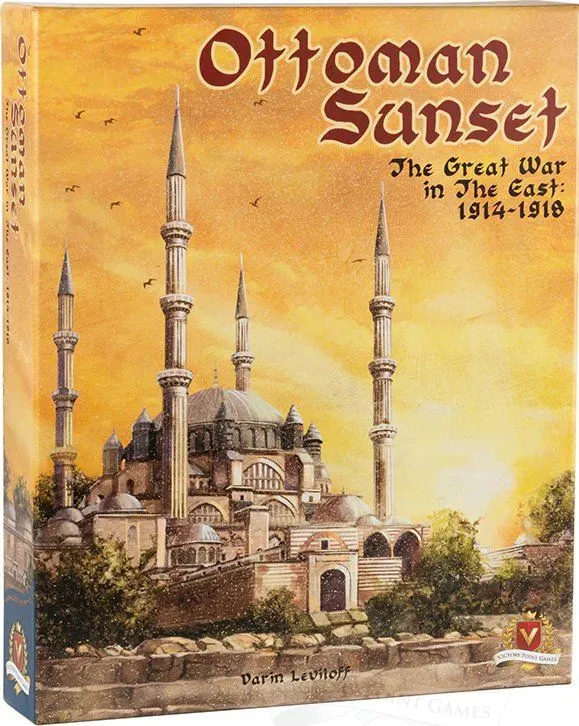
Ottoman Sunset: The Great War in the Near East ist ein Brettspiel aus dem Jahr 2010 für 1 Person, mit 30 Minuten pro Partie und ab 13 Jahren. Entwickelt wurde es von Darin A. Leviloff; die wichtigsten Mechaniken sind Dice Rolling, Point to Point Movement und Simulation.
Über das Spiel
Auf Englisch
When war in Europe broke out in 1914, the Ottoman Empire, pursuant to secret protocols, agreed to provide shelter to the fleeing German Battleship, Goeben, which was renamed Yavuz. After Britain refused to deliver newly ordered Turkish battleships, the Turko-German fleet bombarded Russian forts, signaling the Ottoman Empire’s entrance into World War One. Ottoman Sunset 2nd edition, by designer Darin Leviloff, is a stand-alone solitaire States of SiegeTM game on World War One in the Near East from 1914-1918. The player controls the Young Turks (CUP or Committee of Union and Progress) as they try to keep the Ottoman Empire alive amidst the struggles of the Great War. After many years of being the “Sick man of Europe,” by the late 19th century the Ottoman Empire attempted to reform and modernize itself. Ironically, such attempts convinced restive nationalities such as the Greeks, Romanians, Bulgarians, etc., to assert their independence and/or seek to expand their territory. This weakness caused other Imperial Powers to seize Ottoman territory, both formally and informally. By the outbreak of World War One, the Ottoman Empire was reduced to a core of territory in Asia Minor, the Levant, the Hejaz, Mesopotamia, and a sliver of European territory. This collapse led the military-political leadership in Turkey to take over under the guise of the Young Turks. The Ottoman Empire began with lofty strategic goals, but soon faced a hard slog, defending its core empire against far-flung British-led forces, Russian armies, and a Hashemite Arab revolt. Furthermore, ongoing campaigns on other fronts, such as those with Austria against Romania in the East, against Italy on the Isonzo, and of course the draining stalemate of the Western Front had a direct impact on events in this theater. Like Austria-Hungary, the Ottoman Empire needed direct German aid to keep it in the conflict. Despite victories at Kut and Gallipoli, by October 1918, the Turks had about all they could take and surrendered. Can you lead the Ottomans in the Great War and achieve victory where your historical counterparts failed? Game Data: Complexity: 3 on a 9 scale Solitaire Suitability: 9 on a 9 scale Scale: Each unit is one Allied Front, and each turn is a few weeks of real time What's In The Box?: • One 24-page full-color Rules booklet • One 11” x 17” paper game map • 50 cards • 57 thick, two-sided, multi-shaped game pieces • One six-sided 12mm die • One 11” x 17” mounted, jigsaw-cut game map • One bright red, 9 1/4" x 5 7/8" Standard cardboard VPG game box • One beautiful box cover sleeve • One "Wipes-A-Lot" napkin • One charcoal dessicant packet
Kategorien
Mechanismen
Autoren
Verlage
- Tycoon Games
- Tabletop Tycoon Inc.
- Victory Point Games
Fragen und Antworten
Laut Katalog unterstützt Ottoman Sunset: The Great War in the Near East 1 Person. Das ist die vom Verlag angegebene Spielerzahl, das Spiel ist also genau für diese Anzahl von Mitspielenden ausgelegt. Varianten für andere Gruppengrößen sind, sofern vorhanden, in der Anleitung deiner Ausgabe beschrieben; prüfe sie, bevor du eine andere Konfiguration aufbaust.
Die angegebene Spieldauer für Ottoman Sunset: The Great War in the Near East beträgt 30 Minuten. Das ist die Schätzung des Verlags für eine vollständige Partie. Die tatsächliche Dauer hängt von der Gruppe, der Personenzahl und der Regelkenntnis ab: Erste Partien dauern meist länger, erfahrene Gruppen sind oft schneller fertig. Aufbau und Regelerklärung sind in dieser Schätzung nicht enthalten.
Im Katalog wird Ottoman Sunset: The Great War in the Near East ab 13 Jahren empfohlen. Das ist die Empfehlung des Verlags und berücksichtigt Leseanforderungen, Regelkomplexität und Kleinteile, nicht nur das Thema. Jüngere Kinder können oft mit Hilfe eines Erwachsenen mitspielen; beachte die Altersangabe deiner Ausgabe und die Brettspielerfahrung deiner Gruppe.
Ottoman Sunset: The Great War in the Near East hat bei BoardGameGeek eine Komplexitätswertung von 2,0 von 5 und gilt damit als eher leichtes Spiel. Die Wertung zeigt, wie viel Regelwissen, Planung und Entscheidungen eine typische Partie verlangt. Schwerere Spiele brauchen bei der ersten Erklärung mehr Zeit, daher hilft vor dem Spieleabend eine Vorbereitungsanleitung.
Ottoman Sunset: The Great War in the Near East gehört zu diesen Kategorien: Wargame und World War I. Die wichtigsten Mechaniken sind Dice Rolling, Point to Point Movement und Simulation. Kategorien beschreiben Thema und Setting eines Spiels, Mechaniken dagegen, was die Spielenden in ihrem Zug tatsächlich tun. Jede Mechanik führt zu einer Katalogseite mit ähnlichen Spielen, falls du etwas Vergleichbares suchst.
Als Autoren von Ottoman Sunset: The Great War in the Near East sind angegeben: Darin A. Leviloff. Diese Angaben stammen aus den veröffentlichten Spieldaten und nennen die für das Spieldesign verantwortlichen Personen, nicht die Illustratoren oder Verlage. Die Autorenseiten auf MeepleRules sammeln weitere Titel derselben Autoren – praktisch, wenn dir ein Spiel gefällt und du ähnliche Spiele suchst.
Im Katalog ist Ottoman Sunset: The Great War in the Near East als Grundspiel aufgeführt. Es lässt sich eigenständig mit dem Material aus der Schachtel spielen und benötigt keinen weiteren Titel. Erweiterungen, sofern es welche gibt, ergänzen neues Material oder neue Regeln und sind im Katalog separat mit einem Verweis auf dieses Grundspiel aufgeführt.