

- BGG-Rang
- BGG #9.724
- BGG-Bewertung
- 8,0
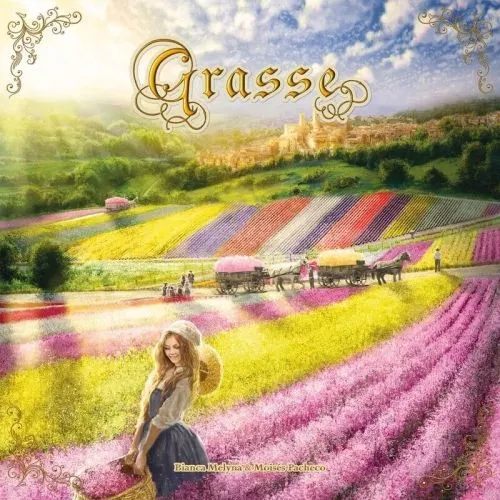
Grasse: Mestres Perfumistas
- 2–4 Spieler
- 60–90 Min.
- Komplexität 2,4/5
- 2018
2018
Regelhilfe für Overdrive
Verständliche Erklärungen zu Spielzügen, Karteneffekten und strittigen Situationen mit Verweisen auf offizielle Quellen und gespeichertem Fragenverlauf.
Was möchtest du wissen?
Antworten stammen aus dem offiziellen Regelheft, mit Seitenangabe zum Nachprüfen.
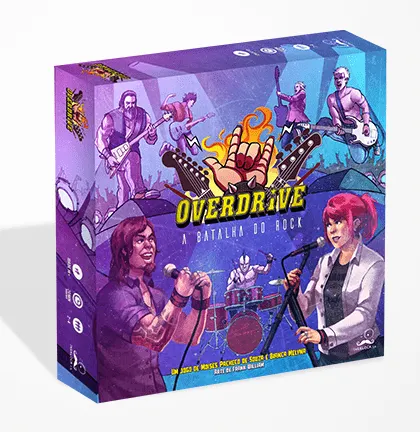
Overdrive ist ein Brettspiel aus dem Jahr 2018 für 2–4 Personen, mit 30–50 Minuten pro Partie und ab 8 Jahren. Entwickelt wurde es von Moisés Pacheco de Souza und Bianca Melyna; die wichtigsten Mechaniken sind Variable Player Powers, Take That und Set Collection.




Auf Englisch
OVERDRIVE is a game of dice allocation, which represents the members of your band. Each player takes on the role of the best rock band in their universe, whose goal is to get the most points until the last battle of bands. Use unique techniques, optimize your bandwidth and invest in improvements to prove who is the biggest band in the whole multiverse. This is rock'n roll, baby! LIST OF COMPONENTS 1 Rules Book 5 Band Sheet 1 Game Board 4 Disc Award Tiles 16 cards of Opportunities 20 Cancellation tiles 1 First Player token 24 Custom dices The game board contains the most basic actions of dice allocation. With a combination of dice faces, the player allocates their dice in the spaces available to perform the specific actions. If a space already contains dices from other players, you can not use that space. All players receive at the beginning of the match 4 dices of their color, which represents the members of their band. On your turn, you use the faces of your rolled dice, and allocate them on the board. In addition to the board, there are the Hit Cards, which work the same way, as there are spaces available to allocate dice and receive the bonuses. The difference is that a player can buy a Hit, and when another player allocates dices on his Hit, you are also benefited. For this reason, there is a deck of Hits with 18 different cards to be restored to the table as the players buy them (only 3 are revealed). Each player also receives a Band Sheet from their band, and each of them has the Fan, Fame, Overdrive and Money tracks, which are marked with cubes. Throughout the match, each player, through their actions, can improve these attributes to try to improve their score at the end of the game. Each band also has special abilities that are unlocked throughout the match, optimizing their technique and improving their performance. At the table, there are 4 discs of awards, which are goals that bands can achieve to claim them, and increase their score. When you take an award disc (bronze, silver, gold or diamond), you become the owner of it, and another player can not take it from you. You still have the option of swapping it for another better scoring disc when you can meet your requirements, but you will have to return the lower scoring score, making it available to other players. Finally, at the end of rounds 3, 6 and 8 (total of 8 rounds) the Battle of Bands takes place. Players use their dices to fight between them, trying to eliminate opponents' dices for 2 scrolling acts and comparing results. You can only defeat an opponent's dice if you have more equal faces than the symbol you want to remove from it. For example, you can use 2 skull faces to defeat the only skull result of one of your target foes. At the end of the battle, the remaining dice will provide bonuses to the players. In addition to the game, there is also a concern to accumulate symbols for the collection, which are printed on the Hit Cards, the Band Sheet, and Dices at the end of the last battle. This will give you more points towards the end of the match, as you score with each collection of at least 3 identical or different symbols. The goal of the game is, at the end of round 8, to have more victory points than its opponents, thus becoming the best band of the multiverse. The game is for 2 to 4 players, and the starting time is around 45 minutes.
Laut Katalog unterstützt Overdrive 2–4 Personen. Diese Spanne entspricht der vom Verlag angegebenen Spielerzahl, das Spiel lässt sich also für jede Gruppengröße innerhalb dieser Spanne aufbauen. Aufbau, einzelne Regeln und Wertungsdetails können je nach Personenzahl trotzdem abweichen; prüfe daher die genaue Konfiguration in der Anleitung deiner Ausgabe.
Die angegebene Spieldauer für Overdrive beträgt 30–50 Minuten. Das ist die Schätzung des Verlags für eine vollständige Partie. Die tatsächliche Dauer hängt von der Gruppe, der Personenzahl und der Regelkenntnis ab: Erste Partien dauern meist länger, erfahrene Gruppen sind oft schneller fertig. Aufbau und Regelerklärung sind in dieser Schätzung nicht enthalten.
Im Katalog wird Overdrive ab 8 Jahren empfohlen. Das ist die Empfehlung des Verlags und berücksichtigt Leseanforderungen, Regelkomplexität und Kleinteile, nicht nur das Thema. Jüngere Kinder können oft mit Hilfe eines Erwachsenen mitspielen; beachte die Altersangabe deiner Ausgabe und die Brettspielerfahrung deiner Gruppe.
Overdrive hat bei BoardGameGeek eine Komplexitätswertung von 2,0 von 5 und gilt damit als eher leichtes Spiel. Die Wertung zeigt, wie viel Regelwissen, Planung und Entscheidungen eine typische Partie verlangt. Schwerere Spiele brauchen bei der ersten Erklärung mehr Zeit, daher hilft vor dem Spieleabend eine Vorbereitungsanleitung.
Overdrive gehört zu diesen Kategorien: Dice und Music. Die wichtigsten Mechaniken sind Variable Player Powers, Take That und Set Collection. Kategorien beschreiben Thema und Setting eines Spiels, Mechaniken dagegen, was die Spielenden in ihrem Zug tatsächlich tun. Jede Mechanik führt zu einer Katalogseite mit ähnlichen Spielen, falls du etwas Vergleichbares suchst.
Als Autoren von Overdrive sind angegeben: Moisés Pacheco de Souza und Bianca Melyna. Diese Angaben stammen aus den veröffentlichten Spieldaten und nennen die für das Spieldesign verantwortlichen Personen, nicht die Illustratoren oder Verlage. Die Autorenseiten auf MeepleRules sammeln weitere Titel derselben Autoren – praktisch, wenn dir ein Spiel gefällt und du ähnliche Spiele suchst.
Im Katalog ist Overdrive als Grundspiel aufgeführt. Es lässt sich eigenständig mit dem Material aus der Schachtel spielen und benötigt keinen weiteren Titel. Erweiterungen, sofern es welche gibt, ergänzen neues Material oder neue Regeln und sind im Katalog separat mit einem Verweis auf dieses Grundspiel aufgeführt.