
- BGG-Rang
- BGG #6.107
- BGG-Bewertung
- 8,4
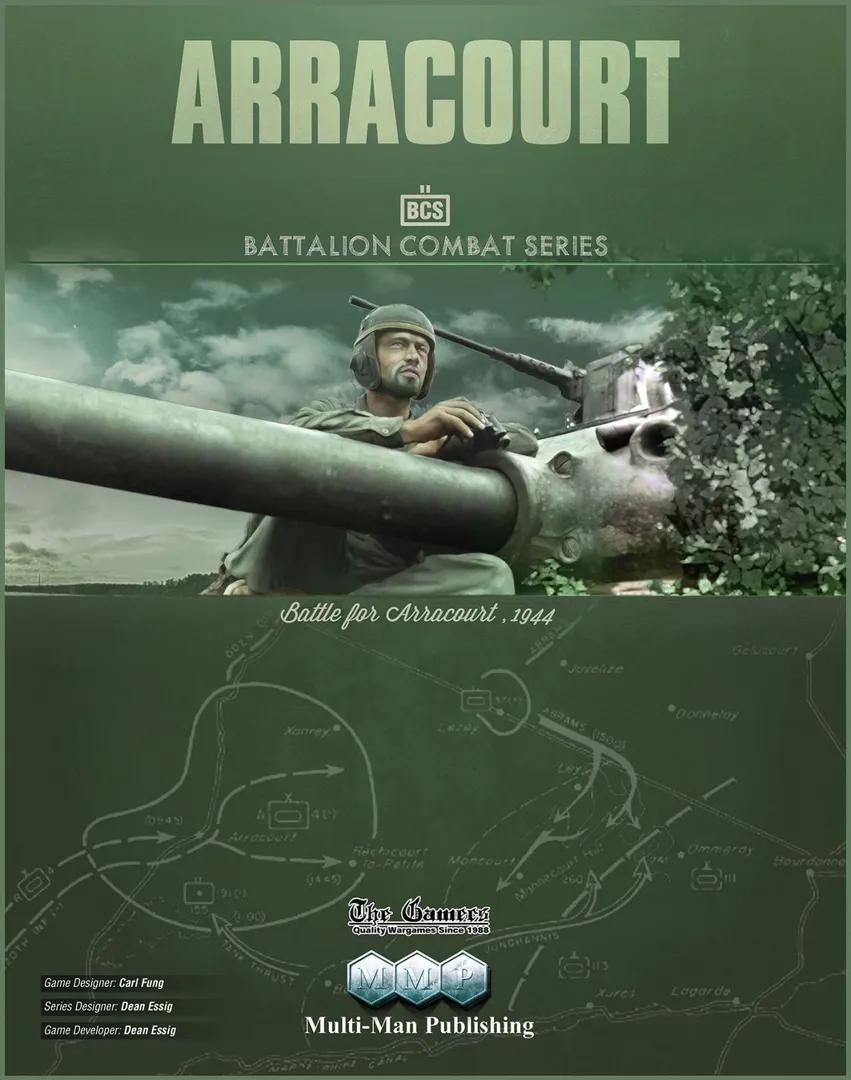
Arracourt
- 2 Spieler
- 120 Min.
- Komplexität 3,9/5
- 2022
2021
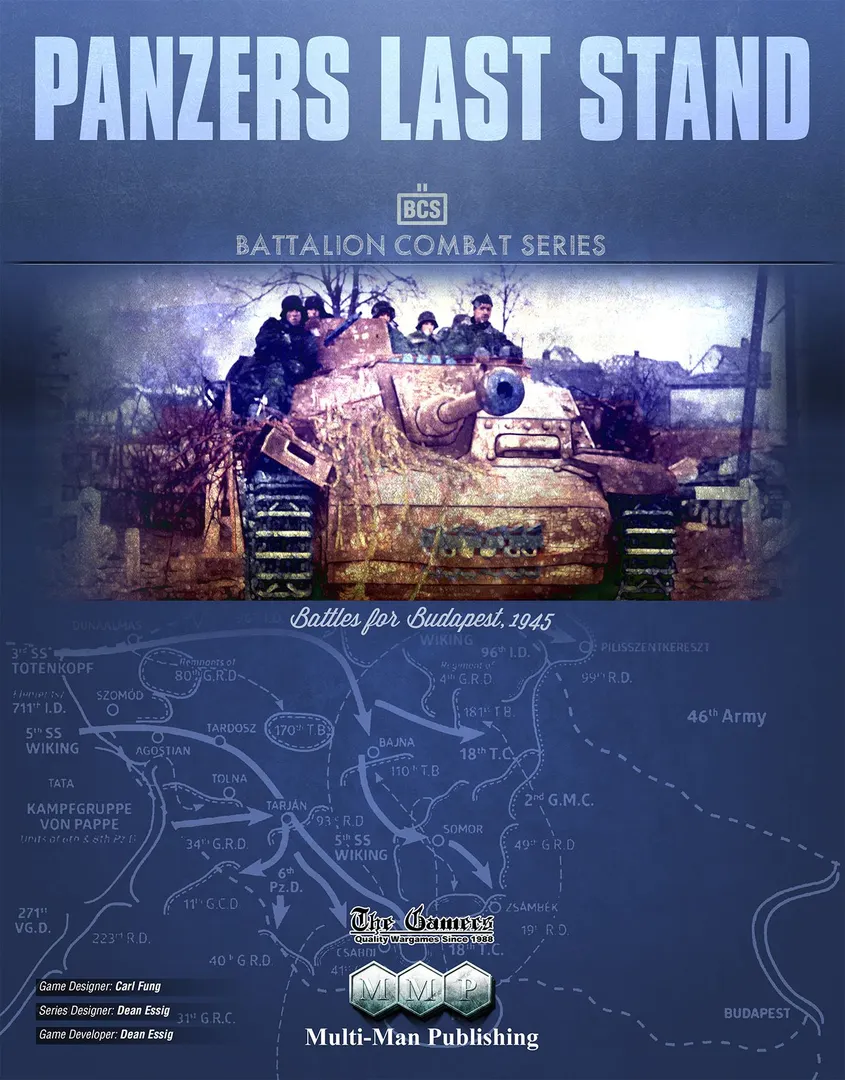
Regelhilfe für Panzers Last Stand: Battles for Budapest, 1945
Verständliche Erklärungen zu Spielzügen, Karteneffekten und strittigen Situationen mit Verweisen auf offizielle Quellen und gespeichertem Fragenverlauf.
Für 2 Personen
Was möchtest du wissen?
Antworten stammen aus dem offiziellen Regelheft, mit Seitenangabe zum Nachprüfen.
Panzers Last Stand: Battles for Budapest, 1945 ist ein Brettspiel aus dem Jahr 2021 für 2 Personen und mit 120–1560 Minuten pro Partie. Entwickelt wurde es von Dean Essig und Carl Fung; die wichtigsten Mechaniken sind Dice Rolling, Hexagon Grid und Simulation.





Auf Englisch
Panzers Last Stand is a Battalion Combat Series game depicting the Axis relief operations of Budapest from January to March 1945 in what became Germany's last major offensives in the war. The campaign game covers the Konrad Operations (I, II, and III) in January 1945. There are scenarios for each of the Konrad Operations as well as Operation Southwind in February and Operation Spring Awakening in March 1945. In the final months of the war, Germany was still full of fight and believed Budapest to be the key to turning the tide. With Budapest fully surrounded by Soviet and former-Axis Romanian forces, the situation in the city was desperate. The Germans devised a plan to relieve Budapest by bringing in the SS-Totenkopf and SS-Wiking Panzer Divisions from Poland to launch a surprise attack before the Soviets closed the ring on the trapped forces in the city. Launched in the wee hours on New Year's Day, 1945, the fate of the Axis hung in the balance. The Soviets, having campaigned continuously from the summer of 1944, fought back viciously and showed their mettle against the elite SS Panzer Divisions. A great proportion of the armored forces for both sides funneled into the Budapest area. All but one of the seven SS Panzer Divisions and half of the Heer Panzer Divisions on the Eastern Front (a full third of all Panzer Divisions total) ultimately fought here. The Soviets committed three Tank, five Mechanized, and one Cavalry Corps to blunt the Axis drive. The battlefield became a graveyard of tanks. The game showcases late-war equipment like the Tiger II, Brummbär, IS-2, and ISU-152 while also including unique units like Cavalry, Assault Pioneers, Soviet Naval Infantry, Hungarian SS, and ad hoc forces mobilized to defend Budapest. Rules covering Danube River crossing, Urban combat, redeployment deception (Maskirovka), and Festung rules highlight this unique and often misunderstood campaign. Scenarios: The Taking of Budapest 123: Full Campaign (4 maps, 26 turns) Operation Konrad I & II (2 maps without Budapest, 10 turns) Operation Konrad I (2 maps without Budapest, 5 turns) Operation Konrad II (1 map without Budapest, 5 turns) Battle for Zamoly (Part of 1 map, 5 turns) Operation Konrad III (2 maps, 10 turns) Battle for Komárom (Part of 2 maps, 17 turns) Days of Battle: Opening Blows to Komárom (Part of 2 maps, 4 turns) Operation Southwind (Part of 2 maps, 8 turns) Operation Spring Awakening (2 maps, 10 turns) Components: BCS rulebook (v2.0, in full color) Two BCS Charts and Tables (v2.0, in full color) BCS Support rulebook (v2.0, in full color) PLS Game Specific rulebook Axis Player Booklet Soviet Player Booklet Turn Record Track Card Axis Player Display Card Soviet Player Display Card Last Blitzkrieg Addenda sheet Four 22” x 34” Full Color Game Maps 1,680 Counters (four sheets of units and two BCS marker sheets) 10 scenarios total, 2 one-map scenarios, 4 are 5 turns or less Box and Dice —description from the publisher
Laut Katalog unterstützt Panzers Last Stand: Battles for Budapest, 1945 2 Personen. Das ist die vom Verlag angegebene Spielerzahl, das Spiel ist also genau für diese Anzahl von Mitspielenden ausgelegt. Varianten für andere Gruppengrößen sind, sofern vorhanden, in der Anleitung deiner Ausgabe beschrieben; prüfe sie, bevor du eine andere Konfiguration aufbaust.
Die angegebene Spieldauer für Panzers Last Stand: Battles for Budapest, 1945 beträgt 120–1560 Minuten. Das ist die Schätzung des Verlags für eine vollständige Partie. Die tatsächliche Dauer hängt von der Gruppe, der Personenzahl und der Regelkenntnis ab: Erste Partien dauern meist länger, erfahrene Gruppen sind oft schneller fertig. Aufbau und Regelerklärung sind in dieser Schätzung nicht enthalten.
Panzers Last Stand: Battles for Budapest, 1945 hat bei BoardGameGeek eine Komplexitätswertung von 3,9 von 5 und gilt damit als schweres Spiel. Die Wertung zeigt, wie viel Regelwissen, Planung und Entscheidungen eine typische Partie verlangt. Schwerere Spiele brauchen bei der ersten Erklärung mehr Zeit, daher hilft vor dem Spieleabend eine Vorbereitungsanleitung.
Panzers Last Stand: Battles for Budapest, 1945 gehört zu diesen Kategorien: Wargame und World War II. Die wichtigsten Mechaniken sind Dice Rolling, Hexagon Grid und Simulation. Kategorien beschreiben Thema und Setting eines Spiels, Mechaniken dagegen, was die Spielenden in ihrem Zug tatsächlich tun. Jede Mechanik führt zu einer Katalogseite mit ähnlichen Spielen, falls du etwas Vergleichbares suchst.
Als Autoren von Panzers Last Stand: Battles for Budapest, 1945 sind angegeben: Dean Essig und Carl Fung. Diese Angaben stammen aus den veröffentlichten Spieldaten und nennen die für das Spieldesign verantwortlichen Personen, nicht die Illustratoren oder Verlage. Die Autorenseiten auf MeepleRules sammeln weitere Titel derselben Autoren – praktisch, wenn dir ein Spiel gefällt und du ähnliche Spiele suchst.
Im Katalog ist Panzers Last Stand: Battles for Budapest, 1945 als Grundspiel aufgeführt. Es lässt sich eigenständig mit dem Material aus der Schachtel spielen und benötigt keinen weiteren Titel. Erweiterungen, sofern es welche gibt, ergänzen neues Material oder neue Regeln und sind im Katalog separat mit einem Verweis auf dieses Grundspiel aufgeführt.