

- BGG-Rang
- BGG #1.440
- BGG-Bewertung
- 7,8
For the People
- 2 Spieler
- 360 Min.
- Komplexität 3,7/5
- 1998
1991
Regelhilfe für Rebel Yell!
Verständliche Erklärungen zu Spielzügen, Karteneffekten und strittigen Situationen mit Verweisen auf offizielle Quellen und gespeichertem Fragenverlauf.
Für 2 Personen
Was möchtest du wissen?
Antworten stammen aus dem offiziellen Regelheft, mit Seitenangabe zum Nachprüfen.
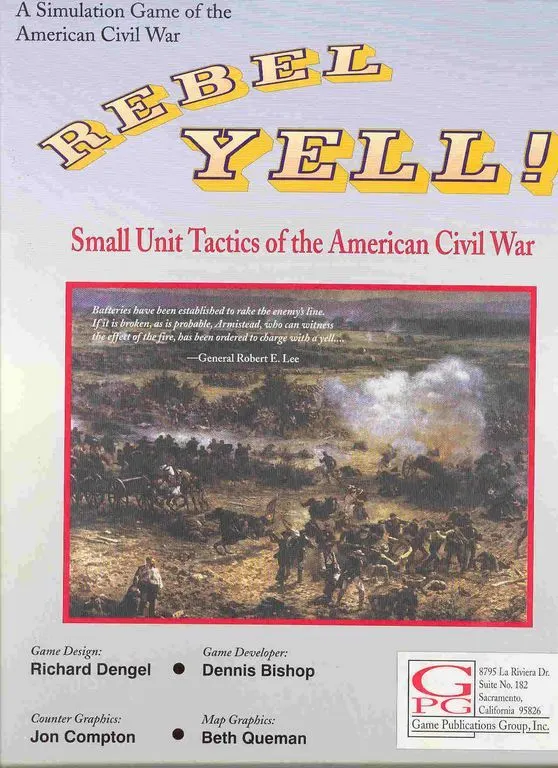
Rebel Yell! ist ein Brettspiel aus dem Jahr 1991 für 2 Personen und mit 240 Minuten pro Partie. Entwickelt wurde es von Richard A. Dengel; die wichtigsten Mechaniken sind Dice Rolling.
Auf Englisch
Rebel Yell is a simulation of American Civil War small-unit tactics. The playing pieces in the game represent companies of infantry and cavalry or sections of artillery Each infantry and cavalry unit has one strength point and is equivalent to between 45 and 100 men, depending upon the scenario. Each artillery unit has two strength points and equals two guns. The players of Rebel Yell assume the roles of divisional commanders. Each game turn is broken down into segments. During an action segment, the units of a particular player may conduct a single action. In the beginning modules these actions are: Move, Fire, Assault, and Rally. During any Small Arms segment, the units of a particular player may only fire. There are no movement phases, fire phases, etc., as there are in other Civil War games. This absence, in addition to the fact that player segments are structured reciprocally, produces a feel of simultaneity uncommon to other designs. One of the most difficult problems faced by the Civil War tactician was the “problem of approach,”—in other words, how he should maneuver his unit to some objective while keeping his casualties and disorganization at a minimum. A commander who did not pay heed to the destructiveness of “modern” weaponry would find his formation damaged up to three hundred yards from the enemy. Rebel Yell addresses this problem. Within restrictions, defending units may fire at the enemy as he advances. Like a real-life commander, a player can no longer be certain that when he initiates an advance, his units will reach their objective. Players may find that even one or two companies Standing to Fire will be difficult to dislodge by frontal assault. Although Rebel Yell is a complex design, it is not out of the reach of the novice gamer. The rules are programmed, allowing small portions to be digested first and getting players into the game quickly. Provisions are made for such factors as infantry line formations (Standing to Maneuver, Standing to Fire, Skirmishers, and Cover), volley effects, leader quality, morale, and regimental flags. The rules for cavalry and artillery are also extensive. Once players have learned all the rules (or even before), they can design their own scenarios. The game includes six geomorphic maps. Because the maps can be aligned in a variety of ways, the players can recreate a “microscopic” examination of virtually any Civil War engagement. Although an excellent multi-player game, Rebel Yell accommodates the solitaire player, Likewise it can be played in a physically limited area. Rebel Yell is “big’ only in the sense that it is detailed.
Laut Katalog unterstützt Rebel Yell! 2 Personen. Das ist die vom Verlag angegebene Spielerzahl, das Spiel ist also genau für diese Anzahl von Mitspielenden ausgelegt. Varianten für andere Gruppengrößen sind, sofern vorhanden, in der Anleitung deiner Ausgabe beschrieben; prüfe sie, bevor du eine andere Konfiguration aufbaust.
Die angegebene Spieldauer für Rebel Yell! beträgt 240 Minuten. Das ist die Schätzung des Verlags für eine vollständige Partie. Die tatsächliche Dauer hängt von der Gruppe, der Personenzahl und der Regelkenntnis ab: Erste Partien dauern meist länger, erfahrene Gruppen sind oft schneller fertig. Aufbau und Regelerklärung sind in dieser Schätzung nicht enthalten.
Rebel Yell! hat bei BoardGameGeek eine Komplexitätswertung von 3,0 von 5 und gilt damit als mittelschweres Spiel. Die Wertung zeigt, wie viel Regelwissen, Planung und Entscheidungen eine typische Partie verlangt. Schwerere Spiele brauchen bei der ersten Erklärung mehr Zeit, daher hilft vor dem Spieleabend eine Vorbereitungsanleitung.
Rebel Yell! gehört zu diesen Kategorien: Wargame und American Civil War. Die wichtigsten Mechaniken sind Dice Rolling. Kategorien beschreiben Thema und Setting eines Spiels, Mechaniken dagegen, was die Spielenden in ihrem Zug tatsächlich tun. Jede Mechanik führt zu einer Katalogseite mit ähnlichen Spielen, falls du etwas Vergleichbares suchst.
Als Autoren von Rebel Yell! sind angegeben: Richard A. Dengel. Diese Angaben stammen aus den veröffentlichten Spieldaten und nennen die für das Spieldesign verantwortlichen Personen, nicht die Illustratoren oder Verlage. Die Autorenseiten auf MeepleRules sammeln weitere Titel derselben Autoren – praktisch, wenn dir ein Spiel gefällt und du ähnliche Spiele suchst.
Im Katalog ist Rebel Yell! als Grundspiel aufgeführt. Es lässt sich eigenständig mit dem Material aus der Schachtel spielen und benötigt keinen weiteren Titel. Erweiterungen, sofern es welche gibt, ergänzen neues Material oder neue Regeln und sind im Katalog separat mit einem Verweis auf dieses Grundspiel aufgeführt.