

- BGG-Rang
- BGG #623
- BGG-Bewertung
- 7,0
Sheriff of Nottingham
- 3–5 Spieler
- 60 Min.
- Komplexität 1,7/5
- 2014
1920
Regelhilfe für Riichi Mahjong
Verständliche Erklärungen zu Spielzügen, Karteneffekten und strittigen Situationen mit Verweisen auf offizielle Quellen und gespeichertem Fragenverlauf.
Für 3 Personen
Was möchtest du wissen?
Antworten stammen aus dem offiziellen Regelheft, mit Seitenangabe zum Nachprüfen.
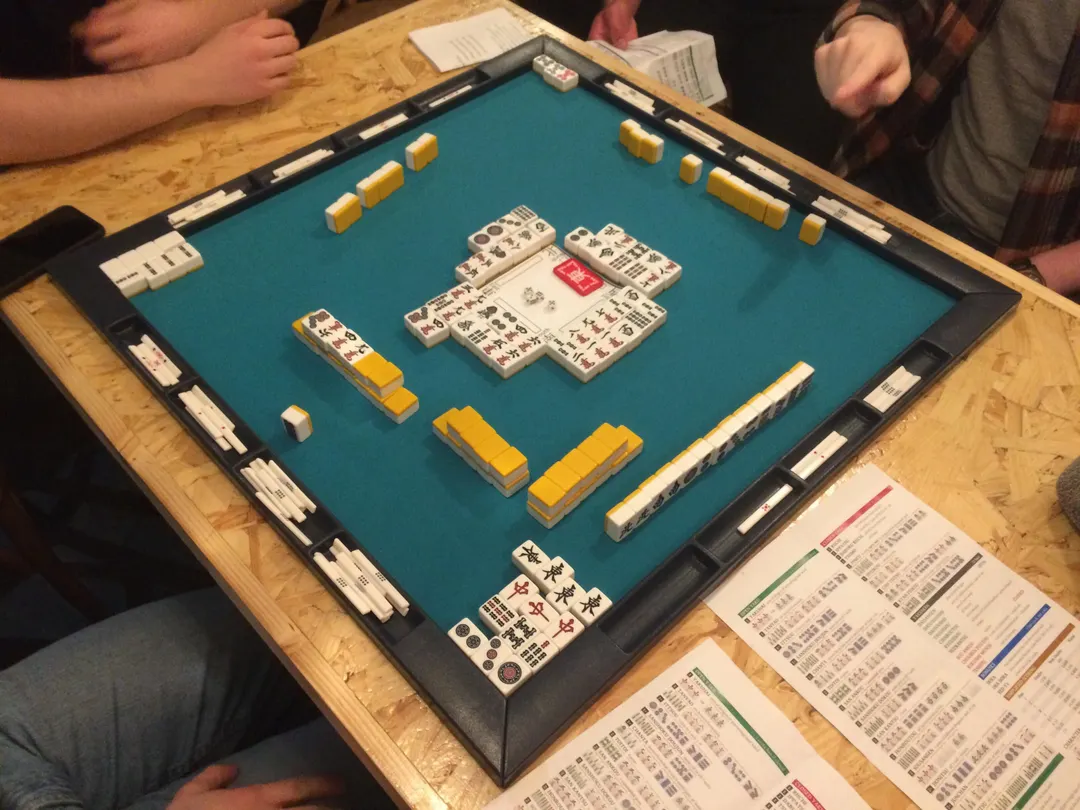
Riichi Mahjong ist ein Brettspiel aus dem Jahr 1920 für 3–4 Personen, mit 60–120 Minuten pro Partie und ab 8 Jahren. Die wichtigsten Mechaniken sind Hand Management, Set Collection und Betting and Bluffing.





Auf Englisch
Japanese Mahjong, especially called Riichi Mahjong (リーチ・マージャン), is a very specific remake from Japan of the traditional Chinese Mahjong. It is as close and yet far from Chinese Mahjong as Shôgi (Japanese Chess) can be the same and yet different from original Chess. Mahjong was brought to Japan in 1904, but the Riichi form that is used in modern times probably originated from the 1920s. Today, the worldwide famous Mahjong Association officially recognized the complete rules of Riichi Mahjong for Tournaments. The main differences are : 1) The 1-Yaku minimum: In order to win a hand, it can only be validated when your hand has at least one of the Yaku (specific hand combinations) in it. 2) Dora: A specific bonus tiles are indicated by the flipped tile from the dead wall and providing other possible Han bonus. 3) Riichi: When a player is Tenpai (one tile away from having a Mahjong hand, valid or not), he can bet a 1000 points chip to add one Yaku to his hand (thus validating a possible invalid hand). Winning with a Riichi hand allows access to the hidden ura-dora, which is an added dora indicator located underneath the revealed dora tile. 4) Abortive draws: Specific conditions, which ends a hand without winning prior to the drawing of all tiles, aside from the dead wall. 5) Scoring system: Much more complex than in Chinese Mahjong, it is based on hand combinations (Yaku) providing multipliers (Han) that combine with some other circumstantial points like the type of tiles in the hand (Fu) for any 4 han or less. The combination of Han and Fu correspond to a chart (and even an equation) to finally produce the hand's scoring points (Ten). Some other minor elements in the Riichi Mahjong differ from the original Mahjong but are not important enough to be fully mentioned, like the Red 5 tiles (a non-official variant sometimes used which gives bonus like the Dora) or the validation of some Yaku (when the hand must be kept hidden or not, depending on the Japanese region where the game is played).
Laut Katalog unterstützt Riichi Mahjong 3–4 Personen. Diese Spanne entspricht der vom Verlag angegebenen Spielerzahl, das Spiel lässt sich also für jede Gruppengröße innerhalb dieser Spanne aufbauen. Aufbau, einzelne Regeln und Wertungsdetails können je nach Personenzahl trotzdem abweichen; prüfe daher die genaue Konfiguration in der Anleitung deiner Ausgabe.
Die angegebene Spieldauer für Riichi Mahjong beträgt 60–120 Minuten. Das ist die Schätzung des Verlags für eine vollständige Partie. Die tatsächliche Dauer hängt von der Gruppe, der Personenzahl und der Regelkenntnis ab: Erste Partien dauern meist länger, erfahrene Gruppen sind oft schneller fertig. Aufbau und Regelerklärung sind in dieser Schätzung nicht enthalten.
Im Katalog wird Riichi Mahjong ab 8 Jahren empfohlen. Das ist die Empfehlung des Verlags und berücksichtigt Leseanforderungen, Regelkomplexität und Kleinteile, nicht nur das Thema. Jüngere Kinder können oft mit Hilfe eines Erwachsenen mitspielen; beachte die Altersangabe deiner Ausgabe und die Brettspielerfahrung deiner Gruppe.
Riichi Mahjong hat bei BoardGameGeek eine Komplexitätswertung von 3,6 von 5 und gilt damit als mittelschweres Spiel. Die Wertung zeigt, wie viel Regelwissen, Planung und Entscheidungen eine typische Partie verlangt. Schwerere Spiele brauchen bei der ersten Erklärung mehr Zeit, daher hilft vor dem Spieleabend eine Vorbereitungsanleitung.
Riichi Mahjong gehört zu diesen Kategorien: Abstract Strategy. Die wichtigsten Mechaniken sind Hand Management, Set Collection und Betting and Bluffing. Kategorien beschreiben Thema und Setting eines Spiels, Mechaniken dagegen, was die Spielenden in ihrem Zug tatsächlich tun. Jede Mechanik führt zu einer Katalogseite mit ähnlichen Spielen, falls du etwas Vergleichbares suchst.
Im Katalog ist Riichi Mahjong als Grundspiel aufgeführt. Es lässt sich eigenständig mit dem Material aus der Schachtel spielen und benötigt keinen weiteren Titel. Erweiterungen, sofern es welche gibt, ergänzen neues Material oder neue Regeln und sind im Katalog separat mit einem Verweis auf dieses Grundspiel aufgeführt.