
- BGG-Rang
- BGG #6.221
- BGG-Bewertung
- 7,8
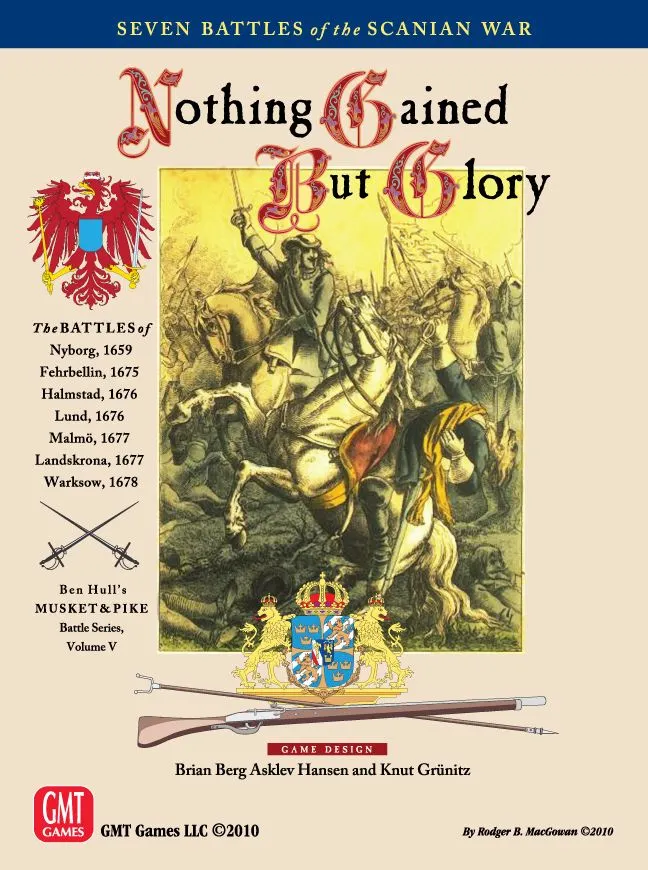
Nothing Gained But Glory
- 2 Spieler
- 300 Min.
- Komplexität 3,7/5
- 2010
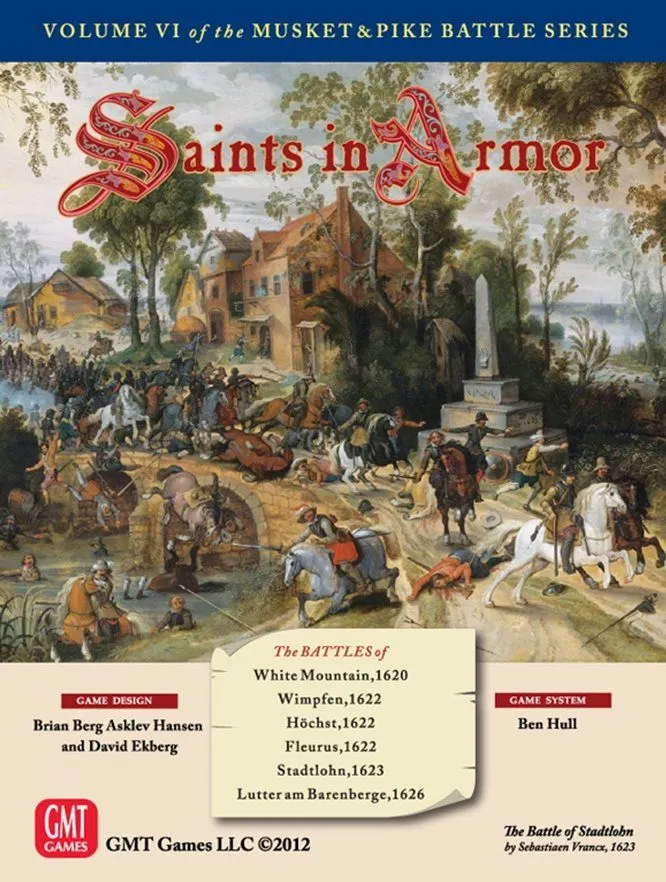
2012
Regelhilfe für Saints in Armor
Verständliche Erklärungen zu Spielzügen, Karteneffekten und strittigen Situationen mit Verweisen auf offizielle Quellen und gespeichertem Fragenverlauf.
Für 2 Personen
Was möchtest du wissen?
Antworten stammen aus dem offiziellen Regelheft, mit Seitenangabe zum Nachprüfen.
Saints in Armor ist ein Brettspiel aus dem Jahr 2012 für 2 Personen, mit 300 Minuten pro Partie und ab 14 Jahren. Entwickelt wurde es von Brian Asklev und David Ekberg; die wichtigsten Mechaniken sind Hexagon Grid und Simulation.




Auf Englisch
The Bohemian Revolt of 1618 triggered the Thirty Years War and in the early period of the war the Catholic/Imperial cause enjoyed an almost unbroken string of victories. This game, part of the Musket and Pike Battle Series, simulates six battles of the early Thirty Years War. In the period covered, the armies deployed in more compact formations so each battle fits on half of a standard map. The battles covered in this game are: White Mountain November, 1620 The combined army of the Holy Roman Empire and the Catholic League under Johann Tserclaes, the Count of Tilly, strike a blow directly at the Bohemian capital of Prague. The Bohemians make a stand on the slopes of White Mountain outside the town. Their Transylvanian allies desert them at the most critical point of the battle, causing the total collapse of the Bohemian army and its cause. This is a short scenario where the qualitatively superior Catholic forces must crush the strongly positioned Bohemians who are bolstered by a large Transylvanian contingent of questionable reliability. Wimpfen May, 1622 Tilly joins forces with the Spanish under Cordoba. Together they pursue the smaller army of the Markgraf of Baden-Durlach. They catch his army near the town of Wimpfen, where it is drawn up in a defensive position in a river bend. The Badian camp is fortified in a special traditional way with Spießwagen ("pikewagons"), mobile barricades equipped with sharp poles and small mortars. Only when a powder wagon detonates in the midst of the Protestant position, scattering the defenders, the Catholics are able to storm the wagonburg and heavy fighting breaks out. A balanced pitched battle. A larger Catholic army tries to defeat a Protestant army that is not only protected by a wagonburg but also possesses a strong cavalry force for counterattacks. Höchst June, 1622 The Bavarians under Tilly catch the forces of the zealous Protestant Duke Christian as they try to cross the river Main. To protect the crossing, Christian makes a stand at a stream. At first Tilly hesitates, but eventually the Bavarians attack and the Protestant army dissolves in a chaotic retreat. A rearguard situation, where the Protestants must delay the Catholics while simultaneously trying to retreat the majority of their army to safety. Fleurus August, 1622 Defeated and demoralized, the combined forces of the condottiere Mansfeld and Duke Christian try to escape the German theater and enter the service of the United Provinces instead. Cordoba's Spanish army blocks them at Fleurus in what is today Belgium. The unpaid and mutinous Protestants attack at dawn in an attempt to break through. In a vicious five-hour fight, the Spanish hold, but enough Protestants break through to force the Spanish to lift an important siege in the Netherlands. This is a smaller pitched battle where a large but very unreliable Protestant army attempts to overwhelm the smaller but more experienced Spanish army. This battle is suitable as an introduction to the game system. Stadtlohn August, 1623 Following the battle of Fleurus, Duke Christian again rebuilds an army with raw recruits to join with Mansfeld in the Netherlands and renew the fight for the Protestant cause. However, he soon finds himself outlawed by the Imperor, unsupported and forced to retreat when Tilly's veteran army bears down on him. The Protestan army, slowed by a massive baggage train attempts a last stand and finds itself caught by Tilly's vanguard when within sight of the Dutch border. True to form, Christian decides to risk his army to save his baggage train, but ends up losing both. A race-against-the-clock rearguard situation where the focus is on the fate of the Protestant baggage train that is slowly moving towards the map edge. Lutter am Barenberge August, 1626 The Danish King Christian IV intervenes in the Thirty Years War and pushes Tilly back during the early summer. However, he finds himself outnumbered and on the defensive when Tilly is reinforced by Imperial troops. Christian decides to turn on his pursuers and gives battle in a strong defensive position at Lutter am Barenberge. The initial Catholic attacks are repulsed, but the subsequent uncontrolled Danish counterattack results in the eventual collapse of the Danish army. This is also a rearguard battle, but with more evenly matched armies, though the Danes are severely hampered by an unusual command situation. In addition to scenario specific special rules that highlight the unique events of each battle, the battles in the game all share a simple set of special rules. These rules show the peculiarities of the early years of the Thirty Years War, such as Croat/Transylvanian style light cavalry. Even though not all of the battles included were equal contests in military terms, the player victory conditions are balanced. Along with the special rules, that means the battles are interesting for both sides.
Laut Katalog unterstützt Saints in Armor 2 Personen. Das ist die vom Verlag angegebene Spielerzahl, das Spiel ist also genau für diese Anzahl von Mitspielenden ausgelegt. Varianten für andere Gruppengrößen sind, sofern vorhanden, in der Anleitung deiner Ausgabe beschrieben; prüfe sie, bevor du eine andere Konfiguration aufbaust.
Die angegebene Spieldauer für Saints in Armor beträgt 300 Minuten. Das ist die Schätzung des Verlags für eine vollständige Partie. Die tatsächliche Dauer hängt von der Gruppe, der Personenzahl und der Regelkenntnis ab: Erste Partien dauern meist länger, erfahrene Gruppen sind oft schneller fertig. Aufbau und Regelerklärung sind in dieser Schätzung nicht enthalten.
Im Katalog wird Saints in Armor ab 14 Jahren empfohlen. Das ist die Empfehlung des Verlags und berücksichtigt Leseanforderungen, Regelkomplexität und Kleinteile, nicht nur das Thema. Jüngere Kinder können oft mit Hilfe eines Erwachsenen mitspielen; beachte die Altersangabe deiner Ausgabe und die Brettspielerfahrung deiner Gruppe.
Saints in Armor hat bei BoardGameGeek eine Komplexitätswertung von 3,6 von 5 und gilt damit als mittelschweres Spiel. Die Wertung zeigt, wie viel Regelwissen, Planung und Entscheidungen eine typische Partie verlangt. Schwerere Spiele brauchen bei der ersten Erklärung mehr Zeit, daher hilft vor dem Spieleabend eine Vorbereitungsanleitung.
Saints in Armor gehört zu diesen Kategorien: Wargame und Pike and Shot. Die wichtigsten Mechaniken sind Hexagon Grid und Simulation. Kategorien beschreiben Thema und Setting eines Spiels, Mechaniken dagegen, was die Spielenden in ihrem Zug tatsächlich tun. Jede Mechanik führt zu einer Katalogseite mit ähnlichen Spielen, falls du etwas Vergleichbares suchst.
Als Autoren von Saints in Armor sind angegeben: Brian Asklev und David Ekberg. Diese Angaben stammen aus den veröffentlichten Spieldaten und nennen die für das Spieldesign verantwortlichen Personen, nicht die Illustratoren oder Verlage. Die Autorenseiten auf MeepleRules sammeln weitere Titel derselben Autoren – praktisch, wenn dir ein Spiel gefällt und du ähnliche Spiele suchst.
Im Katalog ist Saints in Armor als Grundspiel aufgeführt. Es lässt sich eigenständig mit dem Material aus der Schachtel spielen und benötigt keinen weiteren Titel. Erweiterungen, sofern es welche gibt, ergänzen neues Material oder neue Regeln und sind im Katalog separat mit einem Verweis auf dieses Grundspiel aufgeführt.