- BGG-Rang
- BGG #2.494
- BGG-Bewertung
- 7,3
Skat
1810
Regelhilfe für Skat
Verständliche Erklärungen zu Spielzügen, Karteneffekten und strittigen Situationen mit Verweisen auf offizielle Quellen und gespeichertem Fragenverlauf.
- 3 Spieler
- 30 Min.
- 10+
- Komplexität 3,1/5

Für 3 Personen
Regelassistent für Skat
Was möchtest du wissen?
Antworten stammen aus dem offiziellen Regelheft, mit Seitenangabe zum Nachprüfen.
Skat ist ein Brettspiel aus dem Jahr 1810 für 3 Personen, mit 30 Minuten pro Partie und ab 10 Jahren. Die wichtigsten Mechaniken sind Auction / Bidding, Team-Based Game und Communication Limits.
Über das Spiel
Auf Englisch
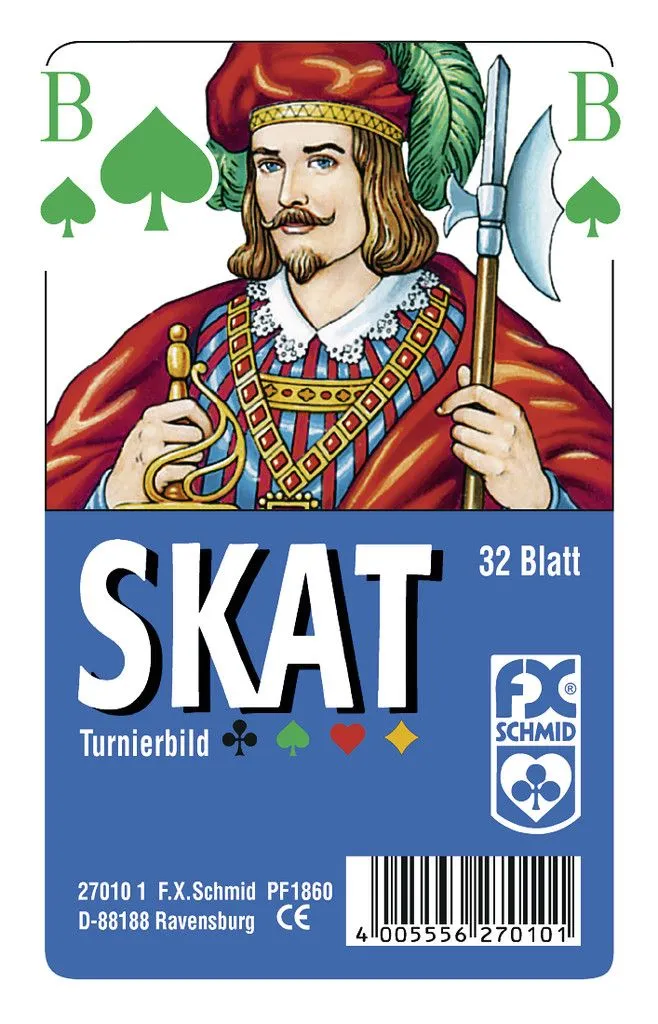
Traditional German card game for three players played with a standard card deck (2-6 removed), roughly 200 years old. The game is based on Schafkopf, Ombre (bidding) and Tarock (remaining cards). The latest revision of rules as approved by both the International Skat Players Association (ISPA) and the German Skat Association (DSkV) dates back to 1998. A play comprises two phases: first an intricate bidding process to decide the solo player who choses the type of game to be played in the second phase, the actual playing of tricks. If the solo player wins (takes more than half the total worth of cards in the game), the solo player alone will score points equal to the announced type of game and other modifiers (listed below); otherwise, the other two players will each score the double amount of these points. Both the bid and the final score depend on type of game announced combination of Jacks margin of winning (score 90+: "schneider"; take all tricks: "schwarz") (optional) declaration of margin of winning before the first trick is played (optional) open play of cards (optional) play with the initial hand ("hand" play) (optional) doubling of scoring value: *2 ("Kontra"); re-doubling *4 ("Re"); unofficial rules allow re-doubling ad infinitum exception for the Ramsch variant including sub-variants: Highest total worth of cards taken as tricks is scored negatively; the score is doubled when one other player took no trick ("virgin"), also doubled for each passing of the remaining cards without exchanging, if the drafting Ramsch variant is applied ("geschoben"); a player may also try to "shoot the moon" by taking all tricks (consequently scores +120 alone when successful). The solo player can choose between the following game modes: Suit (one suit and Jacks are trumps) Grand (only Jacks are trumps) Null (no trumps, solo player only wins without tricks). Unofficial variants: The most popular variant is Ramsch, which is applied when no player bids for the solo. This game mode punishes players who likely avoid the risk of successfully bidding for the solo with an only mediocre, but possible hand. It follows the rules for Grand, but highest score loses (no partnerships!). Due to the sometimes extraordinarily high (negative) scores, Ramsch plays may strongly distort a player's total scoring for the evening, and is therefore not officially sanctioned. Revolution (in three variants): basically a Null in open play, but the counter-players are allowed to exchange cards. Skat gained nation wide popularity and a major development of its mechanisms in the course of the first world war. The game as it is today is a result of constant modification and refinement by countless players in the trenches of the German Western front. The current form of bidding with ascending numbers prevailed among the players, and many unofficial variants were introduced. Though first rejected by the Skat association, a lot of the so-called "trench rules" later became officially sanctioned. The official tournament deck is a compromise that solved another dispute between the German and the International Skat Association by combining the colours of a German Suit (predominantly found in Southern and East Germany, Switzerland, Austria) with the symbols of a French Suit (predominant elsewhere in the regions where Skat is popular, foremost Northern and West Germany).
Kategorien
Verlage
- (Unknown)
- ASS Altenburger Spielkarten
- Piatnik
- AMIGO
- F.X. Schmid
- (Public Domain)
- Heye Verlag
- Teepe Sportverlag
- Cartamundi
- Berliner Spielkarten
- AG Müller (AGMüller)
- Heraclio Fournier
- Pelikan
- Nürnberger-Spielkarten-Verlag
- The United States Playing Card Company
- TS Spielkarten
- Bielefelder Spielkarten
- VEB (Volkseigener Betrieb) Spielkartenfabrik Altenburg
- Clicker Spiele
- Heritage Products Ltd
- English Heritage
- Heinrich Schwarz & Co
- Castrol
- Coeur
- Ilsespiel
- Kömmerling
- Underberg
- Solvay S.A.
- Beardshaker Games
- Dino Entertainment
- Verlag Neue Kritik
- Trienekens R+T Entsorgung
Fragen und Antworten
Laut Katalog unterstützt Skat 3 Personen. Das ist die vom Verlag angegebene Spielerzahl, das Spiel ist also genau für diese Anzahl von Mitspielenden ausgelegt. Varianten für andere Gruppengrößen sind, sofern vorhanden, in der Anleitung deiner Ausgabe beschrieben; prüfe sie, bevor du eine andere Konfiguration aufbaust.
Die angegebene Spieldauer für Skat beträgt 30 Minuten. Das ist die Schätzung des Verlags für eine vollständige Partie. Die tatsächliche Dauer hängt von der Gruppe, der Personenzahl und der Regelkenntnis ab: Erste Partien dauern meist länger, erfahrene Gruppen sind oft schneller fertig. Aufbau und Regelerklärung sind in dieser Schätzung nicht enthalten.
Im Katalog wird Skat ab 10 Jahren empfohlen. Das ist die Empfehlung des Verlags und berücksichtigt Leseanforderungen, Regelkomplexität und Kleinteile, nicht nur das Thema. Jüngere Kinder können oft mit Hilfe eines Erwachsenen mitspielen; beachte die Altersangabe deiner Ausgabe und die Brettspielerfahrung deiner Gruppe.
Skat hat bei BoardGameGeek eine Komplexitätswertung von 3,1 von 5 und gilt damit als mittelschweres Spiel. Die Wertung zeigt, wie viel Regelwissen, Planung und Entscheidungen eine typische Partie verlangt. Schwerere Spiele brauchen bei der ersten Erklärung mehr Zeit, daher hilft vor dem Spieleabend eine Vorbereitungsanleitung.
Skat gehört zu diesen Kategorien: Card Game. Die wichtigsten Mechaniken sind Auction / Bidding, Team-Based Game und Communication Limits. Kategorien beschreiben Thema und Setting eines Spiels, Mechaniken dagegen, was die Spielenden in ihrem Zug tatsächlich tun. Jede Mechanik führt zu einer Katalogseite mit ähnlichen Spielen, falls du etwas Vergleichbares suchst.
Im Katalog ist Skat als Grundspiel aufgeführt. Es lässt sich eigenständig mit dem Material aus der Schachtel spielen und benötigt keinen weiteren Titel. Erweiterungen, sofern es welche gibt, ergänzen neues Material oder neue Regeln und sind im Katalog separat mit einem Verweis auf dieses Grundspiel aufgeführt.