

- BGG-Rang
- BGG #638
- BGG-Bewertung
- 7,7
Space Empires 4X
- 1–4 Spieler
- 60–240 Min.
- Komplexität 3,4/5
- 2011
2020
Regelhilfe für Stellar Horizons
Verständliche Erklärungen zu Spielzügen, Karteneffekten und strittigen Situationen mit Verweisen auf offizielle Quellen und gespeichertem Fragenverlauf.
Für 1 Person
Was möchtest du wissen?
Antworten stammen aus dem offiziellen Regelheft, mit Seitenangabe zum Nachprüfen.
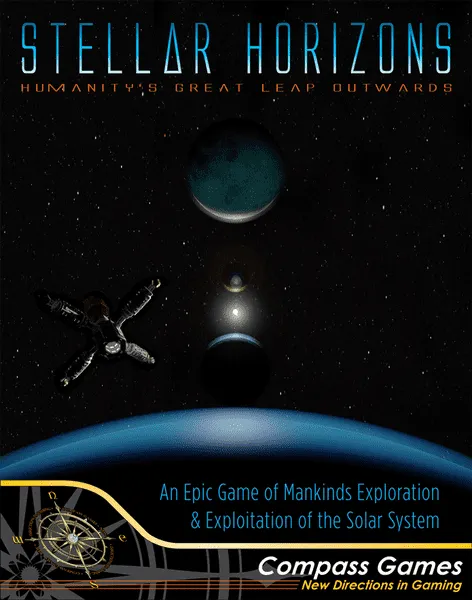
Stellar Horizons ist ein Brettspiel aus dem Jahr 2020 für 1–7 Personen, mit 120–240 Minuten pro Partie und ab 14 Jahren. Entwickelt wurde es von Andrew Rader; die wichtigsten Mechaniken sind Income, Dice Rolling und Simulation.



Auf Englisch
Stellar Horizons is a "build your own space program" game in which you lead one of seven Earth factions to explore and develop our solar system. Designed by a real-life space engineer with a PhD in long-duration spaceflight from MIT, Stellar Horizons is intended to be a plausible representation of the first steps of humanity towards the stars between 2030 and 2169, with each turn representing a year of time. You control your faction's space program, outposts, and fleets spanning across the solar system, although you also have some influence over your faction's politics back home on Earth as space development becomes more important. Movement is based on real physics. You move from orbit to orbit, or conduct long range transfers to move between planetary systems like Earth, Mars, or Jupiter. As you send out robotic explorers and crewed vehicles to explore the solar system, they bring back valuable data to further your scientific research. Technologies are intended to represent plausible extrapolations of existing development during the next 150 years: there are no transporters or warp drive, but you will be able to develop rockets powered by fusion and even anti-matter. In the engineering and biology domains, you'll eventually be able to construct space elevators and put your crews into safe hibernation for long journeys. You'll have access to a wide variety of robot explorers and crewed ships. These range from tiny probes intended to merely take photographs as you fly past Jupiter, to giant destroyers, cruisers, and battleships which ply the space lanes with peaceful or hostile intentions. New ship types become available as you gain access to better technology over the course of the game. You'll be given a budget to spend on Earth and can also build bases to harvest minerals, organics, and fuel to expands your economy. You can also forge diplomatic relationships with players and non-player factions alike, and trade resources at their bases to earn extra cash. Each of the seven factions has different strengths, weaknesses, abilities, and available ships based on their unique geopolitical situation. Military conflict is certainly possible but not always encouraged. Stellar Horizons features more diplomatic, technological, and economic competition than outright combat, although neglecting warships entirely leaves you vulnerable to pirates, trade embargoes, and sneak attacks by rogue players and factions. Stellar Horizons includes short co-operative and competitive scenarios lasting an hour or more, and campaigns lasting a day up to about a full weekend for experienced players. Up to seven players can play at a time and the game is most fun with at least two, but there are also one-player scenarios, and the campaigns are highly suited for solo play. There are three ways to win the campaign: be the first to develop an Interstellar Colonizer, terraform a world, or achieve dominance in space over your rivals.
Laut Katalog unterstützt Stellar Horizons 1–7 Personen. Diese Spanne entspricht der vom Verlag angegebenen Spielerzahl, das Spiel lässt sich also für jede Gruppengröße innerhalb dieser Spanne aufbauen. Aufbau, einzelne Regeln und Wertungsdetails können je nach Personenzahl trotzdem abweichen; prüfe daher die genaue Konfiguration in der Anleitung deiner Ausgabe.
Die angegebene Spieldauer für Stellar Horizons beträgt 120–240 Minuten. Das ist die Schätzung des Verlags für eine vollständige Partie. Die tatsächliche Dauer hängt von der Gruppe, der Personenzahl und der Regelkenntnis ab: Erste Partien dauern meist länger, erfahrene Gruppen sind oft schneller fertig. Aufbau und Regelerklärung sind in dieser Schätzung nicht enthalten.
Im Katalog wird Stellar Horizons ab 14 Jahren empfohlen. Das ist die Empfehlung des Verlags und berücksichtigt Leseanforderungen, Regelkomplexität und Kleinteile, nicht nur das Thema. Jüngere Kinder können oft mit Hilfe eines Erwachsenen mitspielen; beachte die Altersangabe deiner Ausgabe und die Brettspielerfahrung deiner Gruppe.
Stellar Horizons hat bei BoardGameGeek eine Komplexitätswertung von 3,9 von 5 und gilt damit als schweres Spiel. Die Wertung zeigt, wie viel Regelwissen, Planung und Entscheidungen eine typische Partie verlangt. Schwerere Spiele brauchen bei der ersten Erklärung mehr Zeit, daher hilft vor dem Spieleabend eine Vorbereitungsanleitung.
Stellar Horizons gehört zu diesen Kategorien: Economic, Wargame und Exploration. Die wichtigsten Mechaniken sind Income, Dice Rolling und Simulation. Kategorien beschreiben Thema und Setting eines Spiels, Mechaniken dagegen, was die Spielenden in ihrem Zug tatsächlich tun. Jede Mechanik führt zu einer Katalogseite mit ähnlichen Spielen, falls du etwas Vergleichbares suchst.
Als Autoren von Stellar Horizons sind angegeben: Andrew Rader. Diese Angaben stammen aus den veröffentlichten Spieldaten und nennen die für das Spieldesign verantwortlichen Personen, nicht die Illustratoren oder Verlage. Die Autorenseiten auf MeepleRules sammeln weitere Titel derselben Autoren – praktisch, wenn dir ein Spiel gefällt und du ähnliche Spiele suchst.
Im Katalog ist Stellar Horizons als Grundspiel aufgeführt. Es lässt sich eigenständig mit dem Material aus der Schachtel spielen und benötigt keinen weiteren Titel. Erweiterungen, sofern es welche gibt, ergänzen neues Material oder neue Regeln und sind im Katalog separat mit einem Verweis auf dieses Grundspiel aufgeführt.