
- BGG-Rang
- BGG #18.211
- BGG-Bewertung
- 6,5
TRUT
- 2–4 Spieler
- 5–15 Min.
- Komplexität 1,7/5
- 1600
2021
Regelhilfe für Tea, Scones, and Arsenic
Verständliche Erklärungen zu Spielzügen, Karteneffekten und strittigen Situationen mit Verweisen auf offizielle Quellen und gespeichertem Fragenverlauf.
Für 1 Person
Was möchtest du wissen?
Antworten stammen aus dem offiziellen Regelheft, mit Seitenangabe zum Nachprüfen.
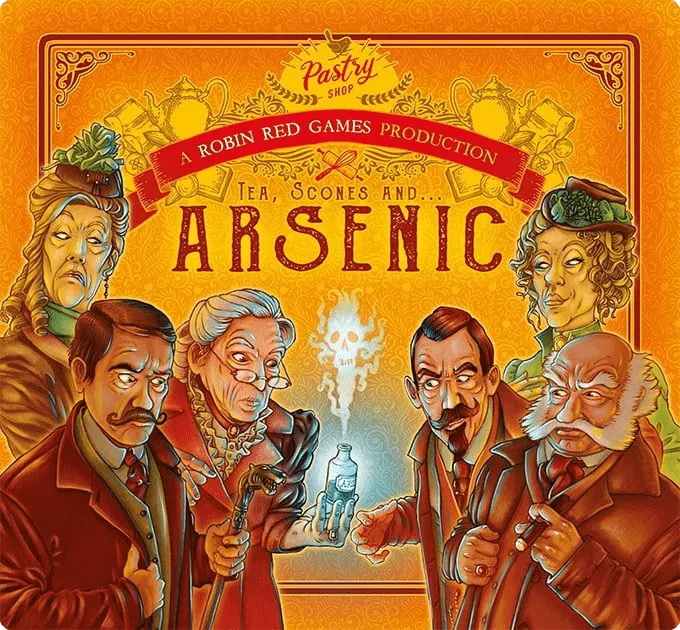
Tea, Scones, and Arsenic ist ein Brettspiel aus dem Jahr 2021 für 1–6 Personen, mit 15–30 Minuten pro Partie und ab 7 Jahren. Entwickelt wurde es von Pascal Boucher; die wichtigsten Mechaniken sind Push Your Luck, Player Elimination und Deduction.




Auf Englisch
You are members of an old English aristocratic family. Your uncle from America had the excellent idea of passing away bequeathing you his immense fortune. To celebrate the event, you decide to go for tea and enjoy some scones. However, each being equally greedy, each of the heirs decides to poison the cookies with Arsenic (a safe bet) in order to increase their share of their inheritance. Digestion promises to be difficult... Tea, Scones and ARSENIC is a family game, for 1 to 6 players. It’s a bluff party-game full of thought, strategy and a hint of luck. Goal of the game : Eat the most Scones without dying in excruciating pain. Setting up : Each player chooses a Cup board for their aristocrat (the choice of characters has no effect on the course of the game), and take 3 Sugar Cubes. The Scones are placed randomly, Poison side down, in the cookie box. You play with all the Scones, regardless of the number of players. Some Scones are normal, but others contain varying amounts of poison. The amount of poison is indicated at the back of the Scone. For each type of Scone, there are 2 harmless and 4 poisoned. The lethal dose at which a character succumbs to poison and is eliminated from the game differs depending on the number of players. The 1st player takes a Scone in hand and turns it over discreetly to know his dose of poison (the other players should not see anything), he can shuffle the Scones before picking if he want to. Either he eats it (he decides to keep it and places it in his Cup in front of him, Poison side hidden) or he puts it back in its place in the box and consumes a Sugar Cube to delay (he can shuffle the Scones afterward if he want to). In the course of the game, Scones pile up on his Cup. A player can look at his Scones at any time. In either case, their turn ends and it is the next player’s turn. When a player runs out of Sugar Cube, he is forced to eat the Scone. Each player, at the start of their turn (before playing), can decide that they have had enough, and stop playing (they take a turn each time it is their turn to play). In doing so, he forces the other players to continue for 2 more rounds (Honor rounds) without the possibility for them to stop. Once the 2 Honor Rounds have been completed, one of the surviving players (if any) may in round choose to stop. The remaining players therefore set off for 2 additional Honor Rounds. And so on… If a player reaches his natural resistance to poison (i.e. the number of arsenic doses he accumulated equals or exceeds the lethal dose), he dies (he is eliminated and his Scones are not counted). The deceased may choose to simply turn their board over to the Deceased side and laconically announce « I’m dead ». Or ... he may suddenly put his hands to his throat, uttering terrible rumblings interspersed with barely audible words such as « Cursed! », « Why so much hatred ... » or « Who will feed the dog? » Before slipping slowly from his chair and ending up lying on the floor in a grotesque position. To each his own style… —user summary
Laut Katalog unterstützt Tea, Scones, and Arsenic 1–6 Personen. Diese Spanne entspricht der vom Verlag angegebenen Spielerzahl, das Spiel lässt sich also für jede Gruppengröße innerhalb dieser Spanne aufbauen. Aufbau, einzelne Regeln und Wertungsdetails können je nach Personenzahl trotzdem abweichen; prüfe daher die genaue Konfiguration in der Anleitung deiner Ausgabe.
Die angegebene Spieldauer für Tea, Scones, and Arsenic beträgt 15–30 Minuten. Das ist die Schätzung des Verlags für eine vollständige Partie. Die tatsächliche Dauer hängt von der Gruppe, der Personenzahl und der Regelkenntnis ab: Erste Partien dauern meist länger, erfahrene Gruppen sind oft schneller fertig. Aufbau und Regelerklärung sind in dieser Schätzung nicht enthalten.
Im Katalog wird Tea, Scones, and Arsenic ab 7 Jahren empfohlen. Das ist die Empfehlung des Verlags und berücksichtigt Leseanforderungen, Regelkomplexität und Kleinteile, nicht nur das Thema. Jüngere Kinder können oft mit Hilfe eines Erwachsenen mitspielen; beachte die Altersangabe deiner Ausgabe und die Brettspielerfahrung deiner Gruppe.
Tea, Scones, and Arsenic hat bei BoardGameGeek eine Komplexitätswertung von 1,3 von 5 und gilt damit als leichtes Spiel. Die Wertung zeigt, wie viel Regelwissen, Planung und Entscheidungen eine typische Partie verlangt. Schwerere Spiele brauchen bei der ersten Erklärung mehr Zeit, daher hilft vor dem Spieleabend eine Vorbereitungsanleitung.
Tea, Scones, and Arsenic gehört zu diesen Kategorien: Humor, Party Game und Murder / Mystery. Die wichtigsten Mechaniken sind Push Your Luck, Player Elimination und Deduction. Kategorien beschreiben Thema und Setting eines Spiels, Mechaniken dagegen, was die Spielenden in ihrem Zug tatsächlich tun. Jede Mechanik führt zu einer Katalogseite mit ähnlichen Spielen, falls du etwas Vergleichbares suchst.
Als Autoren von Tea, Scones, and Arsenic sind angegeben: Pascal Boucher. Diese Angaben stammen aus den veröffentlichten Spieldaten und nennen die für das Spieldesign verantwortlichen Personen, nicht die Illustratoren oder Verlage. Die Autorenseiten auf MeepleRules sammeln weitere Titel derselben Autoren – praktisch, wenn dir ein Spiel gefällt und du ähnliche Spiele suchst.
Im Katalog ist Tea, Scones, and Arsenic als Grundspiel aufgeführt. Es lässt sich eigenständig mit dem Material aus der Schachtel spielen und benötigt keinen weiteren Titel. Erweiterungen, sofern es welche gibt, ergänzen neues Material oder neue Regeln und sind im Katalog separat mit einem Verweis auf dieses Grundspiel aufgeführt.