- BGG-Bewertung
- 7,6
Erweiterung für Barbarian: Rome vs. The Gauls and Samnites, 315-200 BC – SPQR Battle Module
The Great Battles of Magna Graecia: Part 1
2012
Regelhilfe für The Great Battles of Magna Graecia: Part 1
Verständliche Erklärungen zu Spielzügen, Karteneffekten und strittigen Situationen mit Verweisen auf offizielle Quellen und gespeichertem Fragenverlauf.
- 2 Spieler
- 12+
- Komplexität 4,0/5

Regelassistent für The Great Battles of Magna Graecia: Part 1
Was möchtest du wissen?
Antworten stammen aus dem offiziellen Regelheft, mit Seitenangabe zum Nachprüfen.
The Great Battles of Magna Graecia: Part 1 ist eine Erweiterung für Barbarian: Rome vs. The Gauls and Samnites, 315-200 BC – SPQR Battle Module aus dem Jahr 2012 für 2 Personen und ab 12 Jahren. Entwickelt wurde es von Dan Fournie; die wichtigsten Mechaniken sind Dice Rolling, Hexagon Grid und Simulation.
Über das Spiel
Auf Englisch
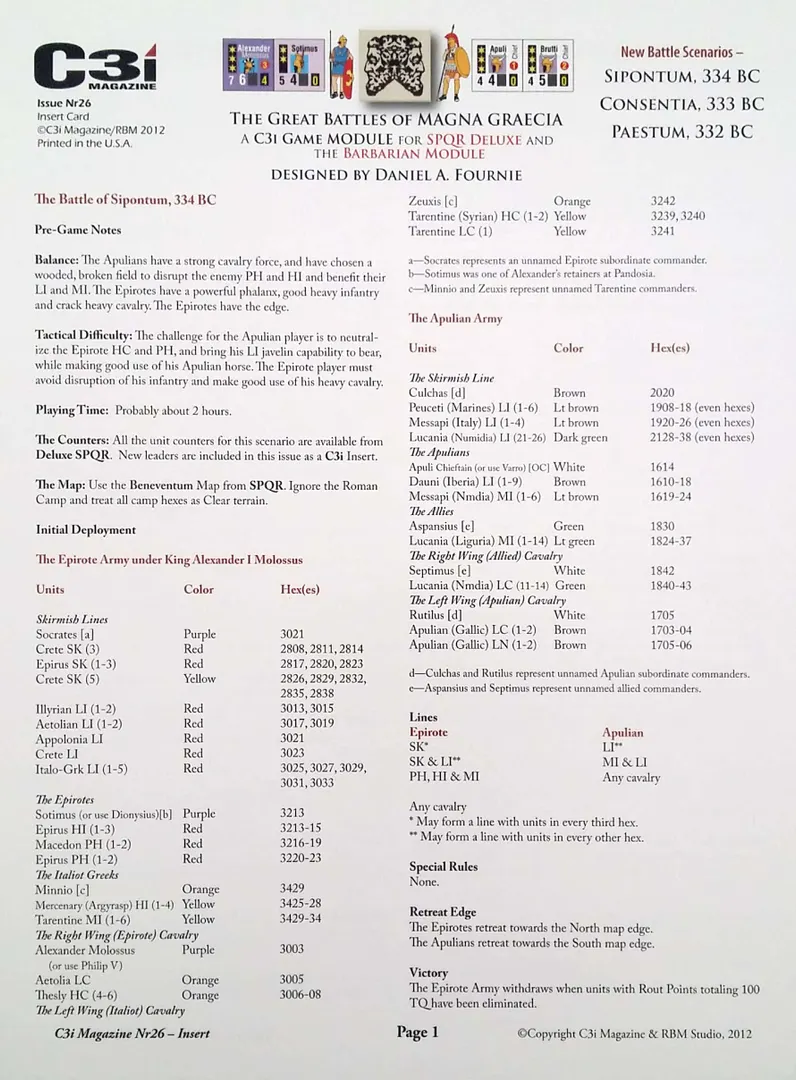
C3i Magazine #26 : A C3i Game Module for SPQR Deluxe and The Barbarian Module. From the publisher: "SPQR Deluxe features three great battles of King Pyrrhus of Epirus - Heraclea, Asculum and Beneventum. These battles give us agood look at the Greco-Macedonian military system in action against Rome. However, before Tarentum called in King Pyrrhus to battle the Romans in southern Italy, this Greek city-state had summoned a number of other Greek condotiere to fight the barbarian tribes of the interior - the piratical Apulians, the fierce Lucanians, the savage Bruttians, the mighty Samnites and the stalwart Romans. The Greek soldiers of fortune who answered her call hailed from many directions - Epirus to the esat, Sparta to the southeast and Syracuse to the southwest. The Hellenistic armies they led were similar in composition, but not indentical. Each mercenary captain brouht a core of troops from his homeland, supplemented by large mercenary forces drawn from the Adriatic and Ionian shores, the levies of Tarentum and tge Italiot League and occasionnally friendly Italian tribes. They were not altogether unsucessful, but none managed to achieve permanent résultats. This survey of foreign Greek armies battling to preserve Magna Graecia in the late Fourth Century BC will be presented in two parts. The battles presented provide an interesting mis of clashing military systems: the Hellenistic combined arms army versus a number of barbarian tribes, Samnite cohorts and even the legions of Rome. Part I begins with the campaigns of King Alexander I Molossus of Epirus." - The Battle of Sipontum, 334 BC. (Epirotes VS Apulians) - The Battle of Consentia, 333 BC. (Bruttians VS Epirotes) - The Battle of Paestrum, 332 BC. (Samnites and Lucanians VS Epirotes) - 4-pages historical background article. - 4-pages scenarios card - 4 new Leaders Counters
Kategorien
Mechanismen
Autoren
Verlage
- GMT Games
- RBM Studio
Fragen und Antworten
Laut Katalog unterstützt The Great Battles of Magna Graecia: Part 1 2 Personen. Das ist die vom Verlag angegebene Spielerzahl, das Spiel ist also genau für diese Anzahl von Mitspielenden ausgelegt. Varianten für andere Gruppengrößen sind, sofern vorhanden, in der Anleitung deiner Ausgabe beschrieben; prüfe sie, bevor du eine andere Konfiguration aufbaust.
Im Katalog wird The Great Battles of Magna Graecia: Part 1 ab 12 Jahren empfohlen. Das ist die Empfehlung des Verlags und berücksichtigt Leseanforderungen, Regelkomplexität und Kleinteile, nicht nur das Thema. Jüngere Kinder können oft mit Hilfe eines Erwachsenen mitspielen; beachte die Altersangabe deiner Ausgabe und die Brettspielerfahrung deiner Gruppe.
The Great Battles of Magna Graecia: Part 1 hat bei BoardGameGeek eine Komplexitätswertung von 4,0 von 5 und gilt damit als schweres Spiel. Die Wertung zeigt, wie viel Regelwissen, Planung und Entscheidungen eine typische Partie verlangt. Schwerere Spiele brauchen bei der ersten Erklärung mehr Zeit, daher hilft vor dem Spieleabend eine Vorbereitungsanleitung.
The Great Battles of Magna Graecia: Part 1 gehört zu diesen Kategorien: Wargame, Ancient und Expansion for Base-game. Die wichtigsten Mechaniken sind Dice Rolling, Hexagon Grid und Simulation. Kategorien beschreiben Thema und Setting eines Spiels, Mechaniken dagegen, was die Spielenden in ihrem Zug tatsächlich tun. Jede Mechanik führt zu einer Katalogseite mit ähnlichen Spielen, falls du etwas Vergleichbares suchst.
Als Autoren von The Great Battles of Magna Graecia: Part 1 sind angegeben: Dan Fournie. Diese Angaben stammen aus den veröffentlichten Spieldaten und nennen die für das Spieldesign verantwortlichen Personen, nicht die Illustratoren oder Verlage. Die Autorenseiten auf MeepleRules sammeln weitere Titel derselben Autoren – praktisch, wenn dir ein Spiel gefällt und du ähnliche Spiele suchst.
Im Katalog ist The Great Battles of Magna Graecia: Part 1 als Erweiterung zu Barbarian: Rome vs. The Gauls and Samnites, 315-200 BC – SPQR Battle Module aufgeführt. Erweiterungen ergänzen das Grundspiel um neues Material, neue Regeln oder Szenarien und sind meist nicht eigenständig spielbar; du brauchst also Barbarian: Rome vs. The Gauls and Samnites, 315-200 BC – SPQR Battle Module, um sie zu nutzen. Prüfe, ob deine Ausgabe von Barbarian: Rome vs. The Gauls and Samnites, 315-200 BC – SPQR Battle Module kompatibel ist, da manche Erweiterungen zwischen den Auflagen überarbeitet wurden.