
- BGG-Bewertung
- 8,7
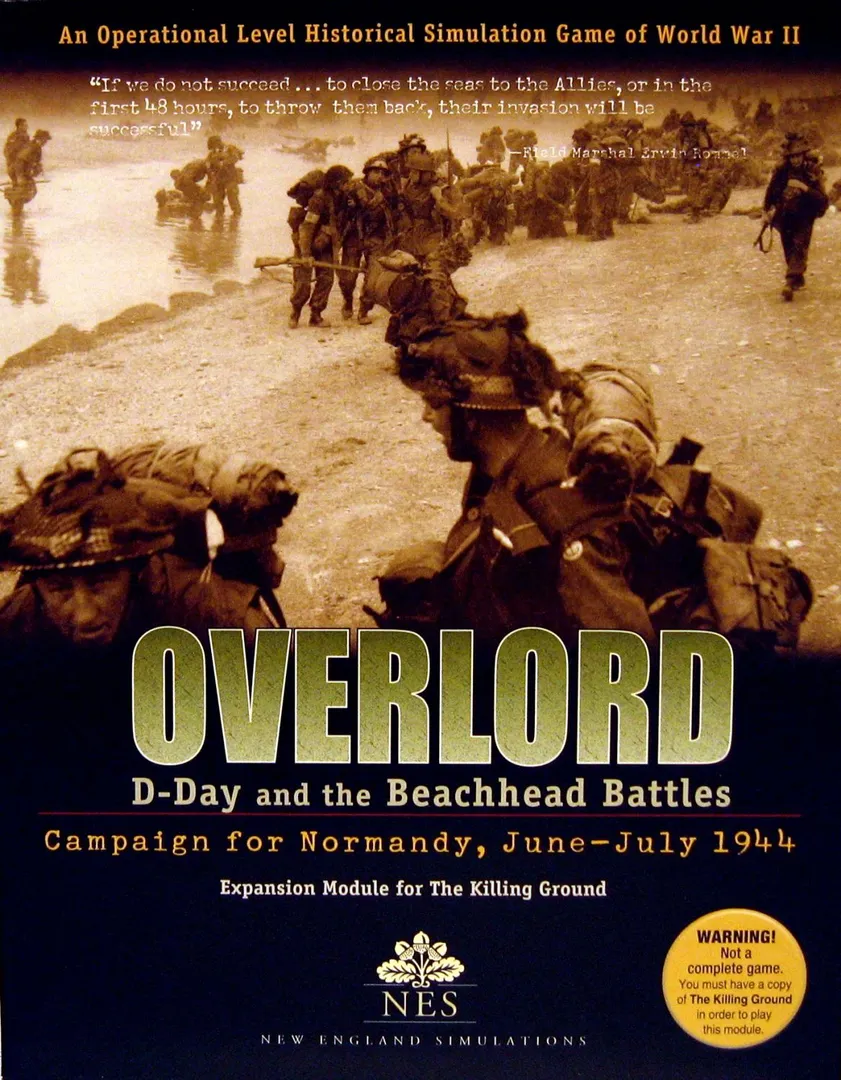
Overlord: D-Day and the Beachhead Battles
- 2–4 Spieler
- 240–2160 Min.
- Komplexität 3,7/5
- 2007

2002
Regelhilfe für The Killing Ground: Campaign for Normandy, July-August 1944
Verständliche Erklärungen zu Spielzügen, Karteneffekten und strittigen Situationen mit Verweisen auf offizielle Quellen und gespeichertem Fragenverlauf.
Für 2 Personen
Was möchtest du wissen?
Antworten stammen aus dem offiziellen Regelheft, mit Seitenangabe zum Nachprüfen.
The Killing Ground: Campaign for Normandy, July-August 1944 ist ein Brettspiel aus dem Jahr 2002 für 2–4 Personen, mit 300–2880 Minuten pro Partie und ab 14 Jahren. Entwickelt wurde es von Mark Hinkle; die wichtigsten Mechaniken sind Dice Rolling, Variable Set-up und Grid Movement.









Auf Englisch
New England Simulations revisits a familiar World War II venue -- the hedgerows of Normandy -- with some refreshing twists in The Killing Ground: Campaign for Normandy, July-August 1944". The game combines a mechanic usually reserved for smaller games -- a chit pull combat system -- with two gorgeous maps, 900 counters, and a 36-page rulebook that should have "Don't Panic!" inscribed on its cover (the designer was content to place the warning on the first page of rules instead). As you read the rules, you get the feeling that the designer wants to bring back the best parts of the "good old days" of wargaming -- that newfound excitement and thrill you once had that gradually wore off as you slogged through the complexity of the latest SPI monster. The rulebook is written almost in prose, gently explaining each rule and including historical footnotes when appropriate. Though long, it is well-organized and easily cross-referenced. The graphics are detailed but subtle, aiding play without distracting the player. A fair amount of information is packed on each counter. Player aids are plentiful. The game itself focuses on post-invasion Normandy, where the Germans are trying to delay and attrite the Allies prior to their inevitable breakout. As much of the victory depends on the Allies' ability to maintain momentum throughout the campaign as it does capturing key victory point hexes -- any signs of trench warfare or, worse, seesaw battling over villages is severely penalized. In yet another attempt to limit intelligence, the combat system includes a combat effectiveness 'chit pull' system that disguises actual unit combat strength up to the last moment. The system adds a level of uncertainty to the game that leads to unexpected combat results and tempers any tendency to attack without some forethought. Although primarily designed for two players, the game can accommodate up to four given its size and attention to detail. The Killing Ground includes five scenarios, all historical. Game Scale Units: Primarily regimental with tank and other support units as battalions. Time: Each game-turn is 1 day. Map: 2.5km per hex. A complete game of The Killing Ground will include the following: 1 rules booklet 1 Combat Manual 2 map sections (22” x 34” each) 3 different countersheets (900 counters printed front & back) 6 different charts (Combat Results Table, Allied Air Allocation Chart, US Army Support Points chart, British/Canadian Army Support Points chart, Game-Turn Record Track, Scenario Card). 2 six-sided dice 1 game box Expanded by: Overlord: D-Day and the Beachhead Battles
Laut Katalog unterstützt The Killing Ground: Campaign for Normandy, July-August 1944 2–4 Personen. Diese Spanne entspricht der vom Verlag angegebenen Spielerzahl, das Spiel lässt sich also für jede Gruppengröße innerhalb dieser Spanne aufbauen. Aufbau, einzelne Regeln und Wertungsdetails können je nach Personenzahl trotzdem abweichen; prüfe daher die genaue Konfiguration in der Anleitung deiner Ausgabe.
Die angegebene Spieldauer für The Killing Ground: Campaign for Normandy, July-August 1944 beträgt 300–2880 Minuten. Das ist die Schätzung des Verlags für eine vollständige Partie. Die tatsächliche Dauer hängt von der Gruppe, der Personenzahl und der Regelkenntnis ab: Erste Partien dauern meist länger, erfahrene Gruppen sind oft schneller fertig. Aufbau und Regelerklärung sind in dieser Schätzung nicht enthalten.
Im Katalog wird The Killing Ground: Campaign for Normandy, July-August 1944 ab 14 Jahren empfohlen. Das ist die Empfehlung des Verlags und berücksichtigt Leseanforderungen, Regelkomplexität und Kleinteile, nicht nur das Thema. Jüngere Kinder können oft mit Hilfe eines Erwachsenen mitspielen; beachte die Altersangabe deiner Ausgabe und die Brettspielerfahrung deiner Gruppe.
The Killing Ground: Campaign for Normandy, July-August 1944 hat bei BoardGameGeek eine Komplexitätswertung von 4,0 von 5 und gilt damit als schweres Spiel. Die Wertung zeigt, wie viel Regelwissen, Planung und Entscheidungen eine typische Partie verlangt. Schwerere Spiele brauchen bei der ersten Erklärung mehr Zeit, daher hilft vor dem Spieleabend eine Vorbereitungsanleitung.
The Killing Ground: Campaign for Normandy, July-August 1944 gehört zu diesen Kategorien: Wargame und World War II. Die wichtigsten Mechaniken sind Dice Rolling, Variable Set-up und Grid Movement. Kategorien beschreiben Thema und Setting eines Spiels, Mechaniken dagegen, was die Spielenden in ihrem Zug tatsächlich tun. Jede Mechanik führt zu einer Katalogseite mit ähnlichen Spielen, falls du etwas Vergleichbares suchst.
Als Autoren von The Killing Ground: Campaign for Normandy, July-August 1944 sind angegeben: Mark Hinkle. Diese Angaben stammen aus den veröffentlichten Spieldaten und nennen die für das Spieldesign verantwortlichen Personen, nicht die Illustratoren oder Verlage. Die Autorenseiten auf MeepleRules sammeln weitere Titel derselben Autoren – praktisch, wenn dir ein Spiel gefällt und du ähnliche Spiele suchst.
Im Katalog ist The Killing Ground: Campaign for Normandy, July-August 1944 als Grundspiel aufgeführt. Es lässt sich eigenständig mit dem Material aus der Schachtel spielen und benötigt keinen weiteren Titel. Erweiterungen, sofern es welche gibt, ergänzen neues Material oder neue Regeln und sind im Katalog separat mit einem Verweis auf dieses Grundspiel aufgeführt.