
- BGG-Rang
- BGG #1.690
- BGG-Bewertung
- 7,7
Heroes of Might and Magic III: The Board Game
- 1–3 Spieler
- 90–120 Min.
- Komplexität 3,5/5
- 2024
1989
Regelhilfe für The Siege of Jerusalem (Third Edition)
Verständliche Erklärungen zu Spielzügen, Karteneffekten und strittigen Situationen mit Verweisen auf offizielle Quellen und gespeichertem Fragenverlauf.
Für 2 Personen
Was möchtest du wissen?
Antworten stammen aus dem offiziellen Regelheft, mit Seitenangabe zum Nachprüfen.
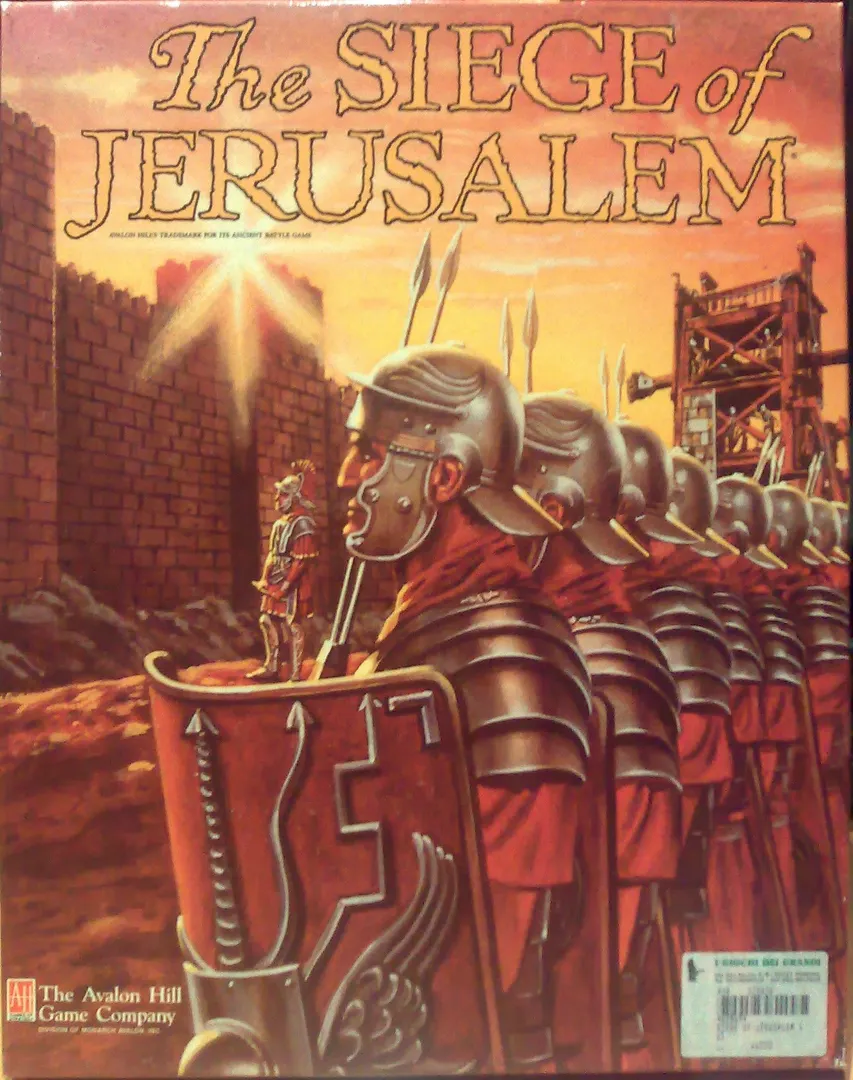
The Siege of Jerusalem (Third Edition) ist ein Brettspiel aus dem Jahr 1989 für 2 Personen, mit 300 Minuten pro Partie und ab 12 Jahren. Entwickelt wurde es von Fred Schachter und Steve Weiss; die wichtigsten Mechaniken sind Dice Rolling, Hexagon Grid und Solo / Solitaire Game.





Auf Englisch
Published by Avalon Hill in 1989 (for the Third edition). (from MMP's web site:) It is 70 A.D. Dawn breaks on the combined might of four Legions arrayed on the heights of Mount Scopus, starting their methodical advance across the valley to the ancient walled city of Jerusalem. Siege lines have been secured tight about the city. There is no hope of escape. The besieged must persist behind their stout walls or perish before a vengeful Rome. Five grueling years of campaigning in Judea is now culminating in the Siege of Jerusalem. But the fortified city defies even the might of Rome. The thick walls atop the steep slopes literally bristle with natural and manmade fortifications. It will take all of Rome's considerable engineering skills to winch their war machines into position for an assault up the slopes to the city. Only here in the north plain can the city's walls be taken by escalade. The rhythmic approach of the Legions is muted by the rumble of the siege engines as an assortment of towers, rams, and artillery precede the maniples. The distant walls seethe with the frenzied activity of an alerted populace as the antagonists draw near. This majestic view is abruptly halted by the blare of trumpets which soon gives way to the cacophony of the clash of arms and screams of the dying. Morning turns to dusk before the walls are breached and the weary legions exact their vengeance. The sky turns bright again, aglow in the reflection of a thousand fires as the northern outskirts burn. But what price victory? Another day such as this will break the Roman Army and only one of the city's ten walled sections has fallen this day. They will have to find another way. Shafts must be dug to undermine the walls or earthen ramps built with which to scale them. It will be a long campaign. This is The Siege of Jerusalem...An epic battle simulation with all the trappings and majesty of a Cecil B. DeMille film spectacular. Facing the greatest army of antiquity, the Judeans must rely on the stoutness of their walls to halt the unbeatable Roman legions and therein lies the fascination: the immovable object vs the unstoppable force. As Eliezar Ben Yair, leader of the Zealots, you must conduct a skilled defense of the city's ever shrinking perimeter - exacting from the Romans a price so terrible that they will be forced to lift their siege - or break out to continue your struggle for freedom at Massada. As Titus, commander of the Roman army, you must decide when, where and how to renew the assault - gauging your troop needs against the progress of your siege works and the press of time caused by outside threats. More than just conducting tactical combat, the Roman must formulate an overall strategic plan for the conduct of the siege. Vastly revised from its 1st & 2nd edition printing from Historical Perspectives in the 70's, Siege of Jerusalem now boasts two-sided counters, a continuous combat system, a strategic interphase for conducting the entire siege, and the morale / panic rules so important in portraying ancient warfare. An Introductory Scenario depicting the abortive assault of Gallus with the XII Legion three years previous allows players to learn how to handle a legion in a single day's play while training for eventual participation in the conduct of the epic siege.
Laut Katalog unterstützt The Siege of Jerusalem (Third Edition) 2 Personen. Das ist die vom Verlag angegebene Spielerzahl, das Spiel ist also genau für diese Anzahl von Mitspielenden ausgelegt. Varianten für andere Gruppengrößen sind, sofern vorhanden, in der Anleitung deiner Ausgabe beschrieben; prüfe sie, bevor du eine andere Konfiguration aufbaust.
Die angegebene Spieldauer für The Siege of Jerusalem (Third Edition) beträgt 300 Minuten. Das ist die Schätzung des Verlags für eine vollständige Partie. Die tatsächliche Dauer hängt von der Gruppe, der Personenzahl und der Regelkenntnis ab: Erste Partien dauern meist länger, erfahrene Gruppen sind oft schneller fertig. Aufbau und Regelerklärung sind in dieser Schätzung nicht enthalten.
Im Katalog wird The Siege of Jerusalem (Third Edition) ab 12 Jahren empfohlen. Das ist die Empfehlung des Verlags und berücksichtigt Leseanforderungen, Regelkomplexität und Kleinteile, nicht nur das Thema. Jüngere Kinder können oft mit Hilfe eines Erwachsenen mitspielen; beachte die Altersangabe deiner Ausgabe und die Brettspielerfahrung deiner Gruppe.
The Siege of Jerusalem (Third Edition) hat bei BoardGameGeek eine Komplexitätswertung von 3,9 von 5 und gilt damit als schweres Spiel. Die Wertung zeigt, wie viel Regelwissen, Planung und Entscheidungen eine typische Partie verlangt. Schwerere Spiele brauchen bei der ersten Erklärung mehr Zeit, daher hilft vor dem Spieleabend eine Vorbereitungsanleitung.
The Siege of Jerusalem (Third Edition) gehört zu diesen Kategorien: Wargame und Ancient. Die wichtigsten Mechaniken sind Dice Rolling, Hexagon Grid und Solo / Solitaire Game. Kategorien beschreiben Thema und Setting eines Spiels, Mechaniken dagegen, was die Spielenden in ihrem Zug tatsächlich tun. Jede Mechanik führt zu einer Katalogseite mit ähnlichen Spielen, falls du etwas Vergleichbares suchst.
Als Autoren von The Siege of Jerusalem (Third Edition) sind angegeben: Fred Schachter und Steve Weiss. Diese Angaben stammen aus den veröffentlichten Spieldaten und nennen die für das Spieldesign verantwortlichen Personen, nicht die Illustratoren oder Verlage. Die Autorenseiten auf MeepleRules sammeln weitere Titel derselben Autoren – praktisch, wenn dir ein Spiel gefällt und du ähnliche Spiele suchst.
Im Katalog ist The Siege of Jerusalem (Third Edition) als Grundspiel aufgeführt. Es lässt sich eigenständig mit dem Material aus der Schachtel spielen und benötigt keinen weiteren Titel. Erweiterungen, sofern es welche gibt, ergänzen neues Material oder neue Regeln und sind im Katalog separat mit einem Verweis auf dieses Grundspiel aufgeführt.