

- BGG-Rang
- BGG #660
- BGG-Bewertung
- 7,6
Labyrinth: The War on Terror, 2001 – ?
- 1–2 Spieler
- 180 Min.
- Komplexität 3,7/5
- 2010
2026
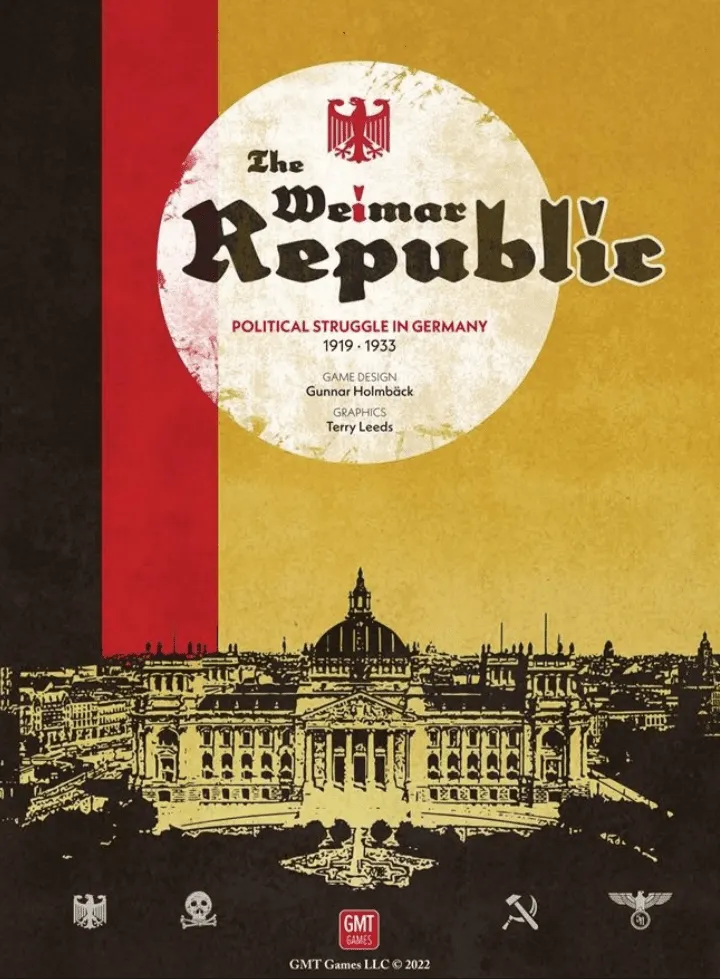
Regelhilfe für The Weimar Republic: Political Struggle in Germany, 1919-1933
Verständliche Erklärungen zu Spielzügen, Karteneffekten und strittigen Situationen mit Verweisen auf offizielle Quellen und gespeichertem Fragenverlauf.
Für 1 Person
Was möchtest du wissen?
Antworten stammen aus dem offiziellen Regelheft, mit Seitenangabe zum Nachprüfen.
The Weimar Republic: Political Struggle in Germany, 1919-1933 ist ein Brettspiel aus dem Jahr 2026 für 1–4 Personen, mit 90–480 Minuten pro Partie und ab 14 Jahren. Entwickelt wurde es von Gunnar Holmbäck; die wichtigsten Mechaniken sind Hand Management, Dice Rolling und Area Majority / Influence.




Auf Englisch
January 19, 1919. The Great War is over, the Kaiser has abdicated, and Germany is on its knees. After suffering a humiliating loss at the hands of the Allied nations, the former Great Power is now confronted not only with the death of millions of its citizens, but also with a severe economic crisis and a political turmoil that threatens to plunge the entire nation into civil war. The November Revolution of 1918 ushered in a new era of liberal democracy in a country traditionally ruled by noblemen warriors. The first democratic election has now been held, but democracy’s enemies are numerous, and the future of the fledgling Republic appears grim. No one can tell whether the democratic Coalition will prevail or whether any of the extremist factions will rise out of the chaos and seize power. One thing is perfectly clear, however: the coming years will not be remembered for their peace and stability. The Weimar Republic is a Card Driven Game of political struggle in interwar Germany. Four factions compete for dominance: the democratic Coalition, the Soviet-backed Communist Party, Hitler’s National Socialists, and the far-right Radical Conservatives. The game follows a timeline of 15 years (1919-1933) with two rounds in each year. During a round, players take turns using their faction-specific abilities to increase their influence in Germany’s regions and major cities, to maneuver the political landscape of the Republic, and to dominate through a combination of propaganda, parliamentary elections, street violence, economic influence, and ideological zeal. Typical actions include agitation, reforms, recruitment and deployment of fighting men, strikes, uprisings, assassinations, and coups. General and regional elections are held at irregular intervals throughout the game, potentially shifting local power balances in sometimes radical ways. The timeline moves through three distinct eras, each with its own deck of event cards. There are also several special cards like Elections and Parliamentary Control Cards. Gameplay is fast-paced; initiative flows back and forth, and the direction of the game may change rapidly and unexpectedly. Although competition between the factions is fierce, some of the faction-specific mechanics overlap, and players can often take advantage of each other--including the making and unmaking of alliances. The Weimar Republic includes scenarios ranging in length from 3 to 8 hours and a special tutorial scenario that can be played by new players in only 90 minutes. Victory is absolute and generally achieved through “sudden death”; there is no final scoring or adding up of different objectives. Each faction can be replaced by a "bot" player, allowing 1-4 players to play with any combination of factions.
Laut Katalog unterstützt The Weimar Republic: Political Struggle in Germany, 1919-1933 1–4 Personen. Diese Spanne entspricht der vom Verlag angegebenen Spielerzahl, das Spiel lässt sich also für jede Gruppengröße innerhalb dieser Spanne aufbauen. Aufbau, einzelne Regeln und Wertungsdetails können je nach Personenzahl trotzdem abweichen; prüfe daher die genaue Konfiguration in der Anleitung deiner Ausgabe.
Die angegebene Spieldauer für The Weimar Republic: Political Struggle in Germany, 1919-1933 beträgt 90–480 Minuten. Das ist die Schätzung des Verlags für eine vollständige Partie. Die tatsächliche Dauer hängt von der Gruppe, der Personenzahl und der Regelkenntnis ab: Erste Partien dauern meist länger, erfahrene Gruppen sind oft schneller fertig. Aufbau und Regelerklärung sind in dieser Schätzung nicht enthalten.
Im Katalog wird The Weimar Republic: Political Struggle in Germany, 1919-1933 ab 14 Jahren empfohlen. Das ist die Empfehlung des Verlags und berücksichtigt Leseanforderungen, Regelkomplexität und Kleinteile, nicht nur das Thema. Jüngere Kinder können oft mit Hilfe eines Erwachsenen mitspielen; beachte die Altersangabe deiner Ausgabe und die Brettspielerfahrung deiner Gruppe.
The Weimar Republic: Political Struggle in Germany, 1919-1933 hat bei BoardGameGeek eine Komplexitätswertung von 3,6 von 5 und gilt damit als mittelschweres Spiel. Die Wertung zeigt, wie viel Regelwissen, Planung und Entscheidungen eine typische Partie verlangt. Schwerere Spiele brauchen bei der ersten Erklärung mehr Zeit, daher hilft vor dem Spieleabend eine Vorbereitungsanleitung.
The Weimar Republic: Political Struggle in Germany, 1919-1933 gehört zu diesen Kategorien: Economic und Political. Die wichtigsten Mechaniken sind Hand Management, Dice Rolling und Area Majority / Influence. Kategorien beschreiben Thema und Setting eines Spiels, Mechaniken dagegen, was die Spielenden in ihrem Zug tatsächlich tun. Jede Mechanik führt zu einer Katalogseite mit ähnlichen Spielen, falls du etwas Vergleichbares suchst.
Als Autoren von The Weimar Republic: Political Struggle in Germany, 1919-1933 sind angegeben: Gunnar Holmbäck. Diese Angaben stammen aus den veröffentlichten Spieldaten und nennen die für das Spieldesign verantwortlichen Personen, nicht die Illustratoren oder Verlage. Die Autorenseiten auf MeepleRules sammeln weitere Titel derselben Autoren – praktisch, wenn dir ein Spiel gefällt und du ähnliche Spiele suchst.
Im Katalog ist The Weimar Republic: Political Struggle in Germany, 1919-1933 als Grundspiel aufgeführt. Es lässt sich eigenständig mit dem Material aus der Schachtel spielen und benötigt keinen weiteren Titel. Erweiterungen, sofern es welche gibt, ergänzen neues Material oder neue Regeln und sind im Katalog separat mit einem Verweis auf dieses Grundspiel aufgeführt.