- BGG-Bewertung
- 7,2
Three Sisters: Rock Garden Expansion
- 1–4 Spieler
- 30–60 Min.
- Komplexität 3,0/5
- 2022
2022
Regelhilfe für Three Sisters
Verständliche Erklärungen zu Spielzügen, Karteneffekten und strittigen Situationen mit Verweisen auf offizielle Quellen und gespeichertem Fragenverlauf.
Für 1 Person
Was möchtest du wissen?
Antworten stammen aus dem offiziellen Regelheft, mit Seitenangabe zum Nachprüfen.
Three Sisters ist ein Brettspiel aus dem Jahr 2022 für 1–4 Personen, mit 30–60 Minuten pro Partie und ab 14 Jahren. Entwickelt wurde es von Ben Pinchback und Matt Riddle; die wichtigsten Mechaniken sind Dice Rolling, Paper-and-Pencil und Solo / Solitaire Game.





Auf Englisch
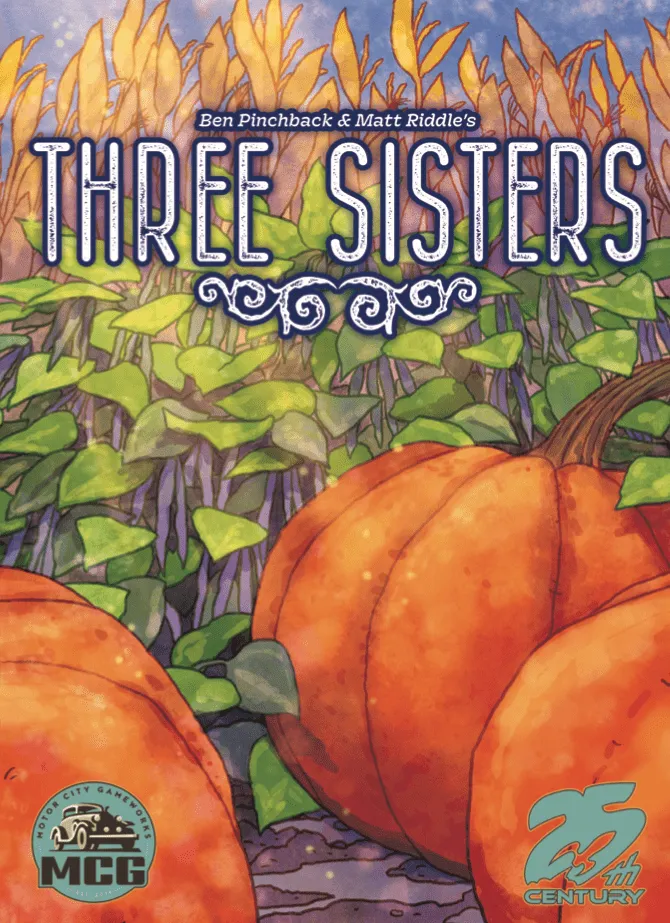
Three Sisters is a strategic roll-and-write game about backyard farming. Three Sisters is named after an indigenous agricultural technique still widely used today in which three different crops — pumpkins, corn, and beans — are planted close together. Corn provides a lattice for beans to climb, the beans bring nitrogen from the air into the soil, and the squash provides a natural mulch ground cover to reduce weeds and keep pests away. In the game, you have your own player sheet with multiple areas: the garden, which is divided into six numbered zones, each containing the three crop types; the apiary; compost; perennials; goods; fruit; and the shed, which is filled with tools that have special abilities. All the crops, fruits, flowers, and hives are represented by tracks that you will mark off as you acquire these items. Many of the tracks are interconnected with other elements in the game, giving you bonuses along the way. A common feature of these tracks are circles that represent a harvest, which generates goods; get enough goods, and you unlock bonus actions. Advancing on all of these tracks offers various amounts of points, advancements, and bonuses. The game lasts eight rounds. Each round, roll dice based on the number of players, group them by number, then place them on an action space of the circular action wheel, starting with the current position of the farmer; the farmer moves each round, which means that dice showing 1s, 2s, etc. will end up on different spaces each round. Once the dice have been placed, each player drafts one die and uses it as described below. Once everyone has drafted a die, all players get to use the lowest-valued die remaining on the action wheel. A die lets you do two things, which you can do in either order: Plant or water the numbered zone matching the value of the die. Take the action of the space from which you removed the die. To plant, you mark the bottom space of two empty crop tracks. (Note that you can't plant beans until the corn adjacent to the beans is tall enough to support them.) To water, you mark one space in all the crop tracks that already have at least one mark in them. As for the actions on the action wheel, you can: Plant or water again in the same numbered zone. Gain one compost (which lets you adjust die values) and four goods (which will get you bonuses at the farmer's market). Mark off the hive track, which can bring you points, goods, or bonus actions. Mark one of the four fruit tracks. Each fruit is worth different points and different amounts of goods and has different track lengths and circle positions. Visit the farmer's market, which gives you points and bonuses based on the number of goods you've collected. Mark one of the fifteen tool tracks in your shed. As soon as you complete a track, you gain that power or end-game scoring opportunity. Perennials don't have a direct action associated with them and are marked off only through actions in other areas, with the various perennials giving different bonuses as you mark them. At the end of the round, all players receive a bonus action, either rain that waters all numbered zones in your garden, a trip to the shed, or a visit to the farmer's market. After eight rounds, you score points for harvested crops, perennials, the apiary, fruit, and some shed items. Whoever has the most points wins. Three Sisters has a solo mode in which you try to top your own score against an "opponent" that drafts dice and blocks areas of your sheet.
Laut Katalog unterstützt Three Sisters 1–4 Personen. Diese Spanne entspricht der vom Verlag angegebenen Spielerzahl, das Spiel lässt sich also für jede Gruppengröße innerhalb dieser Spanne aufbauen. Aufbau, einzelne Regeln und Wertungsdetails können je nach Personenzahl trotzdem abweichen; prüfe daher die genaue Konfiguration in der Anleitung deiner Ausgabe.
Die angegebene Spieldauer für Three Sisters beträgt 30–60 Minuten. Das ist die Schätzung des Verlags für eine vollständige Partie. Die tatsächliche Dauer hängt von der Gruppe, der Personenzahl und der Regelkenntnis ab: Erste Partien dauern meist länger, erfahrene Gruppen sind oft schneller fertig. Aufbau und Regelerklärung sind in dieser Schätzung nicht enthalten.
Im Katalog wird Three Sisters ab 14 Jahren empfohlen. Das ist die Empfehlung des Verlags und berücksichtigt Leseanforderungen, Regelkomplexität und Kleinteile, nicht nur das Thema. Jüngere Kinder können oft mit Hilfe eines Erwachsenen mitspielen; beachte die Altersangabe deiner Ausgabe und die Brettspielerfahrung deiner Gruppe.
Three Sisters hat bei BoardGameGeek eine Komplexitätswertung von 2,6 von 5 und gilt damit als eher leichtes Spiel. Die Wertung zeigt, wie viel Regelwissen, Planung und Entscheidungen eine typische Partie verlangt. Schwerere Spiele brauchen bei der ersten Erklärung mehr Zeit, daher hilft vor dem Spieleabend eine Vorbereitungsanleitung.
Three Sisters gehört zu diesen Kategorien: Dice und Farming. Die wichtigsten Mechaniken sind Dice Rolling, Paper-and-Pencil und Solo / Solitaire Game. Kategorien beschreiben Thema und Setting eines Spiels, Mechaniken dagegen, was die Spielenden in ihrem Zug tatsächlich tun. Jede Mechanik führt zu einer Katalogseite mit ähnlichen Spielen, falls du etwas Vergleichbares suchst.
Als Autoren von Three Sisters sind angegeben: Ben Pinchback und Matt Riddle. Diese Angaben stammen aus den veröffentlichten Spieldaten und nennen die für das Spieldesign verantwortlichen Personen, nicht die Illustratoren oder Verlage. Die Autorenseiten auf MeepleRules sammeln weitere Titel derselben Autoren – praktisch, wenn dir ein Spiel gefällt und du ähnliche Spiele suchst.
Im Katalog ist Three Sisters als Grundspiel aufgeführt. Es lässt sich eigenständig mit dem Material aus der Schachtel spielen und benötigt keinen weiteren Titel. Erweiterungen, sofern es welche gibt, ergänzen neues Material oder neue Regeln und sind im Katalog separat mit einem Verweis auf dieses Grundspiel aufgeführt.