
- BGG-Rang
- BGG #3.403
- BGG-Bewertung
- 6,8
Tao Long: The Way of the Dragon
- 2 Spieler
- 10–30 Min.
- Komplexität 2,7/5
- 2017

Regelhilfe für Toğızqumalaq
Verständliche Erklärungen zu Spielzügen, Karteneffekten und strittigen Situationen mit Verweisen auf offizielle Quellen und gespeichertem Fragenverlauf.
Für 2 Personen
Was möchtest du wissen?
Antworten stammen aus dem offiziellen Regelheft, mit Seitenangabe zum Nachprüfen.
Toğızqumalaq ist ein Brettspiel für 2 Personen und mit 20 Minuten pro Partie. Die wichtigsten Mechaniken sind Mancala.







Auf Englisch
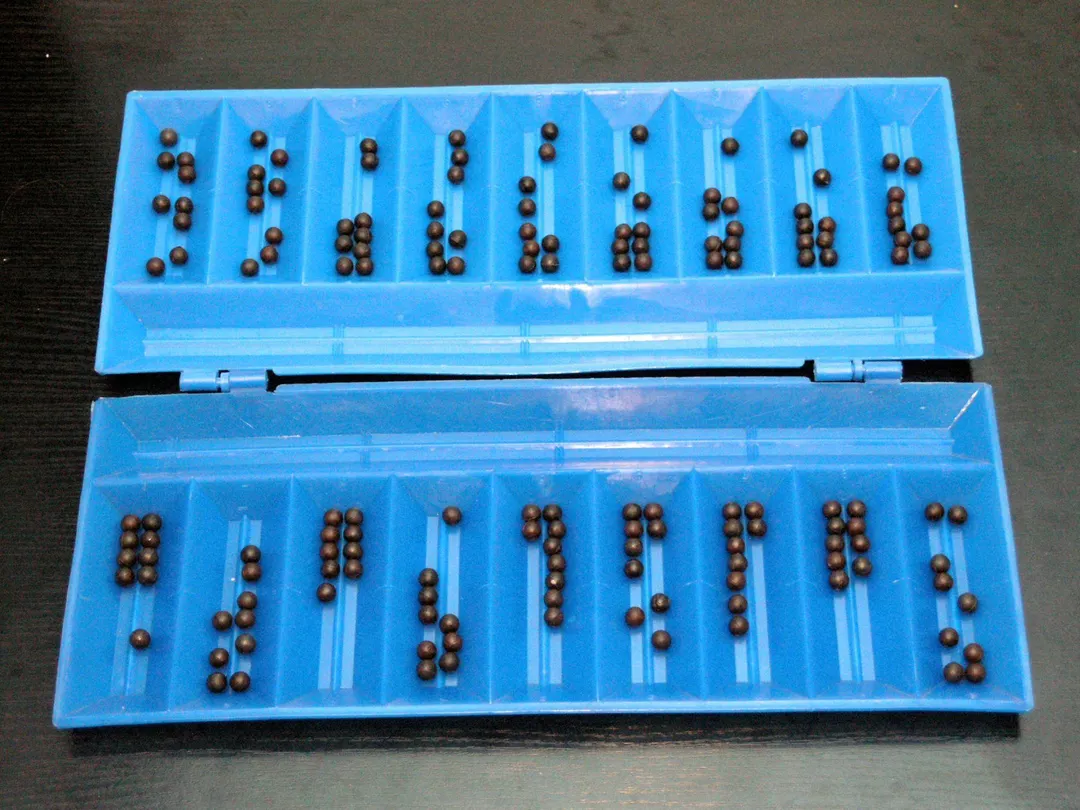
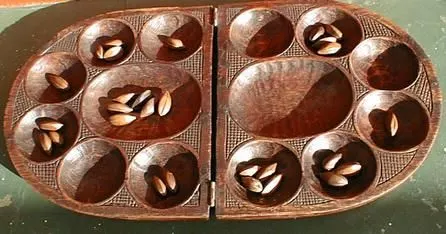
A game of the mancala family. Тоғызқұмалақ (toğızqumalaq, sometimes spelled toghyzqumalaq or togyzqumalaq or toguz kumalak, "nine balls") is the Kazakh name of a mancala game also known as toguz korgool in Kyrgyz. It is played traditionally in Kazakhstan, Kyrgyzstan, Tajikistan, Uzbekistan, Turkmenistan, parts of Russia (Altay, Khakassia, Tuva), Western Mongolia and in China in regions close to the aforementioned countries. There are regular toğızqumalaq championships held in Kazakhstan, Kyrgyzstan and Russia. The first western tournament was in August 2006 at the Mindsports Olympiad (MSO) in London, England. It was won by Aidos Seitzhanov from Kazakhstan. Rules: Toğızqumalaq is played board made of two rows of nine holes, plus two kazans ("boilers"), either in the middle of the board or one at each end of it. The players own the kazan at their right, if at the ends, or the one on the other half of their board, if in the middle. As captures are made by pairs, the holes are usually made in a way so it is evident whether the contents are odd or even. To begin the game, there must be nine balls per hole, except the kazans, which are empty. That is, 162 balls are needed. On his turn, a player takes all the balls of a hole on his side of the board, and distribute them anticlockwise, one per hole, on the following holes, starting from the very same hole he has taken them. If the movement is done from a hole containing just a single ball, it is moved to the next hole, leaving the starting hole empty. If the last ball falls into a hole on the opponent's side… …and this hole afterward contains an even number of balls, these are captured and stored on the player's kazan. …and this hole afterward contains precisely three balls, the hole becomes your тұздық, tuzdyq (or түз үй according to Maksat Shotayev, tüz üy, i.e. "sacred place" in Kazakh; or tuz in Kyrgyz which means "salt"), and it is marked as such. ** Each player can only make one tuzdyq in a game. A tuzdyq cannot be made on the opponent's last hole (ninth, the one on his right). A tuzdyq cannot be made if it is symmetrical to the opponent's one (if the opponent has his tuzdyq in our first hole, we can not make ours on his first hole). In the cases a tuzdyq cannot be done, we can finish a movement there, but the hole simply does not become a tuzdyq. A movement cannot begin from a tuzdyq. The balls that fall into a tuzdyq are captured by its owner. If it is overcharged, we can take the balls and store them in the kazan. The game ends when a player cannot move on his turn, because all the holes on his side (except a possible tuzdyq) are empty. When the game is over, the player who still has balls on his side (except in a possible tuzdyq) gets them and adds them to his kazan. Both players add the contents of their tuzdyq (the one on their opponent's side) to their kazan. The winner is the player with more balls in his kazan at the end of the game. If both players have captured 81 balls, the game is a draw.
Laut Katalog unterstützt Toğızqumalaq 2 Personen. Das ist die vom Verlag angegebene Spielerzahl, das Spiel ist also genau für diese Anzahl von Mitspielenden ausgelegt. Varianten für andere Gruppengrößen sind, sofern vorhanden, in der Anleitung deiner Ausgabe beschrieben; prüfe sie, bevor du eine andere Konfiguration aufbaust.
Die angegebene Spieldauer für Toğızqumalaq beträgt 20 Minuten. Das ist die Schätzung des Verlags für eine vollständige Partie. Die tatsächliche Dauer hängt von der Gruppe, der Personenzahl und der Regelkenntnis ab: Erste Partien dauern meist länger, erfahrene Gruppen sind oft schneller fertig. Aufbau und Regelerklärung sind in dieser Schätzung nicht enthalten.
Toğızqumalaq hat bei BoardGameGeek eine Komplexitätswertung von 3,8 von 5 und gilt damit als schweres Spiel. Die Wertung zeigt, wie viel Regelwissen, Planung und Entscheidungen eine typische Partie verlangt. Schwerere Spiele brauchen bei der ersten Erklärung mehr Zeit, daher hilft vor dem Spieleabend eine Vorbereitungsanleitung.
Toğızqumalaq gehört zu diesen Kategorien: Abstract Strategy. Die wichtigsten Mechaniken sind Mancala. Kategorien beschreiben Thema und Setting eines Spiels, Mechaniken dagegen, was die Spielenden in ihrem Zug tatsächlich tun. Jede Mechanik führt zu einer Katalogseite mit ähnlichen Spielen, falls du etwas Vergleichbares suchst.
Im Katalog ist Toğızqumalaq als Grundspiel aufgeführt. Es lässt sich eigenständig mit dem Material aus der Schachtel spielen und benötigt keinen weiteren Titel. Erweiterungen, sofern es welche gibt, ergänzen neues Material oder neue Regeln und sind im Katalog separat mit einem Verweis auf dieses Grundspiel aufgeführt.