- BGG-Rang
- BGG #1.795
- BGG-Bewertung
- 6,9
Tournay
2011
Regelhilfe für Tournay
Verständliche Erklärungen zu Spielzügen, Karteneffekten und strittigen Situationen mit Verweisen auf offizielle Quellen und gespeichertem Fragenverlauf.
- 2–4 Spieler
- 30–60 Min.
- 12+
- Komplexität 2,9/5

Für 2 Personen
Regelassistent für Tournay
Was möchtest du wissen?
Antworten stammen aus dem offiziellen Regelheft, mit Seitenangabe zum Nachprüfen.
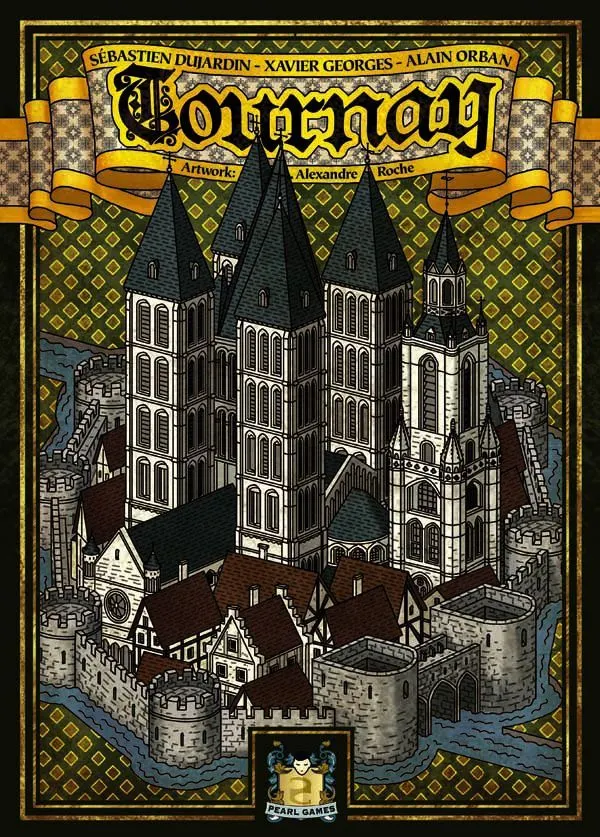
Tournay ist ein Brettspiel aus dem Jahr 2011 für 2–4 Personen, mit 30–60 Minuten pro Partie und ab 12 Jahren. Entwickelt wurde es von Xavier Georges, Alain Orban und Sébastien Dujardin; die wichtigsten Mechaniken sind Hand Management, Income und End Game Bonuses.
Über das Spiel
Auf Englisch
Game description from the publisher: Built by the Romans during the first century in Belgian Gaul, Tournay experienced most of its growth along the Scheldt river. Unfortunately, the river also contributed to its troubles, because in 881, the Normans traversed its watery path, and thereby easily captured the city. That act of aggression stunted Tournay's prosperity. This game invites you to participate in the reconstruction of the city, in order to establish a glorious era that will last for more than seven centuries. Help your district flourish by cleverly coordinating the work of the city's three domains: military, religious, and civil. Certainly the prestige of your buildings will brighten the entire city! Tournay is a card game from the same designing team as the 2010 release Troyes with artwork once again by Alexandre Roche. In this game, players manage a district of the city and its three classes of citizens. The cards are classified by level (I to III) and color to form nine distinct decks. Players initially have two citizens in each class that they will use each turn to carry out one of five available actions, such as drawing cards, or using the powers of their buildings. In each player's district, the building cards save them money, make more efficient use of the decks of cards, or recruit new citizens. The character cards optimize the use of buildings if properly positioned. It's up to you to create the most effective card combinations. Finally, constructed prestige buildings will give you valuable prestige points, depending on how your district has developed. But beware: Your opponents will also benefit from every prestige building you build! Note that an expansion is included in the base game's box, so advanced players can add still more replay value to this dynamic game! Game Summary There are 3 sets of cards (yellow, red, white) in 3 groups (I, II, III); also, a set of black event cards. There are always 3 face-up event cards, most of which are bad. Players start with 2 meeples in 3 colors (yellow, red, white), placed on their Plaza card. On your turn: First, you may play a card from hand to your display (3x3 grid) by paying the appropriate cost (some combination of coins, meeples, cards, etc). You may play a card on top of another of the same color; if played on top of a different color, discard the older card. Then take one action: Draw a card; move 1-3 meeples off the Plaza to draw a level I-III card; you may pay others 2 coins to use their worker(s). If you draw the event card of that deck, place a coin on each event card, then trigger all event cards once per coin. Activate a building card by moving a meeple from your Plaza to the building card (max 1 Meeple/building); cards do a variety of things like give you coins, recruit an additional meeple, use someone else's card, etc. Combat an event by paying the cost (usually 1 Meeple, 1 coin, +1/coin on the card; or, 2 meeples) shown; take the card as a reward. Later, when events trigger, you may play this from hand to prevent an event from affecting you. Reactivate all workers: return all meeples to your Plaza, and remove all markers from building cards. The game ends at the start of the Start Player's turn if 2+ players have all 9 cards in their display; OR if only 1 player has, but at least n-1 Town Crier cards have been revealed. Everyone then gets to play one final card (paying normal costs). Earn VPs for all cards in display, and for all Event cards you've combated. Most VP wins!
Kategorien
Mechanismen
Verlage
- uplay.it edizioni
- Heidelberger Spieleverlag
- Z-Man Games
- Pearl Games
Fragen und Antworten
Laut Katalog unterstützt Tournay 2–4 Personen. Diese Spanne entspricht der vom Verlag angegebenen Spielerzahl, das Spiel lässt sich also für jede Gruppengröße innerhalb dieser Spanne aufbauen. Aufbau, einzelne Regeln und Wertungsdetails können je nach Personenzahl trotzdem abweichen; prüfe daher die genaue Konfiguration in der Anleitung deiner Ausgabe.
Die angegebene Spieldauer für Tournay beträgt 30–60 Minuten. Das ist die Schätzung des Verlags für eine vollständige Partie. Die tatsächliche Dauer hängt von der Gruppe, der Personenzahl und der Regelkenntnis ab: Erste Partien dauern meist länger, erfahrene Gruppen sind oft schneller fertig. Aufbau und Regelerklärung sind in dieser Schätzung nicht enthalten.
Im Katalog wird Tournay ab 12 Jahren empfohlen. Das ist die Empfehlung des Verlags und berücksichtigt Leseanforderungen, Regelkomplexität und Kleinteile, nicht nur das Thema. Jüngere Kinder können oft mit Hilfe eines Erwachsenen mitspielen; beachte die Altersangabe deiner Ausgabe und die Brettspielerfahrung deiner Gruppe.
Tournay hat bei BoardGameGeek eine Komplexitätswertung von 2,9 von 5 und gilt damit als eher leichtes Spiel. Die Wertung zeigt, wie viel Regelwissen, Planung und Entscheidungen eine typische Partie verlangt. Schwerere Spiele brauchen bei der ersten Erklärung mehr Zeit, daher hilft vor dem Spieleabend eine Vorbereitungsanleitung.
Tournay gehört zu diesen Kategorien: Card Game, Economic und Medieval. Die wichtigsten Mechaniken sind Hand Management, Income und End Game Bonuses. Kategorien beschreiben Thema und Setting eines Spiels, Mechaniken dagegen, was die Spielenden in ihrem Zug tatsächlich tun. Jede Mechanik führt zu einer Katalogseite mit ähnlichen Spielen, falls du etwas Vergleichbares suchst.
Als Autoren von Tournay sind angegeben: Xavier Georges, Alain Orban und Sébastien Dujardin. Diese Angaben stammen aus den veröffentlichten Spieldaten und nennen die für das Spieldesign verantwortlichen Personen, nicht die Illustratoren oder Verlage. Die Autorenseiten auf MeepleRules sammeln weitere Titel derselben Autoren – praktisch, wenn dir ein Spiel gefällt und du ähnliche Spiele suchst.
Im Katalog ist Tournay als Grundspiel aufgeführt. Es lässt sich eigenständig mit dem Material aus der Schachtel spielen und benötigt keinen weiteren Titel. Erweiterungen, sofern es welche gibt, ergänzen neues Material oder neue Regeln und sind im Katalog separat mit einem Verweis auf dieses Grundspiel aufgeführt.