
- BGG-Rang
- BGG #25.332
- BGG-Bewertung
- 5,9
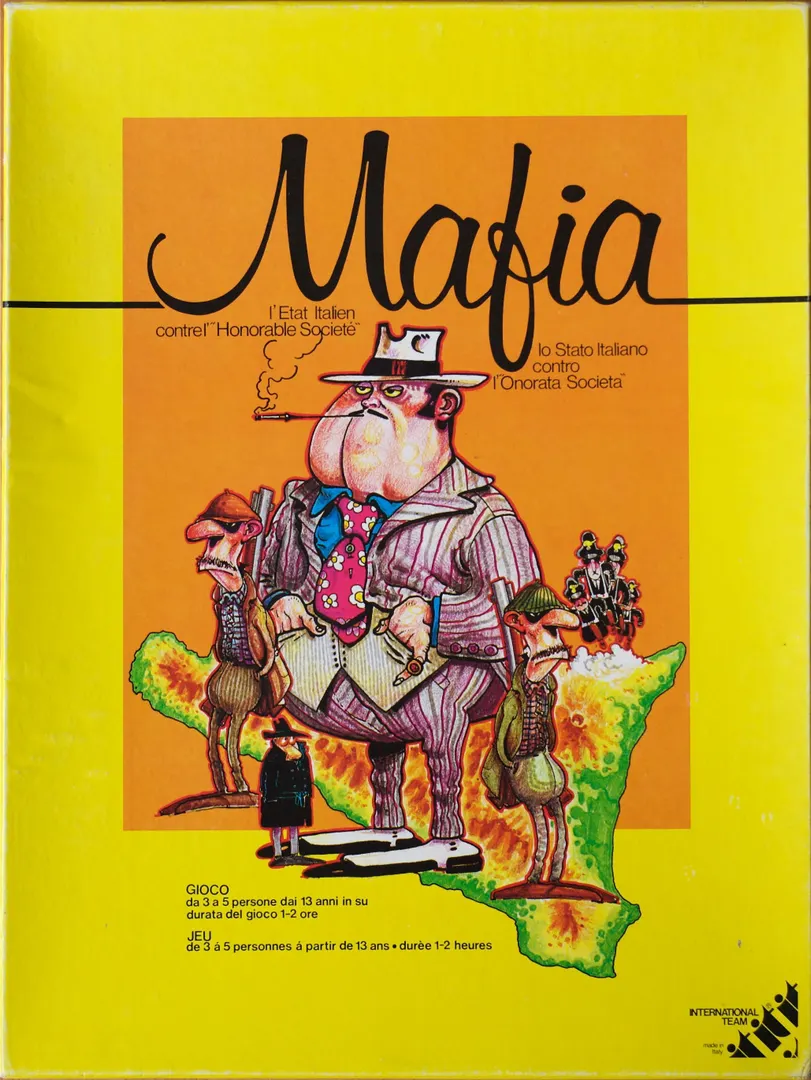
Mafia
- 3–5 Spieler
- 60–120 Min.
- Komplexität 1,8/5
- 1981
2004
Regelhilfe für Tuchulcha
Verständliche Erklärungen zu Spielzügen, Karteneffekten und strittigen Situationen mit Verweisen auf offizielle Quellen und gespeichertem Fragenverlauf.
Was möchtest du wissen?
Antworten stammen aus dem offiziellen Regelheft, mit Seitenangabe zum Nachprüfen.
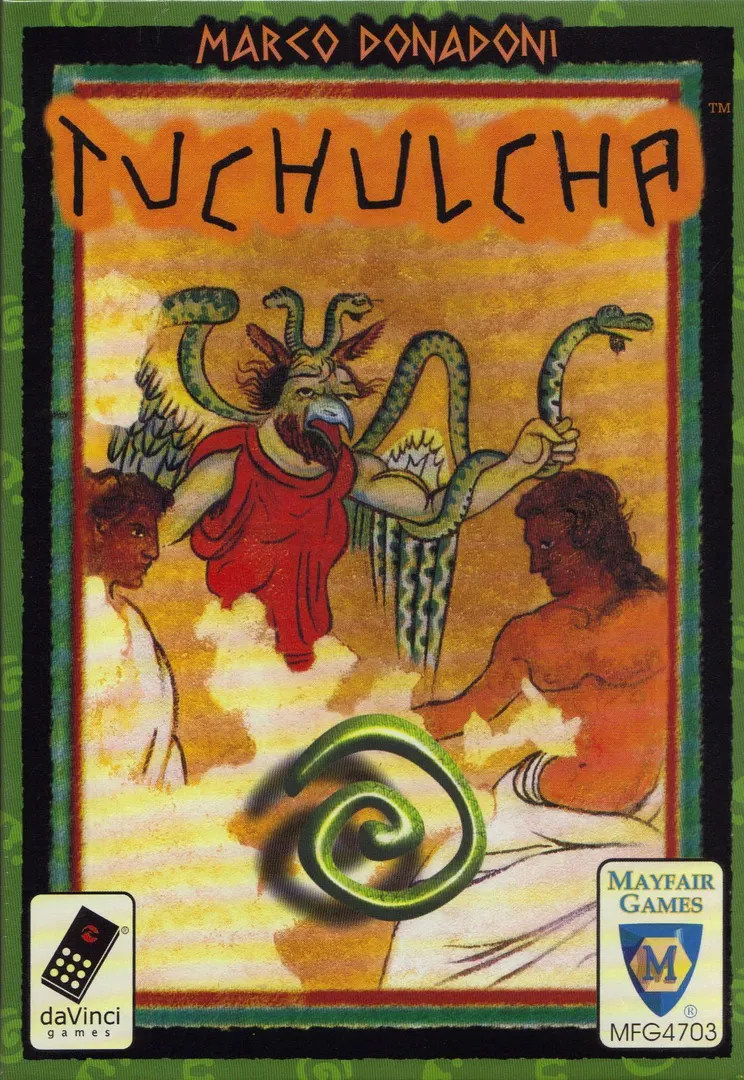
Tuchulcha ist ein Brettspiel aus dem Jahr 2004 für 2–4 Personen, mit 30 Minuten pro Partie und ab 8 Jahren. Entwickelt wurde es von Marco Donadoni; die wichtigsten Mechaniken sind Variable Player Powers, Roll / Spin and Move und Dice Rolling.



Auf Englisch
Theme: Game is themed around a purification ritual of the ancient Etruscan people, who predated the Roman Empire around 6th century B.C. Each player represents a different temple, faithful to the divinities Achvizr, Alpan, Leinth, and Thalna. On "Tagete's" day, the Etruscan Haruspexes [priests] proceed down the path of purification to the Velthumena Altar. Goal: Each player has 8 pawns representing "Haruspexes" [priests] in their color. Each player is trying to move their priests along the path of purifiction from their home temple to the altar at the center of the board. One player may also choose the path of darkness and consecrate themselves to the divinity "Tuchulcha" with the goal of elminating all rival priests. This role is only available in 3 and 4 player games. If a player chooses this path, then another single player may consecrate themselves to "Lasa Vecuvia" with a different set of powers. This player's goal is to now move their priests to set "passages" on the path and place 4 seals to win the game. This role is only available in 4 player games. Players win by having the most priests in the center altar at game end. If a player chooses Tuchulcha's power, they win by eliminating all other priests, and lose if any priest enters the altar. A player that chooses the Lasa Vecuvia power wins only by placing all 4 seals. Gameplay: Game plays with 2, 3, or 4 players. Each player begins the game with 8 pawns on their home temple. On their turn players roll 2 dice. If doubles are rolled, the player may throw a third die. Then player chooses to move one or more of their pawns the number of pips shown on each die. For example, if a 5 and a 2 are rolled, a player may move one pawn 5 and another 2, or one pawn 5, and then 2 [not seven at once]. This is important as where you land can be significant on each move. Players move their pawns around a spiral path approaching the altar at the center. Along the way players will encounter other players' pawns, and special spaces on the path. These spaces can increase the "spiritual strength" of players' pieces by two times of three times [Mystical Stones], or "passage" spaces can banish them to the Tuchulcha forest. While Mystical Stone spaces are powerful in defense, pawns must move off these spaces as soon as they can. Pawns can normally pass through each other regardless of owner. Any number of a single player's pawns may occupy a single space. However, when a pawn would land on another player's by exact count, it must equal the "spiritual strength" of the player's pieces in the space. Normally, spiritual strenght is one per pawn, but in the 2x or 3x spaces these are multiplied respectively. If a moving player can eqaul the spiritual strength of pawns in the space, then the occupying pawns are banished to the Tuchulcha forest. These pawns are essentially out of the game, but can be used to activate the alternate "Tuchulcha" player role. Once a pawn banishes an opponent's pawn, it may not move again this turn. 2 player game uses 2 "neutral" colors which any player can move during their turn. 3 player game adds the optional Tuchulcha player role, and 4 player adds both Tuchulcha and Lasa Vecuvia roles to play. At any time one and only one player [in 3 and 4 player games], may choose to take on the role of Tuchulcha [a god of destruction]. To activate this power, the player must "sacrifice" 3 pawns. These pawns may come from the home temple, altar, path, or Tuchulcha forest. Once activated, the Tuchulcha player's new objective is to eliminate all other players' pawns. As soon as one other player's pawn enters the altar, Tuchulcha loses and is eliminated from the game. This can make this role selection a risky move. However, this player gains powerful new abilities. Tuchulcha's pawns can never be banished to the forest, he rolls 4 dice and selects the 3 best, and no longer has to stop after banishing an opponent's pawn. If a player chooses to be Tuchulcha in a 4 player game, then another [and only one] player may take the role of Lasa Vecuvia. This player must still have 4 active pawns in play to activate. This player's objectives are now to "seal" the 4 passages along the path. These passages normally banish pawns to the forest, but when the Lasa player lands a pawn on the passage, she places a seal token on the passage and removes the pawn from play. Once she places all four seals in this manner she wins the game. Components: 32 high quality wooden pawns in 4 colors 4 green wooden dice with gold pips and rounded corners 1 double sided game board for 3 and 4 player games 1 full color illustrated rules booklet
Laut Katalog unterstützt Tuchulcha 2–4 Personen. Diese Spanne entspricht der vom Verlag angegebenen Spielerzahl, das Spiel lässt sich also für jede Gruppengröße innerhalb dieser Spanne aufbauen. Aufbau, einzelne Regeln und Wertungsdetails können je nach Personenzahl trotzdem abweichen; prüfe daher die genaue Konfiguration in der Anleitung deiner Ausgabe.
Die angegebene Spieldauer für Tuchulcha beträgt 30 Minuten. Das ist die Schätzung des Verlags für eine vollständige Partie. Die tatsächliche Dauer hängt von der Gruppe, der Personenzahl und der Regelkenntnis ab: Erste Partien dauern meist länger, erfahrene Gruppen sind oft schneller fertig. Aufbau und Regelerklärung sind in dieser Schätzung nicht enthalten.
Im Katalog wird Tuchulcha ab 8 Jahren empfohlen. Das ist die Empfehlung des Verlags und berücksichtigt Leseanforderungen, Regelkomplexität und Kleinteile, nicht nur das Thema. Jüngere Kinder können oft mit Hilfe eines Erwachsenen mitspielen; beachte die Altersangabe deiner Ausgabe und die Brettspielerfahrung deiner Gruppe.
Tuchulcha hat bei BoardGameGeek eine Komplexitätswertung von 1,7 von 5 und gilt damit als leichtes Spiel. Die Wertung zeigt, wie viel Regelwissen, Planung und Entscheidungen eine typische Partie verlangt. Schwerere Spiele brauchen bei der ersten Erklärung mehr Zeit, daher hilft vor dem Spieleabend eine Vorbereitungsanleitung.
Tuchulcha gehört zu diesen Kategorien: Dice und Mythology. Die wichtigsten Mechaniken sind Variable Player Powers, Roll / Spin and Move und Dice Rolling. Kategorien beschreiben Thema und Setting eines Spiels, Mechaniken dagegen, was die Spielenden in ihrem Zug tatsächlich tun. Jede Mechanik führt zu einer Katalogseite mit ähnlichen Spielen, falls du etwas Vergleichbares suchst.
Als Autoren von Tuchulcha sind angegeben: Marco Donadoni. Diese Angaben stammen aus den veröffentlichten Spieldaten und nennen die für das Spieldesign verantwortlichen Personen, nicht die Illustratoren oder Verlage. Die Autorenseiten auf MeepleRules sammeln weitere Titel derselben Autoren – praktisch, wenn dir ein Spiel gefällt und du ähnliche Spiele suchst.
Im Katalog ist Tuchulcha als Grundspiel aufgeführt. Es lässt sich eigenständig mit dem Material aus der Schachtel spielen und benötigt keinen weiteren Titel. Erweiterungen, sofern es welche gibt, ergänzen neues Material oder neue Regeln und sind im Katalog separat mit einem Verweis auf dieses Grundspiel aufgeführt.