

- BGG-Rang
- BGG #3.708
- BGG-Bewertung
- 7,4
Cruel Necessity: The English Civil Wars 1640-1653
- 1 Spieler
- 60 Min.
- Komplexität 2,8/5
- 2013
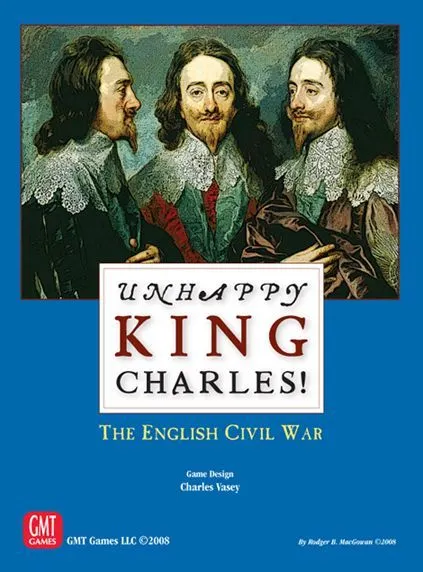
2008
Regelhilfe für Unhappy King Charles!
Verständliche Erklärungen zu Spielzügen, Karteneffekten und strittigen Situationen mit Verweisen auf offizielle Quellen und gespeichertem Fragenverlauf.
Für 2 Personen
Was möchtest du wissen?
Antworten stammen aus dem offiziellen Regelheft, mit Seitenangabe zum Nachprüfen.
Unhappy King Charles! ist ein Brettspiel aus dem Jahr 2008 für 2 Personen und mit 240 Minuten pro Partie. Entwickelt wurde es von Charles Vasey; die wichtigsten Mechaniken sind Dice Rolling, Point to Point Movement und Campaign / Battle Card Driven.



Auf Englisch
Unhappy King Charles! allows two players to decide whether Commons or Cavalier shall rule in England. Both seek to establish control over the country and of its economic structures. They seek not only to defeat their opponents in battle but also to seize control of the local government of England and Wales. The game is based on We the People, Mark Herman's ingenious game on a later rebellion. As the organization of armies and states was often desultory, the cards do not provide a wide range of choices (as in Paths of Glory). The players in Unhappy King Charles! must make do with what they have. The three decks of cards - Early(1642-1643), Middle(1644) and Late (1645)- have been developed to give the correct feel for the early, middle and late war, based on storyboarding techniques. As befits a Civil War, there is treachery, bravery and stupidity in the events on the cards. Unhappy King Charles! is played over eleven turns, each representing about four months. Brigades of troops are used to form Armies (defined Rule 3) or garrisons of fortresses (Rule 13). Only unled Brigades are on the map; the others are placed on the box of their General on the Command Displays. Generals move on the maps. The Armies of Unhappy King Charles! are temporary massings of troops that have as much to do with feudal armies as modern revolutionaries. With inadequate supply and poor equipment it is not surprising that these armies suffer from continual desertion; and in using them you are going to have to ensure they wander the map collecting fresh recruits. Armies can be over 30,000 for a vital siege or battle or 3,000 tough cavalry under Prince Rupert or Black Tom Fairfax. Movement activations are initiated via a numbered Ops Card, as in We the People, and are based on Army size. The smaller the Army the faster it can move. Movement across the map is by means of Areas joined by movement lines. Control of areas can change during movement if movement points are spent. Non-moving Armies can attempt interception, placing themselves in the path of the moving Army to cause Battle. The game's basic combat unit is the Brigade, which comes in two types: Veterans (value 2) and militia (value 1). Usually militia units must be recruited before veterans of that Region. Each Region's Areas and Brigades use the same basic colour system. Fresh Brigades are received by Recruitment, which is usually limited to the unit's region of origin. Brigades lost in combat are not available for recruitment (though some Event Cards can bring them back); other losses are available. Leader counters are either Generals (with a Strategic and Battle Rating) or Local Notables (Governors of fortresses). Generals can be Field Generals (who operate everywhere) or Regional Generals who can suffer disadvantages when outside their Region. Generals cannot transfer Brigades to other Generals (unless Event Cards require), Brigades remain with their original General until death, dispersal or desertion takes them. Local Notables can transfer Brigades to other friendly Generals. Battles use the Combat Value of Brigades, General's Battle Ratings and Combat Cards to resolve combat. But before any Battle is fought one side can try to Evade (leave the Area) or Disperse (remove itself before combat). Losses in combat are not available for recruitment. Drawn and Decisive Victories will kill Veteran Brigades (if there are any) first. The loser must retreat and can suffer further losses if he retreats through enemy PC Markers. Major and Decisive Victories earn extra Cards. Fortresses cover a wide range of locations. They are ranked by class and must be forced to Surrender by Siege or Event Card. Siege requires the attention of an Army for some time (most Fortresses will require more than one activation to capture). If attacked during that time the besieger can have to abandon the Siege. Assaults can be attempted (at a cost in losses). The game can be won by an Automatic Victory, by one side failing to control enough Areas, or at the end of the eleventh turn. For those players who like some counter-factuals a pack of would-be events is provided. Now players can use Dutch squadrons to blockade the King, summon the Duke of Lorraine, or cause a rising in London. As an Optional Rule, four events are drawn each game and shuffled into the middle and late decks. Cover artwork inspired by Sir Anthony van Dyck (1599-1641)
Laut Katalog unterstützt Unhappy King Charles! 2 Personen. Das ist die vom Verlag angegebene Spielerzahl, das Spiel ist also genau für diese Anzahl von Mitspielenden ausgelegt. Varianten für andere Gruppengrößen sind, sofern vorhanden, in der Anleitung deiner Ausgabe beschrieben; prüfe sie, bevor du eine andere Konfiguration aufbaust.
Die angegebene Spieldauer für Unhappy King Charles! beträgt 240 Minuten. Das ist die Schätzung des Verlags für eine vollständige Partie. Die tatsächliche Dauer hängt von der Gruppe, der Personenzahl und der Regelkenntnis ab: Erste Partien dauern meist länger, erfahrene Gruppen sind oft schneller fertig. Aufbau und Regelerklärung sind in dieser Schätzung nicht enthalten.
Unhappy King Charles! hat bei BoardGameGeek eine Komplexitätswertung von 3,3 von 5 und gilt damit als mittelschweres Spiel. Die Wertung zeigt, wie viel Regelwissen, Planung und Entscheidungen eine typische Partie verlangt. Schwerere Spiele brauchen bei der ersten Erklärung mehr Zeit, daher hilft vor dem Spieleabend eine Vorbereitungsanleitung.
Unhappy King Charles! gehört zu diesen Kategorien: Wargame, Civil War und Pike and Shot. Die wichtigsten Mechaniken sind Dice Rolling, Point to Point Movement und Campaign / Battle Card Driven. Kategorien beschreiben Thema und Setting eines Spiels, Mechaniken dagegen, was die Spielenden in ihrem Zug tatsächlich tun. Jede Mechanik führt zu einer Katalogseite mit ähnlichen Spielen, falls du etwas Vergleichbares suchst.
Als Autoren von Unhappy King Charles! sind angegeben: Charles Vasey. Diese Angaben stammen aus den veröffentlichten Spieldaten und nennen die für das Spieldesign verantwortlichen Personen, nicht die Illustratoren oder Verlage. Die Autorenseiten auf MeepleRules sammeln weitere Titel derselben Autoren – praktisch, wenn dir ein Spiel gefällt und du ähnliche Spiele suchst.
Im Katalog ist Unhappy King Charles! als Grundspiel aufgeführt. Es lässt sich eigenständig mit dem Material aus der Schachtel spielen und benötigt keinen weiteren Titel. Erweiterungen, sofern es welche gibt, ergänzen neues Material oder neue Regeln und sind im Katalog separat mit einem Verweis auf dieses Grundspiel aufgeführt.