- BGG-Bewertung
- 9,2
Wallenstein: Military Leaders – Expansion Module 3
- 3–5 Spieler
- 120 Min.
- 2016
2012
Regelhilfe für Wallenstein (Second Edition)
Verständliche Erklärungen zu Spielzügen, Karteneffekten und strittigen Situationen mit Verweisen auf offizielle Quellen und gespeichertem Fragenverlauf.
Für 3 Personen
Was möchtest du wissen?
Antworten stammen aus dem offiziellen Regelheft, mit Seitenangabe zum Nachprüfen.
Wallenstein (Second Edition) ist ein Brettspiel aus dem Jahr 2012 für 3–5 Personen, mit 90–120 Minuten pro Partie und ab 12 Jahren. Entwickelt wurde es von Dirk Henn; die wichtigsten Mechaniken sind Area Movement, Area Majority / Influence und Simultaneous Action Selection.
Auf Englisch
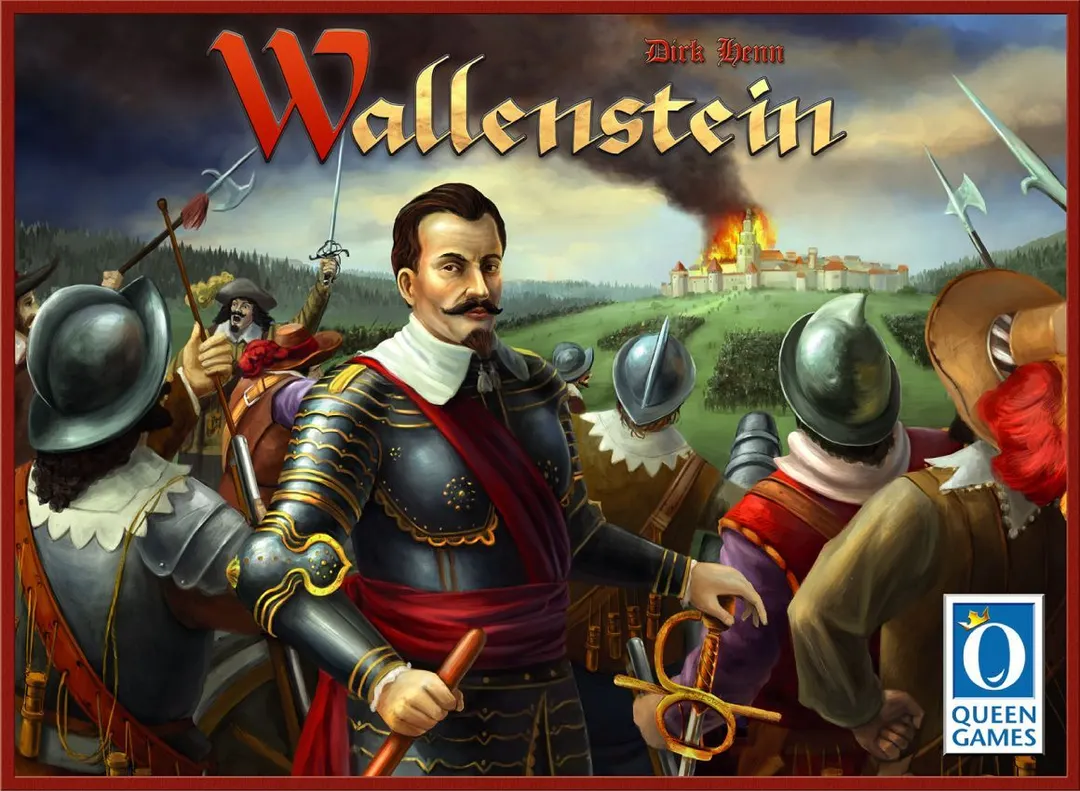
The 2012 rerelease of Wallenstein tweaks the 2002 title from designer Dirk Henn and publisher Queen Games, while including two new expansions. The setting and game play of the two games are mostly the same. In 1625, the Thirty Years' War is underway, and military leaders like Albrecht von Wallenstein and Gottfried Heinrich Graf zu Pappenheim are roaming the country, fighting for land, and trying to establish the best of everything for themselves. The game lasts two "years," with players taking actions in the spring, summer, and fall, then possibly suffering from grain shortage and revolts in the winter before scoring points for the year. After two years, the player with the most points – with points being scored for land and buildings under one's control – wins. In each of the "action" seasons, ten action cards are shuffled, then laid out, with five face-up and the rest face-down. The five bonus tiles (which provide extra money, grain, or armies) are also laid out. Each player then secretly assigns one of his county cards (or a blank card) to each of the ten actions on his individual player board, in addition to bidding for player order and choice of bonus tile. After revealing that round's event card and determining player order, players carry out actions in the order determined earlier, revealing which county is taking the current action, then revealing the next face-down action, thus giving players some information about when actions will occur, but not all. Taxing a county or taking grain from it can increase the chance of a revolt during winter, but without money you can't deploy troops or build palaces or churches and without grain you increase the chance of revolt. Combat and revolts are handled via a dice tower in which players drop army units and peasants (colored wooden cubes) into the top of the tower and see which ones emerge in the bottom tray (representing the fighting forces for that combat) and which get stuck in the tower's baffles to possibly emerge in the future. Wallenstein includes two expansions: "Emperor's Court," in which a player's army tokens that fall from the dice tower at the start of the game become courtiers who compete for favors (special actions) from the emperor; a player can convert armies to courtiers during the game, and whoever has the most courtiers in the court's entrance hall each turn gets first shot at the favors available. "Landsknechte," which can be used with "Emperor's Court" or on its own, consists of a set of four cards for each player stacked in a particular order. If after determining turn order, a player controls counties in four different regions, he removes the top card from the stack, then takes one of the bonuses (such as money or armies in the tray) shown on the newly revealed card. This stack resets after winter ends. Note that the box of this game states is for 2-5 players, but the game actually plays only with 3-5 players.
Laut Katalog unterstützt Wallenstein (Second Edition) 3–5 Personen. Diese Spanne entspricht der vom Verlag angegebenen Spielerzahl, das Spiel lässt sich also für jede Gruppengröße innerhalb dieser Spanne aufbauen. Aufbau, einzelne Regeln und Wertungsdetails können je nach Personenzahl trotzdem abweichen; prüfe daher die genaue Konfiguration in der Anleitung deiner Ausgabe.
Die angegebene Spieldauer für Wallenstein (Second Edition) beträgt 90–120 Minuten. Das ist die Schätzung des Verlags für eine vollständige Partie. Die tatsächliche Dauer hängt von der Gruppe, der Personenzahl und der Regelkenntnis ab: Erste Partien dauern meist länger, erfahrene Gruppen sind oft schneller fertig. Aufbau und Regelerklärung sind in dieser Schätzung nicht enthalten.
Im Katalog wird Wallenstein (Second Edition) ab 12 Jahren empfohlen. Das ist die Empfehlung des Verlags und berücksichtigt Leseanforderungen, Regelkomplexität und Kleinteile, nicht nur das Thema. Jüngere Kinder können oft mit Hilfe eines Erwachsenen mitspielen; beachte die Altersangabe deiner Ausgabe und die Brettspielerfahrung deiner Gruppe.
Wallenstein (Second Edition) hat bei BoardGameGeek eine Komplexitätswertung von 3,2 von 5 und gilt damit als mittelschweres Spiel. Die Wertung zeigt, wie viel Regelwissen, Planung und Entscheidungen eine typische Partie verlangt. Schwerere Spiele brauchen bei der ersten Erklärung mehr Zeit, daher hilft vor dem Spieleabend eine Vorbereitungsanleitung.
Wallenstein (Second Edition) gehört zu diesen Kategorien: Economic, Territory Building und Renaissance. Die wichtigsten Mechaniken sind Area Movement, Area Majority / Influence und Simultaneous Action Selection. Kategorien beschreiben Thema und Setting eines Spiels, Mechaniken dagegen, was die Spielenden in ihrem Zug tatsächlich tun. Jede Mechanik führt zu einer Katalogseite mit ähnlichen Spielen, falls du etwas Vergleichbares suchst.
Als Autoren von Wallenstein (Second Edition) sind angegeben: Dirk Henn. Diese Angaben stammen aus den veröffentlichten Spieldaten und nennen die für das Spieldesign verantwortlichen Personen, nicht die Illustratoren oder Verlage. Die Autorenseiten auf MeepleRules sammeln weitere Titel derselben Autoren – praktisch, wenn dir ein Spiel gefällt und du ähnliche Spiele suchst.
Im Katalog ist Wallenstein (Second Edition) als Grundspiel aufgeführt. Es lässt sich eigenständig mit dem Material aus der Schachtel spielen und benötigt keinen weiteren Titel. Erweiterungen, sofern es welche gibt, ergänzen neues Material oder neue Regeln und sind im Katalog separat mit einem Verweis auf dieses Grundspiel aufgeführt.