
- BGG-Bewertung
- 7,3
War in the Pacific Extension Kit
- 1–6 Spieler
- 480 Min.
- Komplexität 3,0/5
- 2008
2006
Regelhilfe für War in the Pacific (Second Edition)
Verständliche Erklärungen zu Spielzügen, Karteneffekten und strittigen Situationen mit Verweisen auf offizielle Quellen und gespeichertem Fragenverlauf.
Was möchtest du wissen?
Antworten stammen aus dem offiziellen Regelheft, mit Seitenangabe zum Nachprüfen.
War in the Pacific (Second Edition) ist ein Brettspiel aus dem Jahr 2006 für 2–6 Personen, mit 480 Minuten pro Partie und ab 12 Jahren. Entwickelt wurde es von Kevin Kiff; die wichtigsten Mechaniken sind Hexagon Grid und Simulation.






Auf Englisch
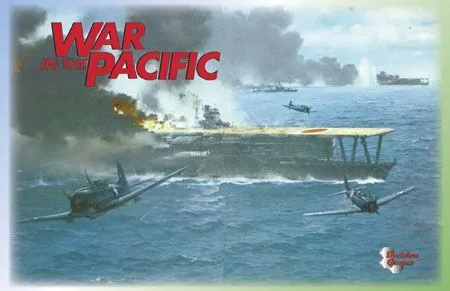
On Sunday, 7 December 1941, the US naval base at Pearl Harbor, Hawaii, was attacked by Japanese aircraft. For the next four years, Allied task forces engaged elements of the Imperial Japanese fleet throughout the ocean. Marines and army units began their program of island-hopping, wresting from the Japanese the empire that they had expanded in every direction. War in the Pacific is a multi-level simulation of the Pacific theater of operations during World War II. The game enables players to recreate the entire course of the war with the US, from the opening Japanese attack on 7 December, 1941 to the climatic Allied assaults in the closing days of 1945. Representing some 30% of the globe, the strategic maps let players move and engage in combat on all levels: air, ground and naval. War in the Pacific is not a simple game; there are a number of rules and concepts that will, at first, be unfamiliar to a majority of players. But playing through smaller map sections and scenarios enables the player to become familiar with the mechanics of the game. This is a reprint edition which substantially expanded the original's components. Components: 7 full size (22 x 34") strategic maps in full color, new tactical maps with nearly 338 individual islands for new ground units to fight over, 32 die-cut counter sheets, nearly 9,000 counters showing all types of units from the Pacific Theater, rule books, chart books and assorted displays and player aid charts. The rules have undergone significant change with greatly increased emphasis on detail in combat while removing the detailed logistics system that was the focus of the old game and replacing it with a command point system modeled after Victory Games' "Pacific War." The order of battle is significantly more detailed. Leaders on many levels (and whose combat performance may be unpredictable), often serve to limit players' ability to affect the outcome of every battle to the Nth degree. A player's assignment of the right task force commander (for the right force at the right time), may spell the difference between a tactical victory and defeat. The ground combat system has been completely revised, substituting a step-loss system adapted from VG's "Pacific War." Pitched battles on islands and atolls are now resolved, including maneuver, on expanded tactical maps in six different scales, rather than simply being abstractly represented in a single hex on the strategic maps. War in the Pacific's original air and naval systems are retained, in their essence, albeit with substantial modifications and above all added chrome in combat. Thus the game still feels like the original in those two aspects. The game comes with the grand campaign and some small introductory battle scenarios. Booklets: Rulebook I (rule 1.0 to 25.0) Rulebook II (rule 26.0 to 62.0) Scenarios & Campaign reinforcements Examples of Play, Optional Rules & Designer's Notes Chartbook I Chartbook II
Laut Katalog unterstützt War in the Pacific (Second Edition) 2–6 Personen. Diese Spanne entspricht der vom Verlag angegebenen Spielerzahl, das Spiel lässt sich also für jede Gruppengröße innerhalb dieser Spanne aufbauen. Aufbau, einzelne Regeln und Wertungsdetails können je nach Personenzahl trotzdem abweichen; prüfe daher die genaue Konfiguration in der Anleitung deiner Ausgabe.
Die angegebene Spieldauer für War in the Pacific (Second Edition) beträgt 480 Minuten. Das ist die Schätzung des Verlags für eine vollständige Partie. Die tatsächliche Dauer hängt von der Gruppe, der Personenzahl und der Regelkenntnis ab: Erste Partien dauern meist länger, erfahrene Gruppen sind oft schneller fertig. Aufbau und Regelerklärung sind in dieser Schätzung nicht enthalten.
Im Katalog wird War in the Pacific (Second Edition) ab 12 Jahren empfohlen. Das ist die Empfehlung des Verlags und berücksichtigt Leseanforderungen, Regelkomplexität und Kleinteile, nicht nur das Thema. Jüngere Kinder können oft mit Hilfe eines Erwachsenen mitspielen; beachte die Altersangabe deiner Ausgabe und die Brettspielerfahrung deiner Gruppe.
War in the Pacific (Second Edition) hat bei BoardGameGeek eine Komplexitätswertung von 4,4 von 5 und gilt damit als schweres Spiel. Die Wertung zeigt, wie viel Regelwissen, Planung und Entscheidungen eine typische Partie verlangt. Schwerere Spiele brauchen bei der ersten Erklärung mehr Zeit, daher hilft vor dem Spieleabend eine Vorbereitungsanleitung.
War in the Pacific (Second Edition) gehört zu diesen Kategorien: Wargame und World War II. Die wichtigsten Mechaniken sind Hexagon Grid und Simulation. Kategorien beschreiben Thema und Setting eines Spiels, Mechaniken dagegen, was die Spielenden in ihrem Zug tatsächlich tun. Jede Mechanik führt zu einer Katalogseite mit ähnlichen Spielen, falls du etwas Vergleichbares suchst.
Als Autoren von War in the Pacific (Second Edition) sind angegeben: Kevin Kiff. Diese Angaben stammen aus den veröffentlichten Spieldaten und nennen die für das Spieldesign verantwortlichen Personen, nicht die Illustratoren oder Verlage. Die Autorenseiten auf MeepleRules sammeln weitere Titel derselben Autoren – praktisch, wenn dir ein Spiel gefällt und du ähnliche Spiele suchst.
Im Katalog ist War in the Pacific (Second Edition) als Grundspiel aufgeführt. Es lässt sich eigenständig mit dem Material aus der Schachtel spielen und benötigt keinen weiteren Titel. Erweiterungen, sofern es welche gibt, ergänzen neues Material oder neue Regeln und sind im Katalog separat mit einem Verweis auf dieses Grundspiel aufgeführt.
