

- BGG-Bewertung
- 5,8
Worker Placement: Cash Is King
- 2–8 Spieler
- 60 Min.
- Komplexität 3,0/5
- 2014
2014
Regelhilfe für Worker Placement
Verständliche Erklärungen zu Spielzügen, Karteneffekten und strittigen Situationen mit Verweisen auf offizielle Quellen und gespeichertem Fragenverlauf.
Für 2 Personen
Was möchtest du wissen?
Antworten stammen aus dem offiziellen Regelheft, mit Seitenangabe zum Nachprüfen.
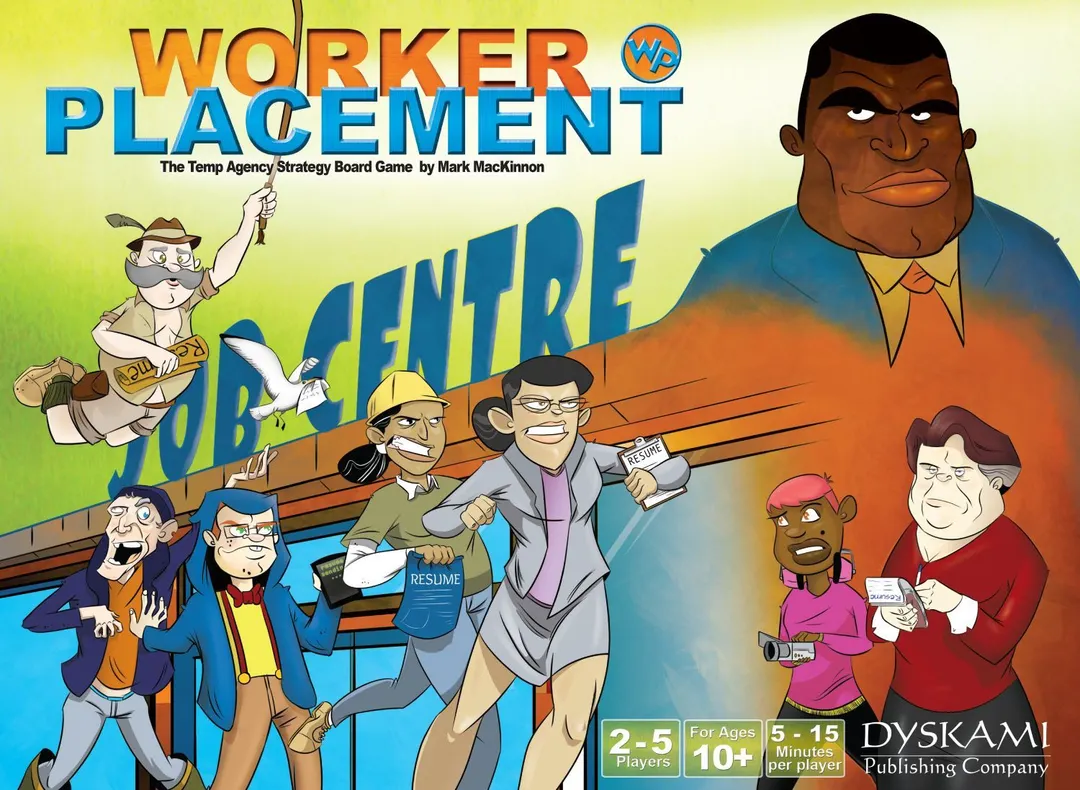
Worker Placement ist ein Brettspiel aus dem Jahr 2014 für 2–5 Personen, mit 45 Minuten pro Partie und ab 10 Jahren. Entwickelt wurde es von Mark C. MacKinnon; die wichtigsten Mechaniken sind Hand Management, Set Collection und Auction / Bidding.





Auf Englisch
Worker Placement is an easy-to-learn strategy board game of earning cash and gaining reputation. In the game, you assume the role of a temporary employment agency CEO who is trying to build his or her start-up business into a thriving operation. The path to success seems simple enough: hire unemployed temp workers, help them to upgrade their skills, and find them the best short-term jobs so your company can get paid its cut. Competition with other temp agencies is fierce, though, so establishing a solid reputation as a reliable and dependable agency can bump your workers towards the front of the employment line. Worker Placement plays in about 45 minutes and is suitable for 2-5 players, ages 10+. With a variety of engaging play mechanics – including card drafting, hand management, bidding, set collecting, and of course worker placement – playful illustrations with accompanying flavor text, and simple rules that take only minutes to learn, running a successful temp agency business has never been this much fun! Gameplay Round Summary: Action 1: Determine Player Order Player Order card + Thumbs Track position = position on the Player Order Track. Action 2: Reveal New Jobs Deal one Job card for each player (minimum four cards) face up on the game board edge at the Job Centre building. Action 3: Draft Business Cards Deal three Business cards to each player, who selects one card to add to his or her hand, passes one to the player on the left, and places the final card face down on the Peer Networking Group building. Action 4: Auction Discarded Business Cards Place face up three randomly select Business cards from those at the Peer Networking Group building and discard the others. Starting with the first player and continuing along the Player Order Track, each player may pass or bid. Players with the top three bids select, in order, one of the Business cards up for auction and add it to their hands, reducing their positions on the Cash Track equal to their bids. Discard unselected cards. Action 5: Place Workers Clockwise, beginning with the first player, players take turns placing all meeples on the game board buildings to gain benefits. Cash cost = number of meeples at the building. If a Job is filled, the player gains the Cash and Thumbs on the Job card. Action 6: Reset Players reclaim placed meeples. Advance the Hourglass token one space on the Time Track. Players must discard down to five Business cards if holding more than five in their hands.
Laut Katalog unterstützt Worker Placement 2–5 Personen. Diese Spanne entspricht der vom Verlag angegebenen Spielerzahl, das Spiel lässt sich also für jede Gruppengröße innerhalb dieser Spanne aufbauen. Aufbau, einzelne Regeln und Wertungsdetails können je nach Personenzahl trotzdem abweichen; prüfe daher die genaue Konfiguration in der Anleitung deiner Ausgabe.
Die angegebene Spieldauer für Worker Placement beträgt 45 Minuten. Das ist die Schätzung des Verlags für eine vollständige Partie. Die tatsächliche Dauer hängt von der Gruppe, der Personenzahl und der Regelkenntnis ab: Erste Partien dauern meist länger, erfahrene Gruppen sind oft schneller fertig. Aufbau und Regelerklärung sind in dieser Schätzung nicht enthalten.
Im Katalog wird Worker Placement ab 10 Jahren empfohlen. Das ist die Empfehlung des Verlags und berücksichtigt Leseanforderungen, Regelkomplexität und Kleinteile, nicht nur das Thema. Jüngere Kinder können oft mit Hilfe eines Erwachsenen mitspielen; beachte die Altersangabe deiner Ausgabe und die Brettspielerfahrung deiner Gruppe.
Worker Placement hat bei BoardGameGeek eine Komplexitätswertung von 2,1 von 5 und gilt damit als eher leichtes Spiel. Die Wertung zeigt, wie viel Regelwissen, Planung und Entscheidungen eine typische Partie verlangt. Schwerere Spiele brauchen bei der ersten Erklärung mehr Zeit, daher hilft vor dem Spieleabend eine Vorbereitungsanleitung.
Worker Placement gehört zu diesen Kategorien: Economic und Abstract Strategy. Die wichtigsten Mechaniken sind Hand Management, Set Collection und Auction / Bidding. Kategorien beschreiben Thema und Setting eines Spiels, Mechaniken dagegen, was die Spielenden in ihrem Zug tatsächlich tun. Jede Mechanik führt zu einer Katalogseite mit ähnlichen Spielen, falls du etwas Vergleichbares suchst.
Als Autoren von Worker Placement sind angegeben: Mark C. MacKinnon. Diese Angaben stammen aus den veröffentlichten Spieldaten und nennen die für das Spieldesign verantwortlichen Personen, nicht die Illustratoren oder Verlage. Die Autorenseiten auf MeepleRules sammeln weitere Titel derselben Autoren – praktisch, wenn dir ein Spiel gefällt und du ähnliche Spiele suchst.
Im Katalog ist Worker Placement als Grundspiel aufgeführt. Es lässt sich eigenständig mit dem Material aus der Schachtel spielen und benötigt keinen weiteren Titel. Erweiterungen, sofern es welche gibt, ergänzen neues Material oder neue Regeln und sind im Katalog separat mit einem Verweis auf dieses Grundspiel aufgeführt.