
- BGG-Rang
- BGG #5.750
- BGG-Bewertung
- 7,2
Shadows of Malice
- 1–8 Spieler
- 120 Min.
- Komplexität 3,2/5
- 2014
2016
Regelhilfe für Zimby Mojo
Verständliche Erklärungen zu Spielzügen, Karteneffekten und strittigen Situationen mit Verweisen auf offizielle Quellen und gespeichertem Fragenverlauf.
Für 1 Person
Was möchtest du wissen?
Antworten stammen aus dem offiziellen Regelheft, mit Seitenangabe zum Nachprüfen.
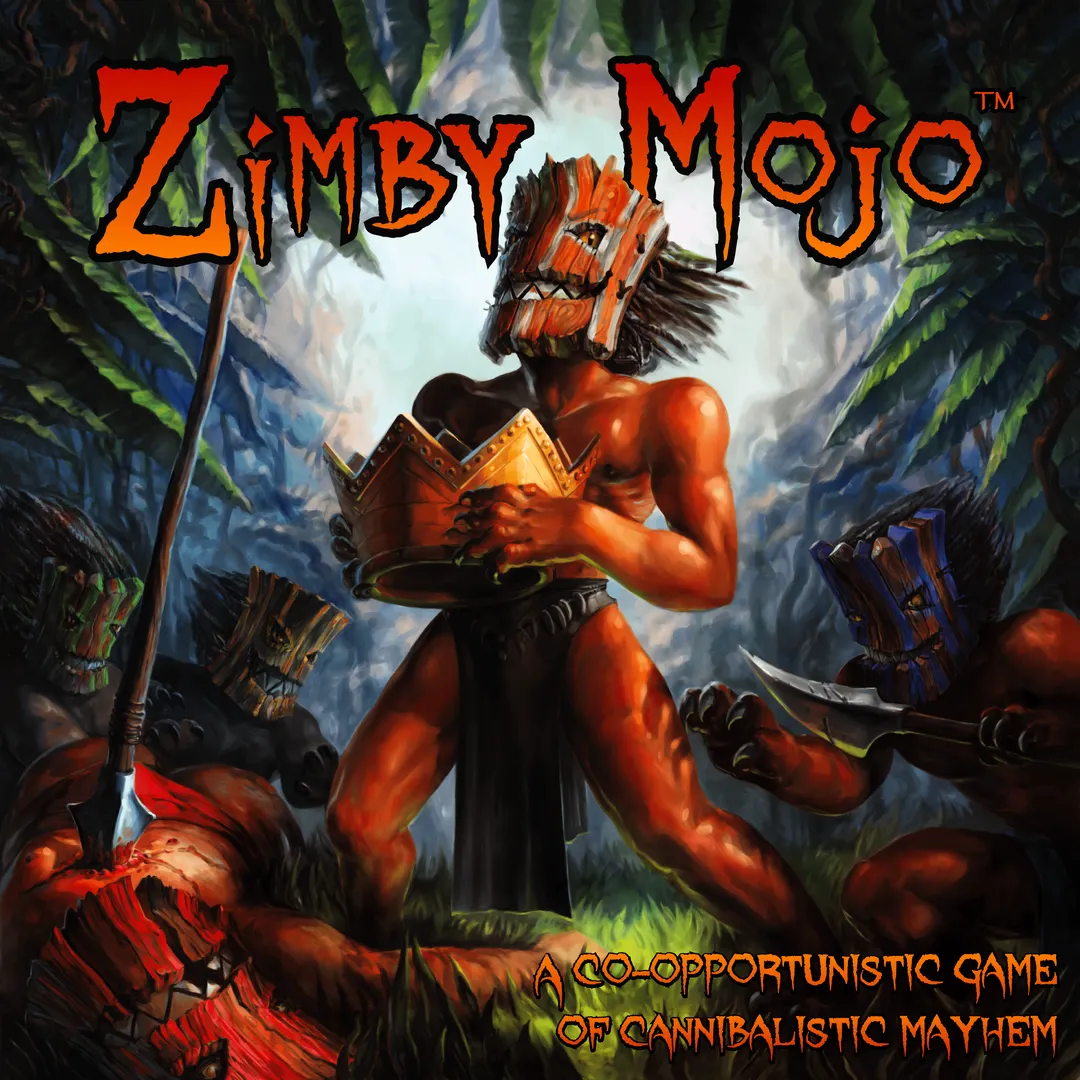
Zimby Mojo ist ein Brettspiel aus dem Jahr 2016 für 1–8 Personen, mit 20–150 Minuten pro Partie und ab 14 Jahren. Entwickelt wurde es von Jenna Felli; die wichtigsten Mechaniken sind Hand Management, Dice Rolling und Simultaneous Action Selection.
Auf Englisch
Zimby Mojo is a co-opportunistic game for 2-8 players that also supports solo play. Each player is the all-powerful shaman of a tribe of ferocious, conniving, vicious little cannibals called zimbies, and each player has a single goal: to become the new Cannibal King. To achieve their goal, each player will have to use their zimbies to infiltrate the current King’s compound, kill him, take his Crown, and carry it safely to their tribal board before a rival zimby tribe can do so first. In solo play, the player must use their zimbies, scrolls, and strategy to defeat the Cannibal King, evade his thugs, and bring the Cannibal Crown to their tribal board before time runs out. In a multiplayer game, the players must work together to gain access to the Cannibal King’s sanctum before they can confront him. Once they kill the King, however, it’s every tribe for itself and the player that reaches their tribal board with the King’s Crown immediately becomes the new Cannibal King and wins the game! Keep one eye on the Crown. Keep the other on your back. WHAT'S A ZIMBY? Zimbies are vicious, conniving little cannibals. They are small, stubborn, anti-heroes in a game of control of a land of nasty little creatures. They are not human: each zimby tribe has followed its own cultural and evolutionary path -- there are humanoid zimbies, avian zimbies, aquatic zimbies, simian zimbies, ursine zimbies, arachnid zimbies, the list goes on! That's why there's a bunch of reptilian-eyed, orange-skinned, clawed, stick-haired creatures on the box! The name "zimby" itself derives from a play on words on the word "zombie" and the designer's love of the cartoon character Invader Zim, who he feels exquisitely exemplifies zimby behavior and fanaticism. MORE DETAILED DESCRIPTION OF CONCEPTS AND ELEMENTS Each player plays the shaman of a different zimby tribe. Zimbies are nasty, unruly, conniving little cannibals that follow their shaman with fanatical loyalty. Each player’s goal is to bring about the death of the Cannibal King, steal his fallen Crown, and get the Crown to his tribal board so he can become the new Cannibal King. To do this, the players will have to: 1. Get some zimbies onto the main game board (you can’t get the Crown without a zimby to grab it and carry it home), 2. Cooperate with at least one other tribe to activate a sigil (you can’t kill the King unless you can get to him), 3. Kill the Cannibal King (that’s the only way he will give up his Crown), 4. Get the Crown and deliver it to your tribal board (you win the game by becoming the new Cannibal King). Part 1 of the game is completely cooperative. Part 2 of the game is completely competitive. CREATURES There are four creature types in the game: zimbies, obnoxious little cannibals that do a shaman’s bidding with ruthless (sometimes inept) fanaticism; zombies, undead meat-puppets; thugs, the Cannibal King’s dim-witted, fervently devoted brutes; the Cannibal King, the sadistic yet cowardly overlord of the zimby tribes. Shaman are players and don’t count as creatures. MOJO Mojo is "a power that may seem magical and allows someone to be very effective, successful, etc." (Mirriam Webster). It is the inexplicable, mystical energy than allows shamans to both impel their zimbies into action and release the powerful magical spells bound in the scrolls they raid from the Scroll Library! But be warned, mojo is drawn from shamans and zimbies! The more zimbies a shaman sends forth to kill the Cannibal King and steal his Crown, the less mojo that shaman has available! Every turn, each player (shaman) generates a small amount of mojo and may also draw forth mojo from zimbies on their tribal board, thereby depleting them of energy for the remainder of the turn and rendering them useless. A shaman may also cannibalize (yes, eat!) their own zimbies for more mojo... Of course, eaten zimbies are dead and gone... STACKING Multiple zimbies can stack to form columns which count as single, giant creatures. The more zimbies in the stack, the stronger they are but the slower they move. And the shaman whose turn it is fully controls the column... SCROLLS, MOVEMENT, AND COMBAT Shamans may use mojo to empower scrolls to cast one-off rituals, long-lasting incantations, and blindingly fast witcheries. These cast magical effects -- beneficial and detrimental -- on the shaman themselves. Shamans also use mojo to move their zimbies on the main board -- so, the more scrolls a shaman uses the less mojo they have available for movement. Combat is a simple 1d6 "roll-off" with the combatant making the higher die roll dealing a number of wounds damage equal to the difference in the die rolls to the combatant making the lower die roll. TIMING Many of a player's actions are limited to the player's turn, such as spawning new zimbies, turning zimbies into zombies, movement and combat. Players may extract and use mojo at any time on any player's turn. So, scroll use is always an option! FIRST MOVER STRATEGY At the end of the round, after all the players have gone, the player with the most undepleted zimbies on his tribal board becomes the first mover on the next round. That player goes first and play proceeds clockwise from them. SOLO There is also a solo mode, which is not only a fully realized game but also very useful to hone the strategies that you will use in your multiplayer games. But be warned: solo play is limited to 12 turns and your score gets lower the more turns you take. It's not too hard to win, but it's tough to get a high score! HAVE FUN WREAKING HAVOC!
Laut Katalog unterstützt Zimby Mojo 1–8 Personen. Diese Spanne entspricht der vom Verlag angegebenen Spielerzahl, das Spiel lässt sich also für jede Gruppengröße innerhalb dieser Spanne aufbauen. Aufbau, einzelne Regeln und Wertungsdetails können je nach Personenzahl trotzdem abweichen; prüfe daher die genaue Konfiguration in der Anleitung deiner Ausgabe.
Die angegebene Spieldauer für Zimby Mojo beträgt 20–150 Minuten. Das ist die Schätzung des Verlags für eine vollständige Partie. Die tatsächliche Dauer hängt von der Gruppe, der Personenzahl und der Regelkenntnis ab: Erste Partien dauern meist länger, erfahrene Gruppen sind oft schneller fertig. Aufbau und Regelerklärung sind in dieser Schätzung nicht enthalten.
Im Katalog wird Zimby Mojo ab 14 Jahren empfohlen. Das ist die Empfehlung des Verlags und berücksichtigt Leseanforderungen, Regelkomplexität und Kleinteile, nicht nur das Thema. Jüngere Kinder können oft mit Hilfe eines Erwachsenen mitspielen; beachte die Altersangabe deiner Ausgabe und die Brettspielerfahrung deiner Gruppe.
Zimby Mojo hat bei BoardGameGeek eine Komplexitätswertung von 2,9 von 5 und gilt damit als eher leichtes Spiel. Die Wertung zeigt, wie viel Regelwissen, Planung und Entscheidungen eine typische Partie verlangt. Schwerere Spiele brauchen bei der ersten Erklärung mehr Zeit, daher hilft vor dem Spieleabend eine Vorbereitungsanleitung.
Zimby Mojo gehört zu diesen Kategorien: Fantasy und Fighting. Die wichtigsten Mechaniken sind Hand Management, Dice Rolling und Simultaneous Action Selection. Kategorien beschreiben Thema und Setting eines Spiels, Mechaniken dagegen, was die Spielenden in ihrem Zug tatsächlich tun. Jede Mechanik führt zu einer Katalogseite mit ähnlichen Spielen, falls du etwas Vergleichbares suchst.
Als Autoren von Zimby Mojo sind angegeben: Jenna Felli. Diese Angaben stammen aus den veröffentlichten Spieldaten und nennen die für das Spieldesign verantwortlichen Personen, nicht die Illustratoren oder Verlage. Die Autorenseiten auf MeepleRules sammeln weitere Titel derselben Autoren – praktisch, wenn dir ein Spiel gefällt und du ähnliche Spiele suchst.
Im Katalog ist Zimby Mojo als Grundspiel aufgeführt. Es lässt sich eigenständig mit dem Material aus der Schachtel spielen und benötigt keinen weiteren Titel. Erweiterungen, sofern es welche gibt, ergänzen neues Material oder neue Regeln und sind im Katalog separat mit einem Verweis auf dieses Grundspiel aufgeführt.