

- Puesto en BGG
- BGG #48
- Puntuación BGG
- 8,0
Heat: Pedal to the Metal
- 1–6 jugadores
- 30–60 min
- Complejidad 2,2/5
- 2022
2000
Ayuda con las reglas de 4th Street Pro Football
Explicaciones claras de turnos, efectos de cartas y situaciones dudosas, con referencias a fuentes oficiales e historial de preguntas guardado.
Para 1 jugador
¿Qué quieres saber?
Las respuestas salen del reglamento oficial, con la página para comprobarlo.
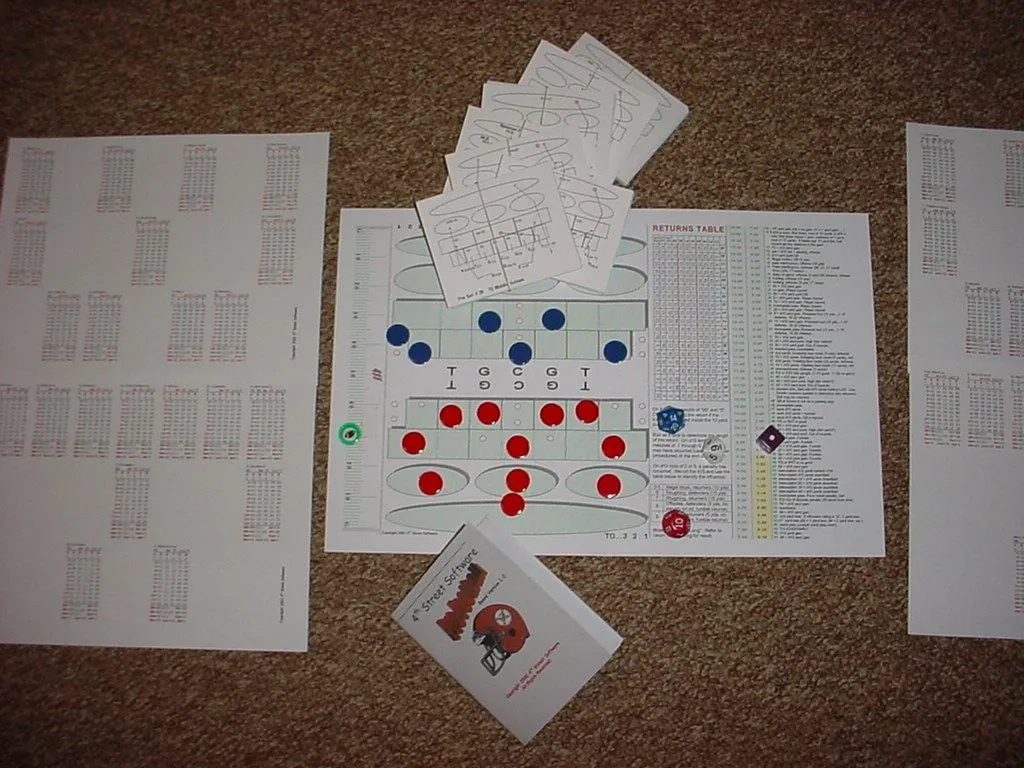
4th Street Pro Football es un juego de mesa publicado en 2000 para 1–2 jugadores, con partidas de 180 minutos y a partir de 10 años. Fue diseñado por Bryan Aldrich y sus mecánicas principales son Simulation.








En inglés
4th Street Software Pro Football is a dice, chart and card simulation of NFL football. The game combines detailed individualized players cards for every player position with specific offensive and defensive play calls to generate action. Here is a brief description of play from the manufacturer's web-site: First, let’s set the scene. It’s the first round of the playoffs, with Miami hosting New England. Miami’s got the ball on the New England 37 yard line with 4:23 to go in the fourth quarter. They’re down by a touchdown. The Miami coach selects a passing play, “F1 Cross” (F1 is the flanker, and he’s running a crossing pattern over the middle of the field). The play card is essentially a 3” x 5” card filled with information about the ensuing play. The larger letters (s, T, G, C, Q, etc.) represent offensive players. The boxes and ovals represent defensive zones which may or may not be occupied by one or more defensive players. The lines represent the routes each of the offensive players takes after the snap. The red line represents the route taken by the intended receiver. Blue lines represent secondary receivers, while black lines represent the motion taken by blockers. The smaller letters are the player ratings, which are followed by a number or range of numbers, which correspond to a 20-sided (d20) die. So let’s roll the dice and see what happens… 20 sided die = 2 12 sided die = 6 2 six sided die roll = 1+3 = 4 The d20 roll (2) tells us what the matchup is. In this case, the left guard is matched up against the defender in the zone opposite him (in this case, the right defensive tackle). Here are the two players involved on the play: J. Buckley [G - Miami 97] Hen. Thomas [DT - New England 97] The offensive player’s “D” rating (pass blocking) is now compared to the “B” rating (pass rush) of the defensive player’s. These two ratings are subtracted (6 – 4 = 2) and compared to the d10 (in this case, a 6 was rolled). Since 6 is larger than 2, the defensive player wins the matchup. Now, the two d6 are added together (1 + 3 = 4). Since Thomas won the matchup, we look under his “B” column across from “4” and find the result code of “47”. This is a sack! (Result codes are listed on the field…there are approximately 90 of them.) That’s it! All other plays are completed in a similar fashion.
Según el catálogo, 4th Street Pro Football admite de 1 a 2 jugadores. Este intervalo corresponde al número de jugadores indicado por la editorial, así que el juego puede prepararse para cualquier grupo dentro de ese margen. La preparación, algunas reglas y la puntuación pueden variar según el número de jugadores; consulta la configuración exacta en el reglamento de tu edición.
La duración indicada para 4th Street Pro Football es de 180 minutos, la estimación de la editorial para una partida completa. El tiempo real depende del grupo, del número de jugadores y del conocimiento de las reglas: las primeras partidas suelen alargarse y los grupos con experiencia terminan antes. La preparación y la explicación de las reglas no están incluidas.
El catálogo indica 4th Street Pro Football a partir de 10 años. Es la recomendación de la editorial y refleja la lectura necesaria, la complejidad de las reglas y las piezas pequeñas, no solo el tema. Los más pequeños a menudo pueden jugar con ayuda de un adulto: comprueba la edad recomendada en tu edición y la experiencia de tu grupo.
4th Street Pro Football tiene una puntuación de complejidad de 3,5 sobre 5 según los jugadores de BoardGameGeek, lo que lo convierte en un juego de complejidad media. La puntuación refleja cuánto conocimiento de reglas, planificación y toma de decisiones exige una partida típica. Los juegos exigentes requieren una explicación inicial más larga, así que conviene usar una guía de preparación.
4th Street Pro Football pertenece a estas categorías: Sports. Sus mecánicas principales son Simulation. Las categorías describen el tema y la ambientación de un juego, mientras que las mecánicas describen lo que los jugadores hacen realmente en su turno. Cada mecánica lleva a una página del catálogo con juegos similares.
Los autores acreditados de 4th Street Pro Football son: Bryan Aldrich. Estos créditos proceden de los datos publicados del juego y nombran a las personas responsables de su diseño, no a ilustradores ni editoriales. Las páginas de autor de MeepleRules reúnen otros títulos de los mismos autores, algo útil cuando un juego te gusta y buscas otros parecidos.
El catálogo clasifica 4th Street Pro Football como juego base. Se juega por sí solo con los componentes de la caja y no requiere ningún otro título. Las expansiones, si existen, añaden contenido o reglas nuevas y aparecen por separado en el catálogo con un enlace a este juego base.