

- Puesto en BGG
- BGG #1659
- Puntuación BGG
- 6,6
Kahuna
- 2 jugadores
- 30–40 min
- Complejidad 2,1/5
- 1998
2016
Ayuda con las reglas de Agamemnon
Explicaciones claras de turnos, efectos de cartas y situaciones dudosas, con referencias a fuentes oficiales e historial de preguntas guardado.
Para 2 jugadores
¿Qué quieres saber?
Las respuestas salen del reglamento oficial, con la página para comprobarlo.
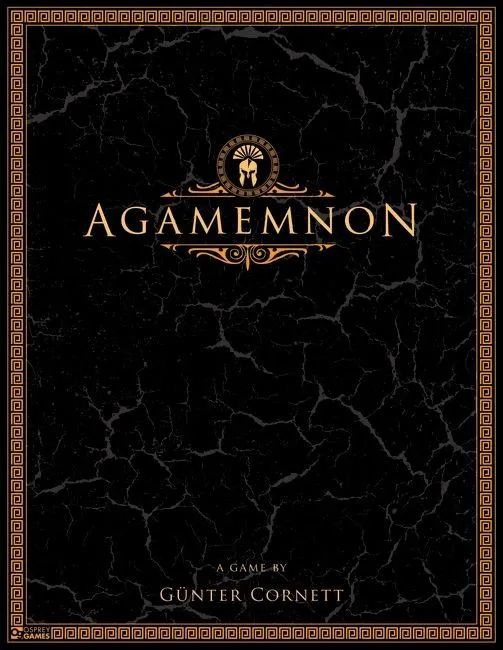
Agamemnon es un juego de mesa publicado en 2016 para 2 jugadores, con partidas de 20 a 30 minutos y a partir de 12 años. Fue diseñado por Günter Cornett y sus mecánicas principales son Area Majority / Influence y Modular Board.




En inglés
None can defy the will of the gods but the gods themselves. Driven by the ambition of their king, the Greeks have arrived on the shores of Troy. Some seek power, some seek revenge, while still others seek the great moment in battle that will define their place in history. Agamemnon is a fast-paced strategy board game in which two players take on the roles of ancient Greek gods during the Trojan War. By tactically deploying warriors to where they're needed across the board, each player may influence the final outcome of the battles famously detailed in Homer's Iliad. Some areas will be decided by the strength of the warriors, others by sheer weight of numbers, and some by the inspiration your heroes provide. To begin the game, Strings of Fate tiles are placed on their matching spaces on the board, and each player receives one set of fifteen playing tiles. These tiles come in three varieties: Warriors, with a numerical value marking their strength, Leaders, with both a letter rank and a strength value, and Weavers who have no strength or rank, but instead manipulate the Strings of Fate. Each player will shuffle their tiles face down in front of them. The first player flips over one of their tiles, and places it on any available space. If it’s a Weaver, its effect immediately comes into play: the Warp Weaver may swap two adjacent Strings of Fate, whilst the Weft Weaver simply splits all strings it’s connected to. After the first turn, each player flips and plays two tiles on their turns. Once all the tiles have been placed, each string is resolved: each Strength String is won by the player with the highest combined strength contained within it; each Leadership String is won by the player with the single highest ranked tile within the string; and Force Strings are won by the player with the most tiles, including Weavers, in the string. Players claim all the tiles from Strings of Fate they have won, and the player with the most tiles at the end wins.
Según el catálogo, Agamemnon admite 2 jugadores. Es el número de jugadores indicado por la editorial, así que el juego está diseñado exactamente para esa cantidad de participantes. Las variantes para otros tamaños de grupo, si existen, se describen en el reglamento de tu edición; consúltalo antes de preparar otra configuración.
La duración indicada para Agamemnon es de 20 a 30 minutos, la estimación de la editorial para una partida completa. El tiempo real depende del grupo, del número de jugadores y del conocimiento de las reglas: las primeras partidas suelen alargarse y los grupos con experiencia terminan antes. La preparación y la explicación de las reglas no están incluidas.
El catálogo indica Agamemnon a partir de 12 años. Es la recomendación de la editorial y refleja la lectura necesaria, la complejidad de las reglas y las piezas pequeñas, no solo el tema. Los más pequeños a menudo pueden jugar con ayuda de un adulto: comprueba la edad recomendada en tu edición y la experiencia de tu grupo.
Agamemnon tiene una puntuación de complejidad de 2,2 sobre 5 según los jugadores de BoardGameGeek, lo que lo convierte en un juego algo ligero. La puntuación refleja cuánto conocimiento de reglas, planificación y toma de decisiones exige una partida típica. Los juegos exigentes requieren una explicación inicial más larga, así que conviene usar una guía de preparación.
Agamemnon pertenece a estas categorías: Abstract Strategy y Ancient. Sus mecánicas principales son Area Majority / Influence y Modular Board. Las categorías describen el tema y la ambientación de un juego, mientras que las mecánicas describen lo que los jugadores hacen realmente en su turno. Cada mecánica lleva a una página del catálogo con juegos similares.
Los autores acreditados de Agamemnon son: Günter Cornett. Estos créditos proceden de los datos publicados del juego y nombran a las personas responsables de su diseño, no a ilustradores ni editoriales. Las páginas de autor de MeepleRules reúnen otros títulos de los mismos autores, algo útil cuando un juego te gusta y buscas otros parecidos.
El catálogo clasifica Agamemnon como juego base. Se juega por sí solo con los componentes de la caja y no requiere ningún otro título. Las expansiones, si existen, añaden contenido o reglas nuevas y aparecen por separado en el catálogo con un enlace a este juego base.