

- Puesto en BGG
- BGG #1299
- Puntuación BGG
- 7,2
Bonsai
- 1–4 jugadores
- 40 min
- Complejidad 1,8/5
- 2023
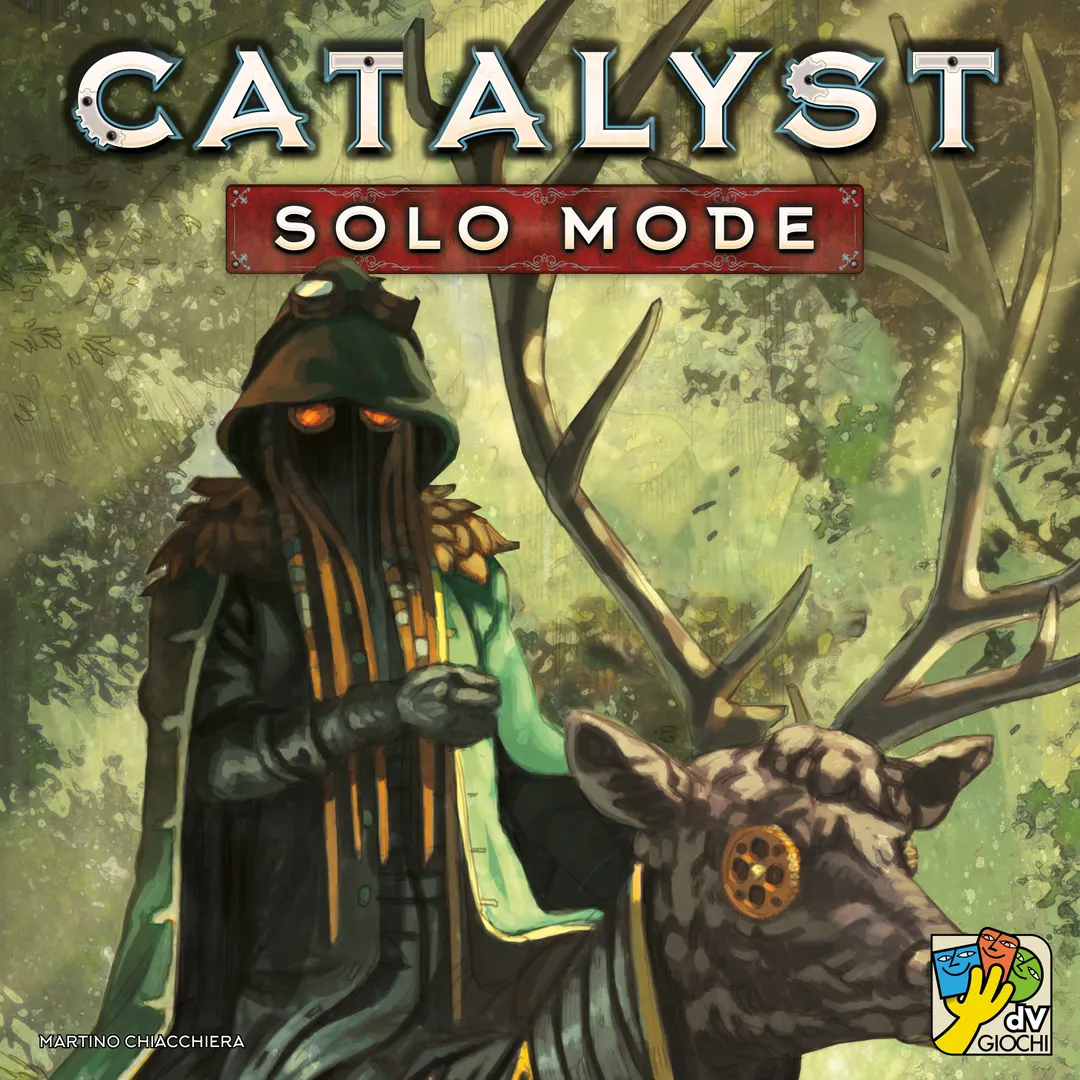
Ayuda con las reglas de Catalyst: Solo mode
Explicaciones claras de turnos, efectos de cartas y situaciones dudosas, con referencias a fuentes oficiales e historial de preguntas guardado.
¿Qué quieres saber?
Las respuestas salen del reglamento oficial, con la página para comprobarlo.
Catalyst: Solo mode es una expansión de Catalyst publicada en 2019 para 1 jugador, con partidas de 20 a 30 minutos y a partir de 8 años. Fue diseñado por Martino Chiacchiera y sus mecánicas principales son Set Collection y Open Drafting.

En inglés
The official solo mode of Catalyst - originally released as a promotional set of rules in IoGioco game magazine. GOAL OF THE GAME Confront your skills against a fearsome Artificial Intelligence (AI). PREPARATION Choose the difficulty level: easy (+10 PV), standard (+20 PV), advanced (+30 PV). Follow the instructions for preparing a 2-player game. You are the first player. Return all building cards to the box with the exception of a building costing 1, one that costs 2, one that costs 3 and one that costs 4. They must all be of a different color and randomly selected (e.g.: play with the blue “1” building, the “2” red building, the “3” yellow building and the “4” green building). PLAYING THE GAME Play multiple turns in a row until the game ends. During each of your turns you must perform one of the three actions of the game, with the following additions to the normal rules: Collect Contributions: you get coins as usual, and the AI gets a military power token. Recruit a Catalyst: You recruit a Catalyst as usual, then take the first card to the left of the one you recruited and place it, without looking at it, in the deck of AI's scoring pile. If you recruit the first Catalyst to the right of the deck (the one on the space marked with “+1”), then place the top card of the draw pile, without looking at it, in the scoring pile of the AI. Activate a Catalyst: activate a Catalyst as usual, then place the card on top of the drawing deck, without looking at it, in the AI’s scoring pile. Note: When you get coins or actions to recruit a Catalyst through a Catalyst or a building’s effects, and when you spend Chain activation tokens to activate Catalysts, the additions to the normal rules (see above) do not apply: This means that while you perform the effect of an activated Catalyst or building, the AI does not get any military power tokens nor you must put cards in its scoring pile. THE END OF YOUR TURN As in the standard rules, after you have chosen and performed one action (and possibly the AI has gained a card in its scoring pile or a military power token), your turn is over. If one or more spaces of the board are empty, slide the other cards to the right until there are no gaps, then draw new cards from the deck to fill the board back up to 5 cards. THE END OF THE GAME When the last card of the reserve deck is discarded or put on the board, the game ends immediately. Count your VPs as usual, including the goal card’s points. The AI instead obtains the VPs written on the cards in its scoring pile, the VPs provided by each pair of its military power tokens (and for the majority), and additional VPs depending on the difficulty level chosen (see Preparation). If you scored at least 1 VP more than the AI, you won – otherwise, try harder! —description from the publisher
Según el catálogo, Catalyst: Solo mode admite 1 jugador. Es el número de jugadores indicado por la editorial, así que el juego está diseñado exactamente para esa cantidad de participantes. Las variantes para otros tamaños de grupo, si existen, se describen en el reglamento de tu edición; consúltalo antes de preparar otra configuración.
La duración indicada para Catalyst: Solo mode es de 20 a 30 minutos, la estimación de la editorial para una partida completa. El tiempo real depende del grupo, del número de jugadores y del conocimiento de las reglas: las primeras partidas suelen alargarse y los grupos con experiencia terminan antes. La preparación y la explicación de las reglas no están incluidas.
El catálogo indica Catalyst: Solo mode a partir de 8 años. Es la recomendación de la editorial y refleja la lectura necesaria, la complejidad de las reglas y las piezas pequeñas, no solo el tema. Los más pequeños a menudo pueden jugar con ayuda de un adulto: comprueba la edad recomendada en tu edición y la experiencia de tu grupo.
Catalyst: Solo mode pertenece a estas categorías: Card Game y Expansion for Base-game. Sus mecánicas principales son Set Collection y Open Drafting. Las categorías describen el tema y la ambientación de un juego, mientras que las mecánicas describen lo que los jugadores hacen realmente en su turno. Cada mecánica lleva a una página del catálogo con juegos similares.
Los autores acreditados de Catalyst: Solo mode son: Martino Chiacchiera. Estos créditos proceden de los datos publicados del juego y nombran a las personas responsables de su diseño, no a ilustradores ni editoriales. Las páginas de autor de MeepleRules reúnen otros títulos de los mismos autores, algo útil cuando un juego te gusta y buscas otros parecidos.
El catálogo clasifica Catalyst: Solo mode como expansión de Catalyst. Las expansiones añaden contenido, reglas o escenarios al juego base y normalmente no se pueden jugar solas, así que necesitas Catalyst para usarla. Comprueba que tu edición de Catalyst sea compatible, porque algunas expansiones se revisaron entre ediciones.